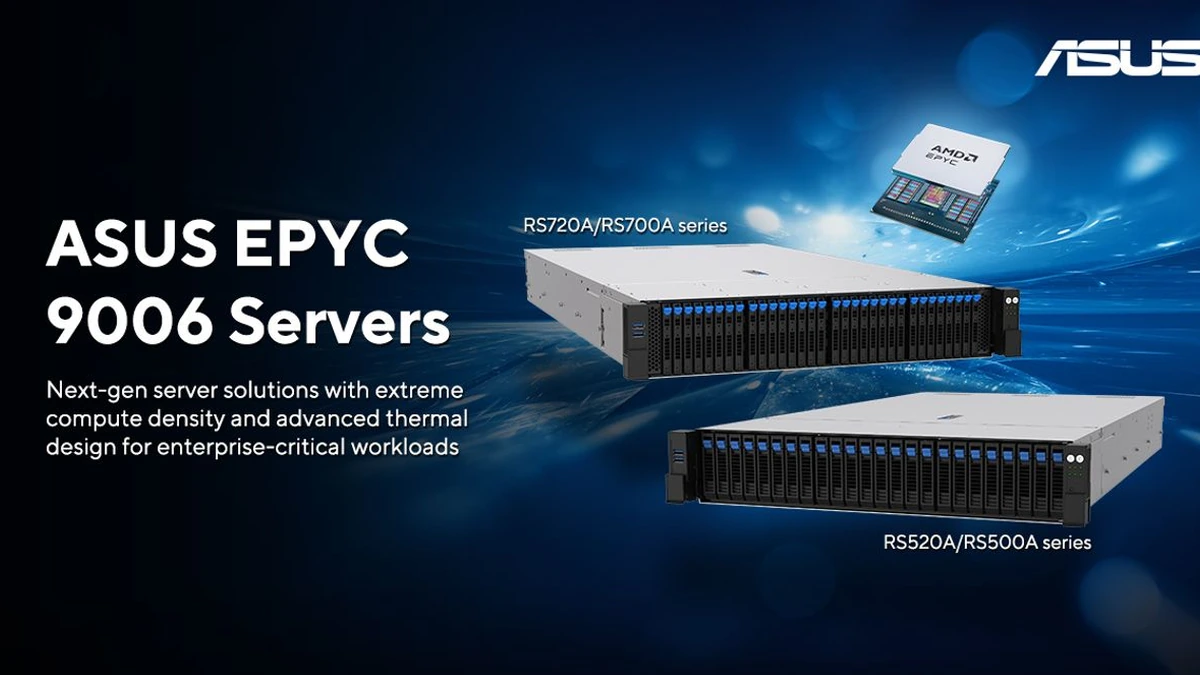
AMD's sixth-generation EPYC 9006 server processors are the foundation of a new ASUS enterprise lineup. ASUS introduced four systems built around the EPYC 9006 platform: the dual-socket RS700A and RS720A, and the single-socket RS500A and RS520A, all designed with PCIe 6.0 connectivity and support for the newer MRDIMM memory standard.
The flagship RS700A and RS720A are dual-socket boards built around AMD's 9006-series chips, aimed at the densest workloads: large-scale AI inferencing and simulation. They pack 32 DIMM slots, room for up to 32 E3.S storage drives, and fit inside a compact 2U chassis.
The RS500A and RS520A trade some of that density for efficiency. Both are single-socket boards under 800mm deep that share components with the larger pair, built for rack-constrained data centers running more mainstream enterprise workloads rather than the heaviest AI clusters.
The chips are AMD's contribution. The engineering around them is ASUS's own. A zone-partitioned chassis design the company calls DC-MHS separates the I/O, power, fan, and storage modules so a technician can service one section without shutting the whole system down. ASUS also moved M.2 storage into the cooler DIMM region of the board, a change it says avoids the thermal throttling that can hit densely packed servers, and paired it with an updated Thermal Radar fan-control system built to hold steady cooling under sustained AI workloads.
"The new ASUS server series, powered by 6th-gen AMD EPYC server CPUs, is engineered to power every enterprise workload with flexible, scalable infrastructure," said Paul Ju, ASUS senior vice president. He called the launch a milestone for the company's enterprise business as demand for AI inference capacity grows.
ASUS did not publish pricing or a general availability date for the new lineup. What's still unclear is how the RS700A and RS720A compare on real AI-inference throughput against EPYC-based servers that rivals including Dell, HPE, and Supermicro have already shipped on the same 9006 platform.