

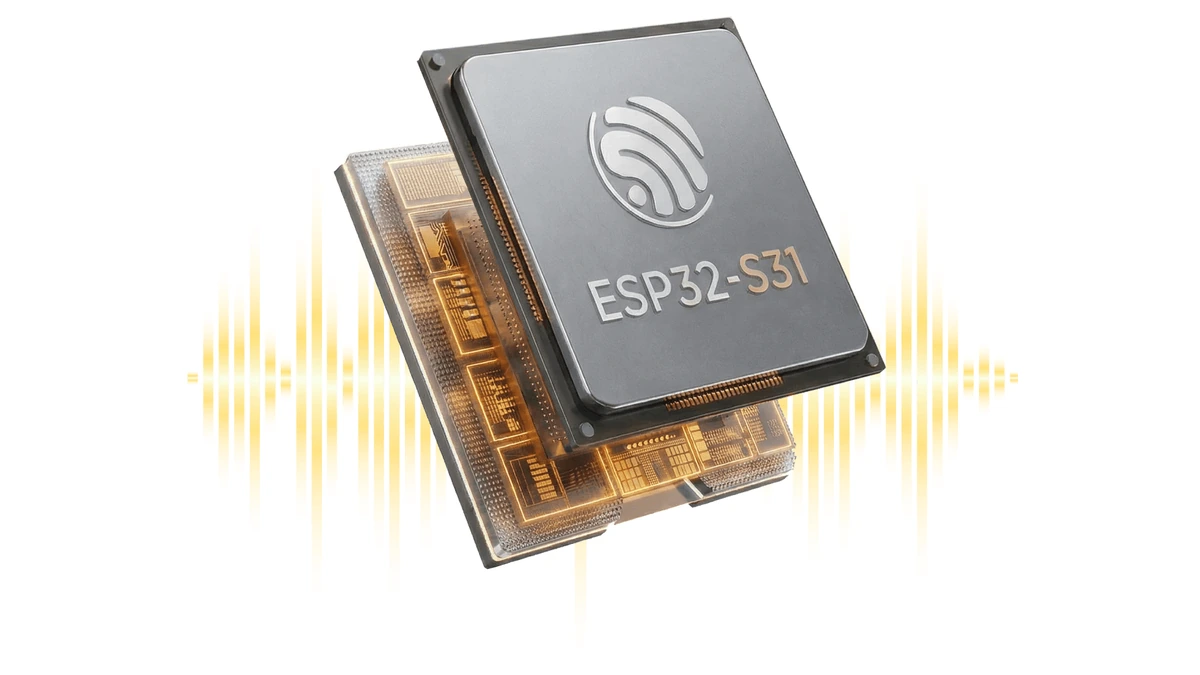
Espressif Systems has begun mass production of the ESP32-S31, a dual-core RISC-V system-on-chip built for smart home hubs, smart speakers, and edge AI hardware that need broad wireless coverage without stacking several separate radio chips.
Embedded designers who previously needed a Wi-Fi and Bluetooth module, a second radio for mesh networking, and a separate wired Ethernet chip can now cover all of that with one part. That kind of consolidation matters most for Matter-certified smart home products and industrial gateways that still need a wired fallback option.
According to Espressif, the S31 packs Wi-Fi 6 (802.11ax) in the 2.4 GHz band, Bluetooth 5.4 with LE Audio and Classic support, an 802.15.4 radio for Thread and Zigbee, and a Gigabit Ethernet MAC onto one die. The company also lists a dual-core RISC-V CPU running at up to 320 MHz, with one core carrying a 128-bit SIMD data path, 512 KB of on-chip SRAM, and support for 250 MHz DDR PSRAM expansion, specs it aims at on-device neural network inference, computer vision, and audio processing.
Espressif also lists hardware accelerators for JPEG encoding and 2D graphics, dual I2S controllers for hardware-level Bluetooth audio sync, and a security block built around a physically unclonable function for key generation, according to the chip's technical specifications.
A Glitchwire report on the launch adds detail Espressif's own release does not: two development boards, a general-purpose module and an audio-focused module with a microphone array and display, are already listed for sale under a house naming scheme Espressif has not put in its own release. The outlet also notes Arduino support is tracked as an open GitHub issue rather than ready at launch, and that the new core closes out Espressif's shift away from the Tensilica Xtensa cores used in the ESP32-S2 and ESP32-S3 toward RISC-V across its S-series line.
Espressif's own release does not put a price on the bare chip, give a global availability date beyond mass production, or state Matter or Wi-Fi Alliance certification status for finished modules, details that will matter more than the spec sheet once designers start committing bill-of-materials numbers to production runs.






