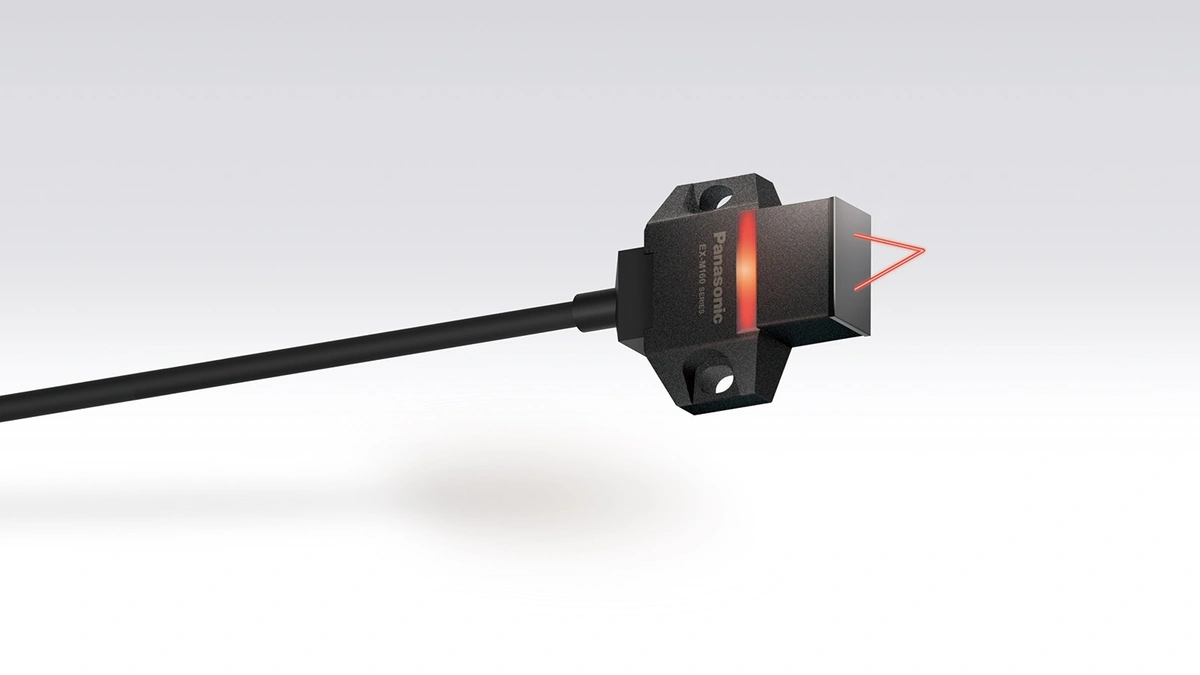
Panasonic Industry has launched the EX-M160 Series, a line of amplifier-built-in photoelectric sensors built to run on the same 5-volt DC rails already present on many industrial control boards, sparing equipment designers a separate power supply just to feed the sensor.
The sensors use a convergent-reflective design: the light-emitting and light-receiving elements are angled so their optical paths cross at a fixed point in space, rather than simply bouncing light off whatever surface happens to sit in range. That crossing point is what lets the sensor pick out one specific object, such as the edge of a chip tray or the presence of a circuit board, while ignoring background clutter just beyond it, regardless of the target's color or surface finish.
The company frames the launch around cost and space pressure in industrial-equipment manufacturing: as competition intensifies across sectors such as biomedical and semiconductor-equipment production, machine builders face growing pressure to cut costs, shrink footprints and compress development schedules, Panasonic Industry says.
The lineup includes three named models, EX-M161, EX-M162 and EX-M163, each covering a different detection range within the same head design: EX-M161 spans roughly 2.5 mm to 8 mm, EX-M162 spans 2 mm to 5 mm, and EX-M163 reaches out to 16 mm. All three run on 5 V to 24 V DC and use an NPN/PNP transistor open-collector output, with a response time of 0.8 milliseconds or faster. One model in the series carries two outputs that switch on separately depending on whether light reaches the receiver, a feature meant to cut the wiring logic a machine builder needs to design around the sensor. Panasonic Industry says every model in the EX-M160 Series carries three protection circuits as standard, ships with CE Marking and UL/c-UL Recognition, and offers the widest sensing range it has produced yet for a 5V-compatible convergent-reflective sensor aimed at factory-automation use, based on the company's own August 2026 survey of comparable parts.
Panasonic Industry also says the EX-M160's light-emission power runs roughly 180% higher than its existing PM2 Series convergent-reflective micro sensors, aimed at detecting harder targets such as low-reflectance workpieces and black resin (materials that tend to scatter or absorb light unpredictably). The company lists chip-tray edge detection, printed-circuit-board presence checks, test-tube-holder detection and capacitor-lead detection among the intended uses, positioning the EX-M160 Series as a component upgrade rather than a new sensor category: existing 24 V industrial equipment gains a cheaper, lower-voltage option without changing how the sensing itself works.