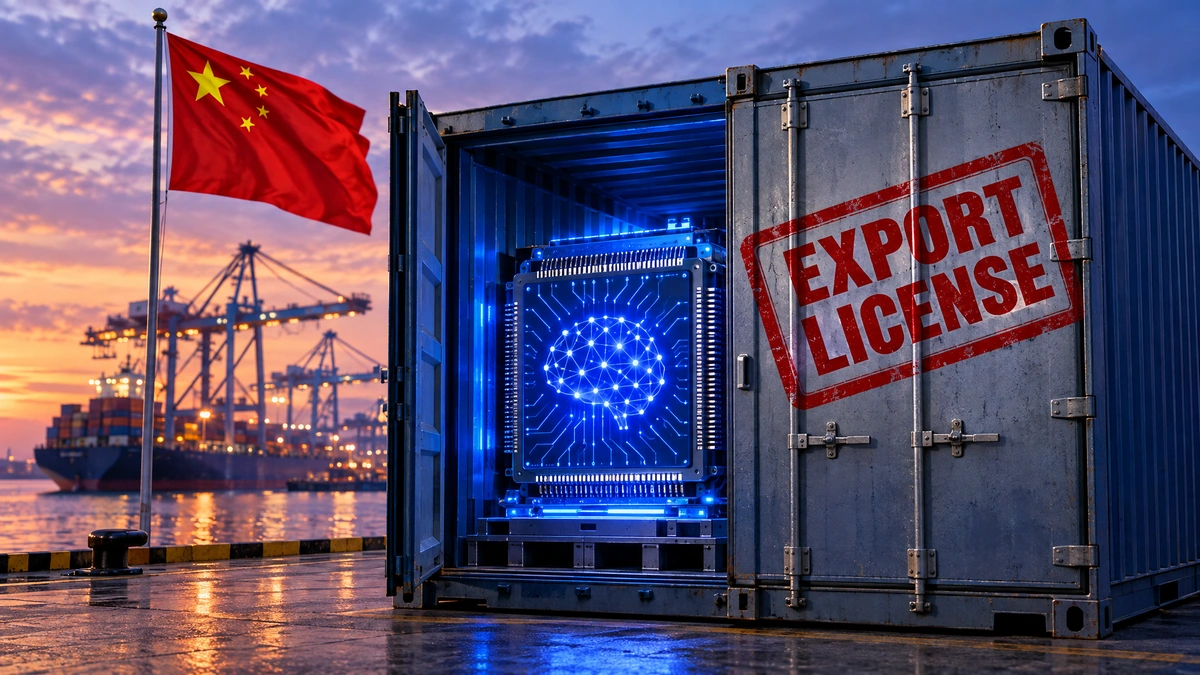
China wants a license requirement on the core technology of any AI model trained with at least 1026 floating-point operations, built with at least 2 trillion parameters, or ranked among the world's 10 best at the time it is exported. That is the threshold in a draft revision of the Catalog of Technologies Prohibited or Restricted from Export, which the Ministry of Commerce (MOFCOM) and the Ministry of Science and Technology published as Announcement No. 48, dated October 16. One part of the notice did not wait for the final text: from that day, companies must register before exporting any technology on the draft list.
The draft adds 40 technologies in three fields: 23 in artificial intelligence, 5 in biomedicine and 12 in solar manufacturing. Of those, 14 would be prohibited outright and 26 restricted, meaning exportable only with a license. In a spokesperson's answers to reporters, MOFCOM says products made with the listed technologies are not covered, and that once the rules take effect "the great majority of AI technologies can still be exported freely." Comments are open until November 15. Reuters reported in July that the ministry had met Alibaba, ByteDance and Z.ai to discuss curbs on top-tier models.
A technology export in Chinese law is a transfer abroad through trade, investment or technical cooperation, which includes licensing and technical services, not only shipping something.
Size, compute or a top-10 rank: the three tests for a model
The restricted list covers a model's "core technology," which the draft says includes weight parameters, key checkpoints, underlying source code, architecture design, and training-optimization and inference-acceleration techniques. Any one of the three tests is enough. The third is defined at length: a model counts as "globally leading" if, when the export takes place, it ranks in the global top 10 on public assessments by major Chinese or foreign evaluators or large industry platforms, measuring overall performance, specialist ability, global call volume, safety or training efficiency.
That wording makes the rank the only test a model can meet, or stop meeting, without changing at all. A model that slips out of a top-10 list on a leaderboard would, read literally, leave the scope, and a specialist ranking such as a coding table appears to be enough to bring one in. The parameter line, by contrast, sits near the top of what Chinese labs release. The draft names no model and does not say whether it means total or active parameters; counting totals, two Chinese open-weight models already sit above that line on their makers' own figures: Moonshot AI puts Kimi K3 at 2.8 trillion parameters, and Alibaba's model card gives 2.4 trillion for Qwen3.8-2.4T-A95B, which Alibaba says its hosted Qwen3.8-Max is based on. The other flagships stay below it on published figures: DeepSeek's V4-Pro has 1.6 trillion, Xiaomi's MiMo-V2.6-Pro 1.02 trillion, Zhipu's GLM-5.3 744 billion and MiniMax's M3 about 428 billion, while Baidu and ByteDance publish no totals for their flagship models. Hugging Face's August report found that China's largest open model in any given month of 2026 ranged from 754 billion to 2.78 trillion parameters, while the largest American open model stayed under 130 billion in five of the seven months.
Training data adds two more tiers, both borrowed from China's Data Security Law. A model trained on "important data" and offering services is restricted, unless it used only a trace, 0.1% or less, that cannot substantively improve its ability in that field, was cleaned and desensitized, and does not reappear in its outputs, or the data is lawfully public. A model trained on "core data" and offering services is prohibited. The draft leaves the definition of both categories to that law.
The compute figure has an American echo. The Biden administration's January 2025 AI diffusion rule would have required a license for the weights of closed models trained on more than 1026 operations, and said plainly that the US was "not today imposing controls on open-weight models." The Commerce Department announced in May 2025 that it was rescinding the rule before it took effect. Beijing's draft uses the same compute line.
Agents built specially or mainly for critical infrastructure, defense or core government systems are prohibited once they reach the draft's performance level. More general agent technology is restricted above set thresholds: breaking an instruction into at least 20 executable steps, coordinating at least 60 agents at once, or working with at least 200 third-party tools, each with accuracy and success floors. So is the technology for running computing clusters of more than 10,000 AI accelerators, from interconnects of at least 800 GB/s to fault recovery and scheduling across chips from two or more vendors. AI-assisted vulnerability hunting is restricted too when it can, for example, autonomously find five or more previously undisclosed high-severity flaws in a major open-source project or operating system in one run. The ministry's own example of the danger is AI-driven malicious code that "could be used to attack critical information infrastructure, defense industry, core government affairs and other sensitive systems," and its fear that non-state actors obtain it.
The chip-design entry reads more widely than it was reported. News reports cited process nodes of 14 nanometers or finer and 2.5D or 3D packaging. The annex lists six features and says a design with "any" of them is restricted. The others include having floating-point or integer arithmetic and being usable for autonomous driving, computer vision or smart voice, features most AI processors have. Read literally, the entry would cover nearly every AI chip design; the ministry has not said whether that is the intent. The same entry adds 3D flash and DRAM design meeting any of several features, among them DRAM at 18 nanometers or below, bonding or multi-layer stacking. Tape-out at a foreign fab is one of the routes the draft puts on automatic licensing, so the entry's breadth would bite mainly when a design itself is sold or licensed abroad.
Selling access abroad is not an export
The ministry's answers draw the line at moving the model, not at serving it. Offering a restricted model abroad through API calls, an app or website, a SaaS product or a lightweight on-device version "does not fall within the scope of large-model technology export management." Deploying the model on servers abroad does, though on a company's own overseas cloud and in similar lower-risk setups it can use what the ministry calls automatic licensing. If the final text keeps this split, Chinese labs' overseas API businesses would be left largely as they are, and what Beijing gains is a say over where the weights physically go.
Technology already public through open source or published papers is outside the scope, so models released before the rules would not be pulled back. Under the draft, open-sourcing a restricted AI technology, building and running a company's own data centers abroad, chip tape-outs at foreign fabs, joint research using foreign resources and international standards work would all get automatic licensing and other facilitation, which the ministry says would "basically" mean export as soon as it is filed.
Automatic licensing is the phrase the open-source question turns on, and it has no published procedure for technology. The ordinary route is slower: under the 2001 Technology Import and Export Administration Regulations, the ministry and its science counterpart have 30 working days to rule on an application for a restricted technology, and 15 more working days to decide on the license once the signed contract is filed. China's Foreign Trade Law describes automatic licensing for goods, which the authorities "shall grant" when it is requested before customs clearance. Liu Xinyu, a lawyer at King & Wood Mallesons, wrote in an op-ed for Securities Times that no detailed rules for technology have been issued yet. Dean Ball, OpenAI's head of strategic futures and a former White House AI adviser, wrote on X that the move "does not mean 'China is shutting down open-weight models,' but it does indicate the Chinese government establishing the optionality to shut down future open-weight models at will." The AI researcher Nathan Lambert wrote that "much hinges on implementation and how 'near automatic' approval would work." On the draft's terms, future releases above the line would pass through a step designed to be quick, whose grounds for refusal have not been published.
| Route abroad for a listed AI technology | Under the draft catalog |
|---|---|
| API, app, website, SaaS or on-device access | Not a technology export |
| Already public through open source or papers | Outside the scope |
| New open-source release of restricted technology | Automatic licensing |
| Deployment on servers abroad | License; automatic licensing on the company's own overseas cloud and similar setups |
| Own data centers abroad, foreign chip tape-out, joint research, standards work | Automatic licensing |
| Sale or license of restricted technology to a foreign party | License |
| Any export of prohibited technology | Barred |
The ministry also promises "more facilitation and support" for technology exports that members of the World AI Cooperation Organization need for cooperation on capacity building, technology sharing and joint rule-making. The organization is an intergovernmental body headquartered in Shanghai; 29 countries signed its founding agreement on July 16, among them Kazakhstan, Laos, Pakistan, Russia and Indonesia, according to China's Foreign Ministry.
The part already in force asks for every deal's price
Registration runs from the notice's date until the revised catalog takes effect, on the commerce ministry's online trade platform, and it covers exports that have started but are not finished. The ministry says exporters "should judge for themselves" whether a planned export falls within the scope. The notice does not say what happens to a company that does not register.


The form attached to the notice shows what Beijing will learn. Beyond names and addresses, it asks for the foreign recipient and its relationship to the exporter, the technology's category, form, purpose, secrecy level and technical indicators, its users and uses, the total contract price in the original currency and in US dollars, the expected earnings, and whether the deal is a transaction inside a multinational group. Liu, the King & Wood Mallesons lawyer, wrote that the ministry does not rule out suspending an export if it finds sensitive circumstances, which makes registration "closer to a preliminary step of formal compliance review." The form suggests the state will hold a deal-by-deal record of outbound transfers of the listed technologies, beginning while the bans and license tiers are still a draft.
The notice requires registration in four cases: transferring ownership of a listed technology to a foreign party, licensing it for use abroad, a domestic owner or controller of the technology becoming a foreign entity, and any other case the ministry names by notice. The third goes beyond the 2001 regulations, which Liu noted have no such provision. A foreign takeover of a Chinese company that owns a listed technology must be registered even if no file or machine crosses the border. "Companies involved in cross-border acquisitions, IP restructuring or international licensing arrangements should assess whether their transactions involving the relevant technologies trigger the new registration requirements," Ting Peng, a partner at BZW Law Firm in Shenzhen, was quoted by The National as saying.
Biotech platforms can be licensed abroad but not sold
The draft prohibits transferring ownership abroad of proprietary cell and gene therapy or siRNA technology platforms, meaning reusable toolkits that support several drugs. It bans the export of techniques that make pathogens more capable or speed their evolution outright. Licensing a platform abroad and using it to provide outsourced research or manufacturing are outside the scope, as is drug-specific technology needed in a partnership deal. Discovering and validating drug targets no one has disclosed anywhere is restricted, but licensing that work abroad gets automatic licensing. The carve-outs protect a large trade: there were 81 licensing deals worth up to $110 billion in the first half of 2026, Bloomberg reported, citing government statistics. "It draws a technology-security boundary, not an industry-development boundary," Zhou Liyun, founder of the industry data firm Pharmcube, wrote. A buyer that wants a Chinese platform outright, rather than a license to use it, would hit both the prohibition and the registration.
Solar equipment makers face the first licenses
Prohibited solar items include perovskite-silicon tandem cell production at 30% efficiency or more on wafers of at least 182 millimeters, wafers 70 microns thick or thinner, and large perovskite modules. Restricted items include polysilicon lines of at least 30,000 tonnes a year, large crystal pullers, slicing with tungsten wire of 28 microns or less, and high-throughput process tools for TOPCon, back-contact and heterojunction cells. One heterojunction threshold is set under AM0, the test spectrum for sunlight outside the atmosphere, which sits alongside the ministry's stated reason that solar technology is increasingly used in "aerospace, national defense, unmanned equipment" and high-security infrastructure.
The draft also treats key machines carrying the listed technology as part of the technology and names them, from polysilicon reactors to slot-die coaters. Liu wrote that such equipment was previously on neither the dual-use control list nor the catalog. The ministry says the listed machines are covered "only where they carry technology meeting the control indicators," and that exports of key equipment within the catalog's scope "must all be registered." Where exporting, installing, commissioning or upgrading a production line abroad carries listed technology, the exporter will need a technology export license. The license then serves for foreign exchange, banking, tax and customs formalities.
That puts equipment makers and companies building factories abroad first in line, at the stage of the industry where China is most dominant: by the end of 2025 it held 96% of global polysilicon capacity, 96.2% of wafers and 91.3% of cells, 21st Century Business Herald reported. Zhao Lei, who heads solar cell research at the Chinese Academy of Sciences' Institute of Electrical Engineering, told the paper that foreign buyers of China's most mature lines could build capacity quickly and divert orders. pv magazine says the measures could delay overseas manufacturing projects and raise compliance costs in the near term.
Beijing calls it routine; the industry heard in July
The catalog rests on Article 20 of the Foreign Trade Law, has been adjusted many times since 2001, and the current revision is "not aimed at any particular country, region or entity," the spokesperson said, adding that research bodies, industry groups and major companies were consulted beforehand. Recent revisions have been small or mixed: the 2023 revision cut the list from 164 entries to 134 while adding 4, and the July 2025 revision added a single entry for battery cathode materials. The ministry counts 40 technologies in this draft, some listed as new entries and some added under existing ones.
The July meetings Reuters described covered proprietary and open-weight models alike, and the Financial Times reported consultations with AI and chip groups on export safeguards. The 2020 revision offers the closest precedent: it added recommendation-algorithm technology while ByteDance was negotiating the sale of TikTok's US business, and ByteDance said it would comply.
In September, Washington and Beijing agreed to cut tariffs on $30 billion of goods and to start talks on AI after Xi Jinping's White House visit. The AP noted progress toward a mechanism for notifying each other of dangerous AI incidents. Wendy Cutler, senior vice president at the Asia Society Policy Institute, was quoted by The National as saying the "fragility of our trade truce cannot be overstated." Lian Jye Su, chief analyst at Omdia, told the AP the move "can be seen as a response to Western countries posting sovereignty requirements on AI, robotics, telecommunications, and other key technologies."
The last comparable draft, on battery and lithium technology, was published in January 2025 and became final about six months later.
Quotations from Chinese-language sources, including Announcement No. 48, its two annexes and the MOFCOM spokesperson's answers, are translated by techshooked; neither ministry has published an English text of them. Links go to the Chinese-language texts.