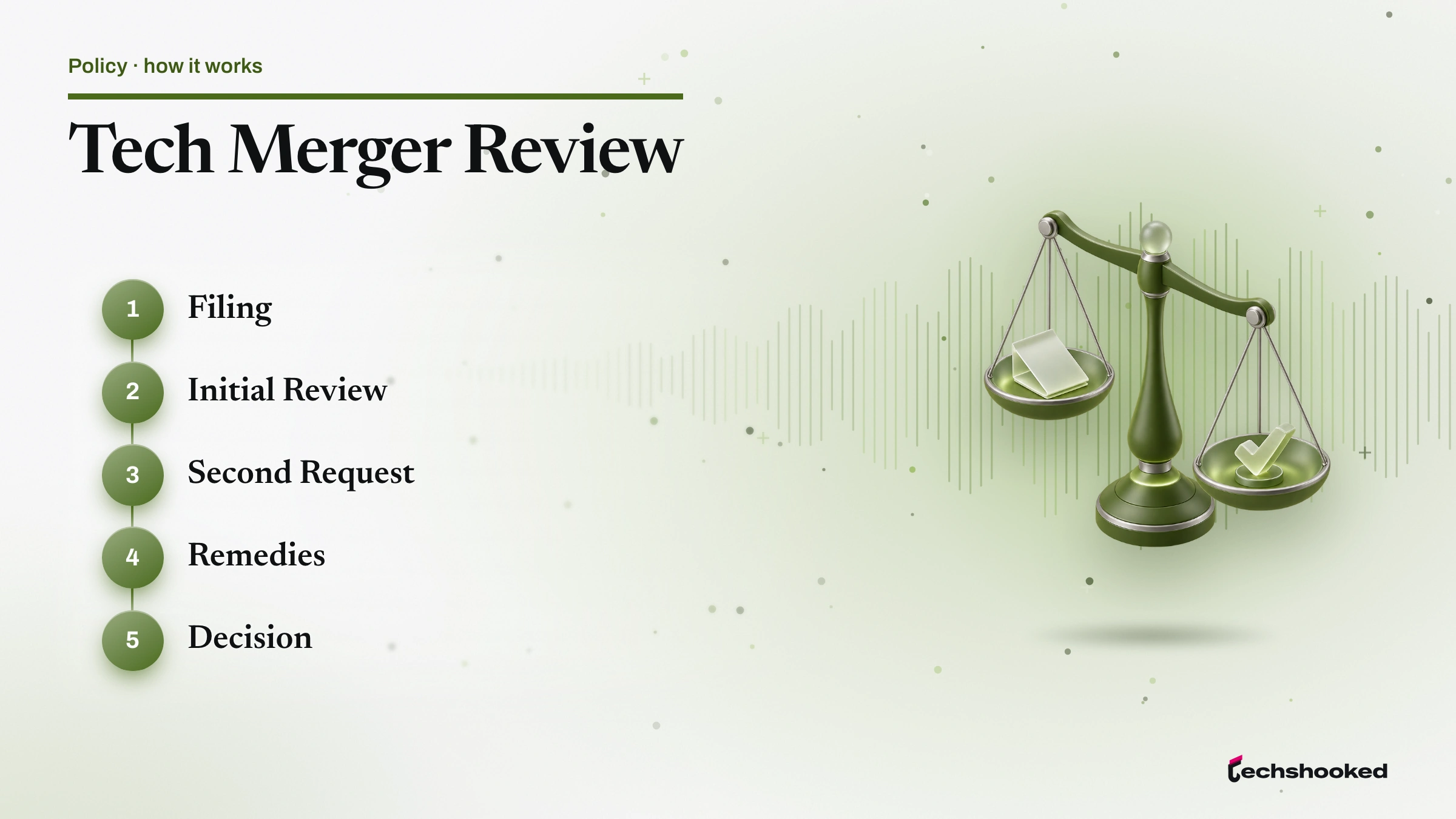
Merger review is the regulatory process that antitrust authorities use to evaluate whether a proposed acquisition would substantially lessen competition before the deal closes.
When a large technology company announces a deal, the legal machinery that follows is rarely visible to outsiders. Filings move between law firms and government agencies, economists model market shares, and regulators decide whether the acquisition would harm consumers, innovators, or market rivals. The outcome shapes which technologies compete and which get absorbed. Understanding how that process works, from initial filing through substantive review, gives practitioners, investors, and policy observers a clearer picture of what regulators actually weigh.
Why Merger Review Exists and What It Covers

Antitrust authorities run merger review as a pre-closing scrutiny step, examining whether a proposed acquisition would harm competition before the parties are permitted to complete the deal. Competition law in most major economies rests on the premise that markets produce better outcomes when buyers can choose among rivals competing on price, quality, and innovation. A transaction that eliminates a significant competitor, or that concentrates market power in ways that discourage future entry, can undermine those outcomes even if both parties to the deal benefit from closing it. Because the stakes scale with market power, merger review applies most forcefully to deals that reshape competitive structure rather than routine transactions.
Four concepts define the framework:
- Concentration
- A merger, acquisition, or joint venture that combines previously independent businesses, reducing the number of competitors in a market. Regulators assess whether the resulting concentration would meaningfully reduce competitive pressure.
- HSR filing
- A pre-merger notification submitted to the FTC and DOJ under the Hart-Scott-Rodino Antitrust Improvements Act of 1976. The filing triggers a mandatory waiting period and gives regulators the information they need to screen for competitive harm.
- Waiting period
- The statutory interval between HSR filing and deal closing during which regulators conduct their initial review. The parties may not close the transaction until the waiting period expires, is terminated early, or a court enjoins the deal.
- Antitrust review
- The substantive competition analysis that follows the procedural filing. Reviewers examine market definition, market concentration, barriers to entry, and the likelihood of anticompetitive effects such as price increases or reduced innovation.
How the US Filing and Waiting Period Process Works
US deals above the Hart-Scott-Rodino threshold must be reported to the FTC and DOJ before closing, triggering a mandatory waiting period during which regulators conduct their initial review. Under the Hart-Scott-Rodino Act, the two agencies review most proposed transactions affecting US commerce that exceed a certain size. Current law requires companies to report any deal valued at more than approximately $101 million, subject to exemptions, per the FTC merger review overview. Either agency can take legal action to block deals that would substantially lessen competition.
The process unfolds in five stages:
- HSR filing. Both parties submit pre-merger notification forms disclosing financial data, business descriptions, and overlapping product markets. The agencies divide jurisdiction over each deal between them; typically only one agency conducts the substantive review.
- Initial waiting period. The parties must wait 30 days before closing, or 15 days when the transaction involves a cash tender offer or a bankruptcy proceeding, per the FTC. This window gives the reviewing agency time to assess whether the deal warrants deeper scrutiny.
- Early termination or second request. If the initial review reveals no competitive concerns, regulators may grant early termination of the waiting period, allowing the parties to close sooner. If concerns surface, the agency issues a second request, a formal demand for additional documents and data covering market shares, competitive dynamics, and internal strategy documents.
- Post-compliance review window. Once the parties certify substantial compliance with the second request, the investigating agency has 30 additional days, or 10 days in cash tender or bankruptcy cases, to complete its review and act if needed, per the FTC. This extended period is when the heaviest economic analysis occurs.
- Closing or enforcement action. If the agency concludes no competitive harm exists, or if the parties agree to remedies, the deal proceeds to closing. If the agency believes the transaction would substantially lessen competition, it may seek a court injunction to block it.
Some transactions may face simultaneous review by a state Attorney General alongside the federal agency. A coordination protocol between the FTC, DOJ, and state enforcement offices governs how those parallel reviews are managed, with the goal of maximizing cooperation and minimizing the burden on the parties, per the FTC coordination protocol. The Section 230 liability explainer provides broader context on how federal statutes define the regulatory relationship between government agencies and technology platforms.
How the European Commission Evaluates Mergers
The European Commission reviews concentrations with an EU dimension under the EU Merger Regulation, applying the significant impediment to effective competition (SIEC) standard to decide whether to clear, remedy, or prohibit a deal. A concentration has an EU dimension when the combined worldwide and EU-wide turnover of the parties exceeds defined thresholds set in the regulation, placing jurisdiction with the Commission rather than member state authorities.
The review proceeds in two sequential phases, as described in the European Commission mergers overview:
| Dimension | Phase I | Phase II |
|---|---|---|
| Duration | 25 working days from complete notification | Up to 90 working days from Phase II opening |
| Trigger | All notifications with EU dimension | Serious doubts about compatibility with the common market |
| Decision types | Clearance; clearance with commitments; referral to Phase II | Clearance; clearance with remedies; prohibition |
| Remedy timing | Commitments offered within 20 working days of notification | Remedies offered later in the in-depth review window |
| Substantive test | Raises serious doubts as to compatibility | SIEC: significantly impedes effective competition |
The Commission is undertaking its broadest review of merger guidance in two decades. Draft Merger Guidelines were published on 30 April 2026, with a public consultation running until 26 June 2026, per the European Commission review of merger guidelines page. These draft guidelines, which remain under consultation and have not yet taken legal effect, aim to modernize the Commission's assessment approach to reflect geopolitical and trade shifts, with greater weight on industrial scale, global competitiveness, and sustainability. The existing Horizontal Merger Guidelines date to 2004 and the Non-Horizontal Merger Guidelines to 2008.
How Regulators Determine the Relevant Market
Regulators begin every substantive antitrust analysis by defining the relevant market, because the boundaries of that market determine which competitors count and how concentrated the merged entity would be. A narrow market definition produces higher concentration numbers; a broad one dilutes them. Getting market definition right is therefore the foundational analytical step, and both sides in a contested merger fight hard over where the boundaries fall.
Four concepts anchor the analytical toolkit, drawing on the DOJ's analytical framework at justice.gov/atr/chapter-2:
- Product market
- The set of products or services that buyers regard as reasonably interchangeable for the same purpose. Regulators ask whether customers would switch to an alternative if the merged firm raised prices, and group together those alternatives that would attract a sufficient share of switching buyers.
- Geographic market
- The geographic area within which buyers can practicably turn to alternative suppliers. For digital services delivered over the internet, the geographic market may be national, regional, or global depending on regulatory access and language constraints.
- Hypothetical monopolist test (SSNIP)
- The standard tool for testing market boundaries. It asks whether a single seller controlling all products in the candidate market could profitably impose a small but significant, non-transitory price increase (typically 5%). If enough buyers would switch away, the market is too narrow and must be expanded to include the next closest substitute.
- Herfindahl-Hirschman Index (HHI)
- A numerical measure of market concentration calculated by summing the squares of each competitor's market share. Regulators use Herfindahl-Hirschman Index levels and post-merger HHI changes to flag transactions in already-concentrated markets as presumptively warranting closer review. Markets with high post-merger HHI scores and large HHI increases draw the heaviest scrutiny under DOJ analytical guidance.
Market definition also matters for the algorithmic systems that shape digital competition. The algorithmic accountability explainer covers how automated decision systems intersect with regulatory scrutiny, and the EU AI Act versus US AI regulation comparison addresses how differing regulatory philosophies affect technology markets more broadly.
Digital Markets: How Tech-Specific Factors Affect Merger Analysis
Technology acquisitions raise competition concerns that traditional brick-and-mortar mergers do not, particularly where the target controls data assets, operates a multi-sided platform, or represents a nascent competitive threat to the acquirer. Standard concentration metrics, designed for markets with stable product boundaries and static market shares, can miss competitive dynamics that are central to digital markets. Regulators have responded by expanding the analytical lens.
Key tech-specific factors that regulators now weigh in merger analysis:
- Data access barriers. When the target holds a proprietary dataset that rivals cannot replicate, the acquisition may foreclose competition by giving the acquirer an informational advantage that compounds over time. Regulators assess whether the data is unique, how quickly rivals could build comparable datasets, and whether access could be mandated as a remedy.
- Network effects. Platforms that become more valuable as more users join create self-reinforcing concentration. A merger that combines two platforms with overlapping user bases can accelerate network effects in ways that raise switching costs for users and deter entry by potential rivals.
- Multi-sided platform dynamics. Competition on platform markets involves multiple distinct user groups, such as advertisers, developers, and end users, whose interactions must be analyzed on each side. A merger that forecloses one side of a platform may harm competition even if aggregate prices do not rise.
- Nascent competition and killer acquisitions. An incumbent may acquire a startup not to integrate its product, but to neutralize a potential future rival. Regulators examining such deals look at internal communications, deal rationale, and whether the target was on a trajectory to challenge the acquirer's core market.
- Interoperability foreclosure. A merged firm may restrict the technical interfaces that allow competing products to work with its platform, raising rivals' costs and reducing the competitive options available to users.
Data governance frameworks shape how these concerns translate into regulatory obligations. The GDPR impact on the US tech industry examines how EU data rules affect American technology companies, and the content moderation pipelines explainer covers platform obligations that overlap with competition policy in digital markets.
Remedies: How Agencies Resolve Competitive Concerns
When regulators identify competitive harm but stop short of outright prohibition, they typically require the parties to accept remedies before clearing the deal. Remedies are negotiated conditions attached to clearance decisions; they are designed to preserve the competitive benefits of the transaction while eliminating the harm. The choice between remedy types carries significant practical consequences for how effectively competition is maintained post-closing.
| Dimension | Structural Remedies | Behavioral Remedies |
|---|---|---|
| Definition | Require the parties to divest a business unit, product line, or asset to a third-party buyer before or after closing | Impose ongoing conduct requirements on the merged entity, such as interoperability mandates, data-sharing obligations, or firewall commitments |
| Examples | Asset sales, spin-offs, divestitures of overlapping product lines, brand divestitures | Licensing requirements, non-discrimination commitments, API access obligations, consent decrees |
| US agency preference | Strongly preferred by both the FTC and DOJ; viewed as a cleaner, self-executing fix | Used where structural remedies are not feasible; subject to ongoing monitoring and enforcement risk |
| EU approach | Also preferred for horizontal overlaps; commonly paired with up-front buyer requirements | Accepted in cases involving vertical or conglomerate concerns where conduct obligations can be precisely defined |
| Monitoring burden | Limited post-closing; trustee may oversee divestiture process | Ongoing; requires a monitoring trustee or periodic compliance reporting for the duration of the order |
In technology markets, antitrust authorities have increasingly experimented with behavioral remedies requiring interoperability between the merged platform and rival services. These are harder to enforce than divestitures because they depend on continued compliance rather than a one-time transaction. Structural remedies, particularly divestitures of competing product lines, remain the preferred tool when the competitive overlap can be cleanly excised. Legal frameworks governing sensitive data categories add another layer of complexity when the divested or licensed assets include personal data. The biometric data protection legal frameworks explainer covers regulatory constraints on data transfers in that context, and the data localization laws and cloud services impact explainer addresses how jurisdictional data rules affect remedy implementation across borders.
References
- FTC: Merger Review (HSR thresholds, waiting periods, second requests, early termination)
- DOJ Antitrust Division: Chapter 2 (analytical framework, market definition, concentration measures)
- European Commission: Review of Merger Guidelines (draft guidelines published April 2026; under public consultation)
- European Commission: Mergers Overview (Phase I and Phase II procedures and timelines)
- FTC: Protocol for Coordination in Merger Investigations (federal-state coordination framework)
Further reading
Frequently Asked Questions
What triggers an HSR filing requirement for a tech acquisition?
A transaction triggers a Hart-Scott-Rodino filing when both size-of-transaction and size-of-person thresholds are met, as reported by the FTC. The FTC notes current law requires reporting deals valued above approximately $101 million, subject to exemptions. Parties must then observe a 30-day waiting period before closing (15 days for cash tender or bankruptcy deals). Early termination of the waiting period can be requested when the agencies are satisfied no action is needed.
How do regulators define the relevant market in a merger review?
Regulators use market definition to identify where competitive harm could occur. The standard analytical tool is the hypothetical monopolist test, which asks whether a small but significant non-transitory price increase would be profitable if imposed by a single seller across the candidate market. Relevant dimensions include product substitutability, geographic scope, and, in digital markets, platform-side network effects and data access.
What is the difference between a Phase I and Phase II merger investigation in the EU?
Phase I is the initial 25-working-day review period in which the European Commission determines whether the concentration raises serious competition doubts. If doubts exist, the Commission opens a Phase II in-depth investigation lasting up to 90 working days. The Commission may approve, approve with remedies, or prohibit the deal at the end of Phase II under the significant impediment to effective competition standard in the EU Merger Regulation.
Can a merger be cleared in one jurisdiction and blocked in another?
Yes. The FTC and DOJ apply U.S. antitrust standards independently from the European Commission, and each authority assesses competitive effects in its own jurisdiction. A deal can receive conditional clearance from the European Commission while the DOJ seeks an injunction in U.S. federal court, as the enforcement standards, market definitions, and remedies available differ between jurisdictions.