Broadband policy is a regulatory framework that governs how internet infrastructure is funded, deployed, and operated across public and private networks.
Two distinct models compete to serve unconnected communities: municipal broadband programs backed by local government ownership, and private ISP deployments subsidized through federal programs. Understanding how each model works as a policy instrument requires tracing the funding mechanisms, compliance obligations, and infrastructure ownership rules that shape what gets built and where. The gap between the two has real consequences for rural broadband coverage, rate regulation, and long-term network governance.
What Broadband Policy Governs
Broadband policy sets the rules for who builds internet infrastructure, who funds it, and what service standards carriers must meet. The regulatory framework spans the Universal Service Fund and other federal subsidy programs, state-level authority over municipal providers, and FCC rules on minimum speeds, rate comparability, and open-access network conditions. Understanding broadband policy requires separating the funding layer from the operational layer: who receives a subsidy and how deployment obligations are enforced are separate questions with separate compliance chains.
The Universal Service Fund (USF) is the primary federal financing mechanism beneath most rural internet programs. Administered by the Universal Service Administrative Company (USAC), it collects contributions from telecommunications carriers and redistributes them through four program areas: high-cost support for rural deployment, low-income Lifeline assistance, E-Rate for schools and libraries, and rural health care connectivity. For broadband policy purposes, the high-cost program is the most consequential, because it sets the terms under which a private internet service provider (ISP) can receive public subsidy to serve areas commercial investment would otherwise bypass. The broader context for these mechanisms sits in the internet governance models that shape how spectrum, infrastructure, and access rights are allocated across jurisdictions.
How the Connect America Fund Works
The Connect America Fund is the primary FCC mechanism for subsidizing broadband deployment in rural areas where private investment alone cannot cover infrastructure costs. Established as a restructured form of USF high-cost support, CAF directs funds to carriers that commit to building fixed broadband to unserved locations meeting FCC-defined speed and latency thresholds. The program's Phase II model set a 10/1 Mbps benchmark for qualifying service, with support terms and deployment timelines verified through primary sources at USAC's CAF Phase II program overview.
Carriers that accept Connect America Fund support must meet a three-step compliance process verified through the High Cost Universal Broadband (HUBB) portal, USAC's centralized deployment tracking system:
- HUBB portal reporting: Carriers submit location-level deployment data through the HUBB portal, identifying each fixed location served with broadband meeting the required speed threshold. USAC uses this data to map funded coverage and identify outstanding obligations, as documented at USAC's CAF Map portal.
- Verification reviews: USAC conducts desk and field reviews to confirm that reported deployments represent real, serviceable infrastructure. Carriers must provide documentation supporting each location's status in the HUBB portal.
- Network performance testing: CAF recipients must demonstrate that deployed networks meet the required speed and latency standards through speed test data submitted to USAC, not merely by asserting that infrastructure has been built.
The HUBB portal serves as the single authoritative record of where CAF-funded broadband deployment has and has not occurred. Discrepancies between portal data and actual deployment trigger compliance reviews and can result in support recovery actions, as detailed in USAC's FCC Rural Broadband Accountability Plan documentation.
Municipal Broadband: The Public-Utility Model
Municipal broadband treats internet connectivity as public infrastructure, following the same ownership model as water and electricity utilities. Rather than relying on private ISP market incentives, a municipal broadband network uses government capital to build fiber infrastructure and either operates retail service directly or leases the infrastructure wholesale to competing providers. The digital divide that CAF programs target through subsidy looks different under municipal broadband policy: the municipality absorbs construction risk rather than transferring it to a subsidized private carrier.
Three distinct municipal models have emerged in practice:
- Full-service utility network
- The municipality owns the fiber infrastructure and operates retail broadband service directly, setting rates and service terms as a public utility. The city functions as the ISP, competing with or replacing private carriers in its footprint.
- Open-access wholesale fiber
- The municipality owns the fiber but does not offer retail service. Instead, it operates an open-access network, leasing the infrastructure to multiple private ISPs that compete to serve end users. This model separates infrastructure ownership from service delivery, preserving private competition at the retail layer while keeping the physical network under public control.
- Public-private partnership
- The municipality co-invests in infrastructure with a private carrier, sharing construction costs and ownership rights in a negotiated arrangement. Terms vary widely: some agreements grant the private partner exclusive retail rights; others include open-access obligations as a condition of municipal financing.
State preemption laws in a significant number of US states restrict or prohibit municipal broadband deployments, meaning the viability of the public-utility model depends heavily on the regulatory environment at the state level, independent of federal broadband policy.
Private ISPs: Market-Driven Deployment
Private internet service providers deploy and operate networks under market incentives, supplemented by federal subsidy programs where commercial returns are insufficient. The Connect America Fund Phase II framework illustrates this model: a private ISP commits to serving a defined set of rural locations in exchange for recurring federal support payments, with the carrier retaining ownership of the infrastructure it builds. According to USAC's CAF Phase II program documentation, the Phase II model set a 10/1 Mbps service benchmark with defined support terms and deployment milestones.
Private ISPs operating under market-driven broadband deployment follow several structural patterns:
- Infrastructure ownership: The private ISP retains full ownership of the network it builds, including any capacity funded through public subsidies. There is no open-access obligation unless one is imposed as a condition of the specific grant program.
- Rate-setting authority: Private ISPs set retail rates independently, subject only to FCC rate comparability requirements under the USF high-cost program, which require that rates in supported areas be reasonably comparable to urban rates nationally.
- CAF compliance burden: Carriers must report deployment progress through the HUBB portal, submit to verification reviews, and pass network performance testing. Missing interim milestones triggers the Rural Broadband Accountability Plan enforcement framework.
- Technology flexibility: Unlike some earlier subsidy programs, CAF Phase II did not restrict recipients to a specific technology type, allowing carriers to deploy fixed wireless, fiber, or cable broadband as long as the service met the speed and latency thresholds.
Policy Mechanism Comparison
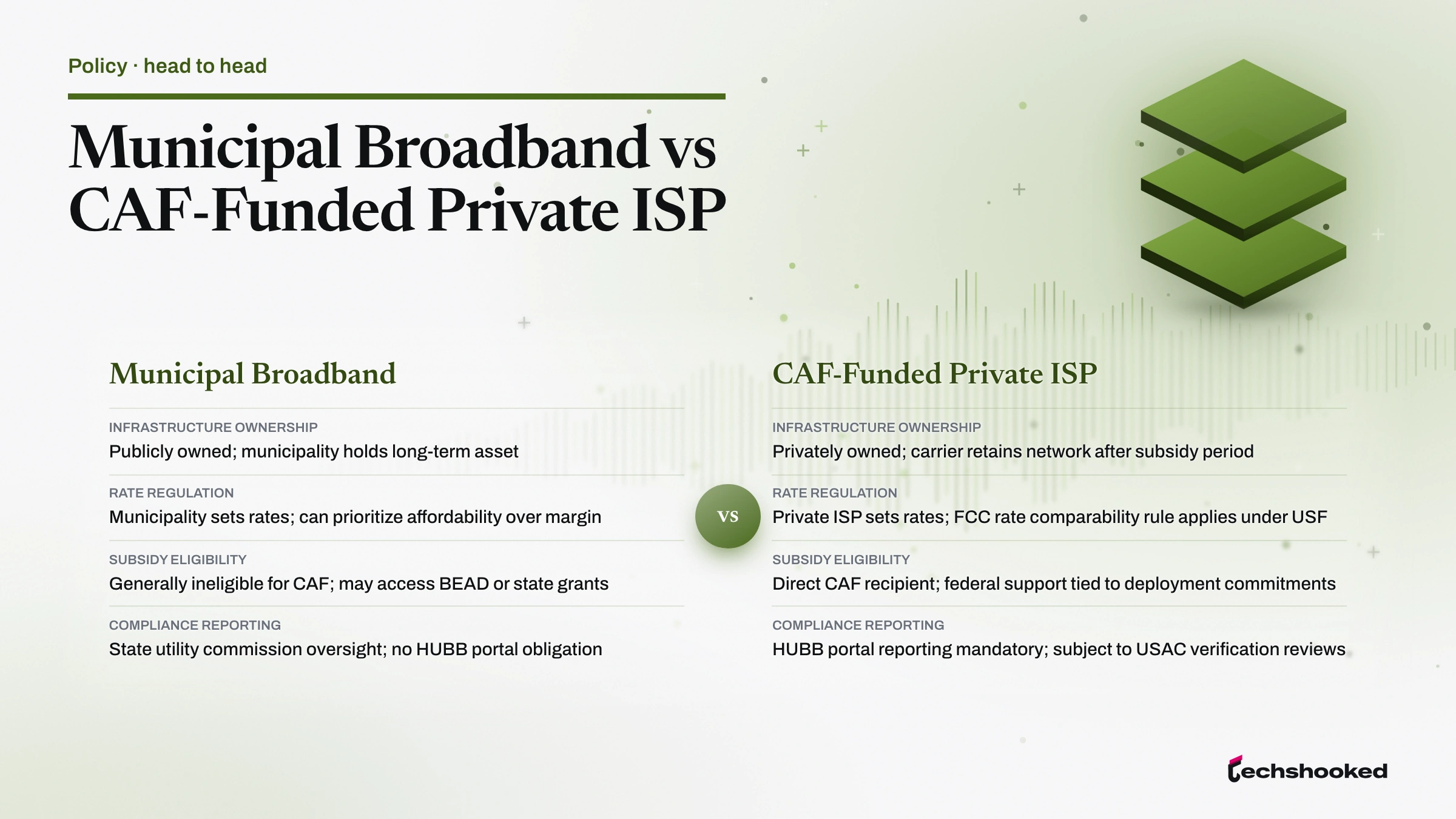
Comparing municipal broadband and private ISP frameworks as policy instruments reveals distinct tradeoffs in infrastructure ownership, rate regulation, and federal subsidy eligibility. Neither model is unconditionally superior: the right choice depends on state regulatory environment, population density, existing infrastructure, and the relative weight placed on public accountability versus private-sector deployment speed.
| Mechanism | Municipal Broadband | CAF-Funded Private ISP |
|---|---|---|
| Infrastructure ownership | Publicly owned; municipality holds long-term asset | Privately owned; carrier retains network after subsidy period |
| Rate regulation | Municipality sets rates; can prioritize affordability over margin | Private ISP sets rates; FCC rate comparability rule applies under USF |
| Subsidy eligibility | Generally ineligible for CAF; may access BEAD or state grants | Direct CAF recipient; federal support tied to deployment commitments |
| Compliance reporting | State utility commission oversight; no HUBB portal obligation | HUBB portal reporting mandatory; subject to USAC verification reviews |
| Net neutrality posture | Varies by model; open-access networks apply rules at retail ISP layer | Subject to applicable FCC traffic-management rules at retail layer |
| Open-access option | Structural open-access network possible; wholesale fiber leasing supported | No open-access requirement under CAF; carrier controls access conditions |
The broadband policy comparison shows that the two models differ most sharply on two dimensions: who holds the infrastructure asset long-term, and who bears the compliance obligation for federal reporting. A CAF-funded private ISP builds an asset it will own permanently, while accepting FCC-defined deployment and reporting obligations during the subsidy period. A municipal broadband network retains the asset publicly but typically falls outside the CAF compliance framework, making it dependent on alternative funding sources.
Deployment Accountability and Compliance
Federal oversight of CAF-funded deployments uses a three-step compliance framework: HUBB portal reporting, verification reviews, and network performance testing. The Rural Broadband Accountability Plan, which the FCC launched in early 2022 to expand USAC's enforcement authority, added structured penalty tiers to this framework. Details are documented at USAC's Rural Broadband Accountability Plan resource page.
- HUBB portal submission: CAF recipients file location-level broadband deployment data through the High Cost Universal Broadband portal. Each submission identifies specific locations as deployed and serviceable. The USAC CAF Map update announcements document how portal data flows into public-facing coverage maps.
- USAC verification review: USAC auditors conduct desk reviews of HUBB portal records and, in selected cases, field verification of reported deployments. Carriers must supply supporting documentation for each claimed location.
- Network performance testing: Deployed networks must pass speed and latency tests confirming that service meets the applicable CAF benchmark. Test data is submitted through USAC's defined process and forms part of the carrier's compliance record.
When a carrier's HUBB portal data shows a gap between committed and actual broadband deployment, the Rural Broadband Accountability Plan triggers a four-tier penalty structure based on the size of the deployment shortfall. Consequences scale from increased reporting obligations to withholding of ongoing support payments and recovery of disbursed funds. Because CAF compliance gap tiers are tied to specific percentage thresholds, carriers with marginal shortfalls face a materially lower penalty burden than those that have failed to deploy in a majority of their committed locations. The digital divide policy solutions framework that informs federal subsidy design treats accountability mechanisms as integral to closing coverage gaps rather than treating compliance as a separate administrative function.
Net Neutrality Implications
Net neutrality requirements interact differently with municipal and private broadband policy frameworks because infrastructure ownership shapes the legal basis for traffic-management rules. The FCC's authority to impose non-discrimination obligations on internet traffic flows from its classification of broadband service providers, and that classification applies at the retail service layer regardless of who owns the physical infrastructure underneath it.
Key distinctions in how net neutrality intersects with each broadband policy model:
- Municipal full-service networks: When a municipality operates retail broadband directly, it functions as an ISP for regulatory purposes and is subject to applicable FCC traffic-management rules, including any net neutrality obligations in effect at the federal level.
- Open-access network wholesale model: The municipality as infrastructure owner leases capacity to private ISPs. Net neutrality obligations attach to those retail ISPs, not to the municipality as the physical infrastructure owner. The open-access network's wholesale lease terms govern how ISPs may use the capacity, but federal traffic-management rules govern how those ISPs serve end users.
- CAF-funded private ISP: Subject to FCC retail traffic-management rules as a condition of operating broadband service. CAF compliance obligations and net neutrality rules operate through separate regulatory channels: the former through USAC, the latter through FCC enforcement.
The net neutrality regulatory debate covers the FCC's classification history and the legal basis for traffic-management obligations in detail. For broadband policy comparison purposes, the key point is that net neutrality posture is determined by who delivers retail service, not by who owns the fiber.
References
- USAC: FCC Rural Broadband Accountability Plan
- USAC: CAF Phase II Model Program Overview
- USAC: CAF Map (High Cost Universal Broadband Portal)
- USAC: CAF Map Update Announcements
- NTIA BroadbandUSA: Broadband Equity, Access, and Deployment (BEAD) Program
- Institute for Local Self-Reliance: Municipal FTTH Networks
Further reading
Frequently Asked Questions
Can a private ISP receive CAF funding and still operate a municipal broadband network in the same area?
Yes, a CAF-funded private ISP and a municipally operated network can serve overlapping geographies. The Universal Service Fund support is allocated to locations the private carrier has committed to serve, and HUBB portal reporting tracks which fixed locations that carrier has deployed to. Municipalities building their own networks in the same area generally do not receive CAF funds for those locations, so the two models operate under separate compliance regimes even when geographically adjacent.
What happens when a CAF recipient misses its deployment milestone?
Carriers that miss interim deployment milestones face a four-tier penalty system tied to the percentage of their deployment shortfall. Consequences include increased reporting requirements, potential withholding of ongoing support payments, and recovery of funds already disbursed. The Rural Broadband Accountability Plan, launched by the FCC in early 2022, expanded USAC's oversight authority to enforce these obligations more systematically.
Does an open-access municipal fiber network have to follow net neutrality rules?
An open-access municipal network separates infrastructure ownership from retail service: the municipality owns the fiber and leases it to private ISPs that compete to serve end users. Net neutrality obligations apply at the retail service layer, meaning the ISPs operating over the municipal fiber are subject to applicable FCC traffic-management rules, not the municipality as infrastructure owner. The net neutrality posture of the municipal network itself depends on the wholesale lease terms it sets.