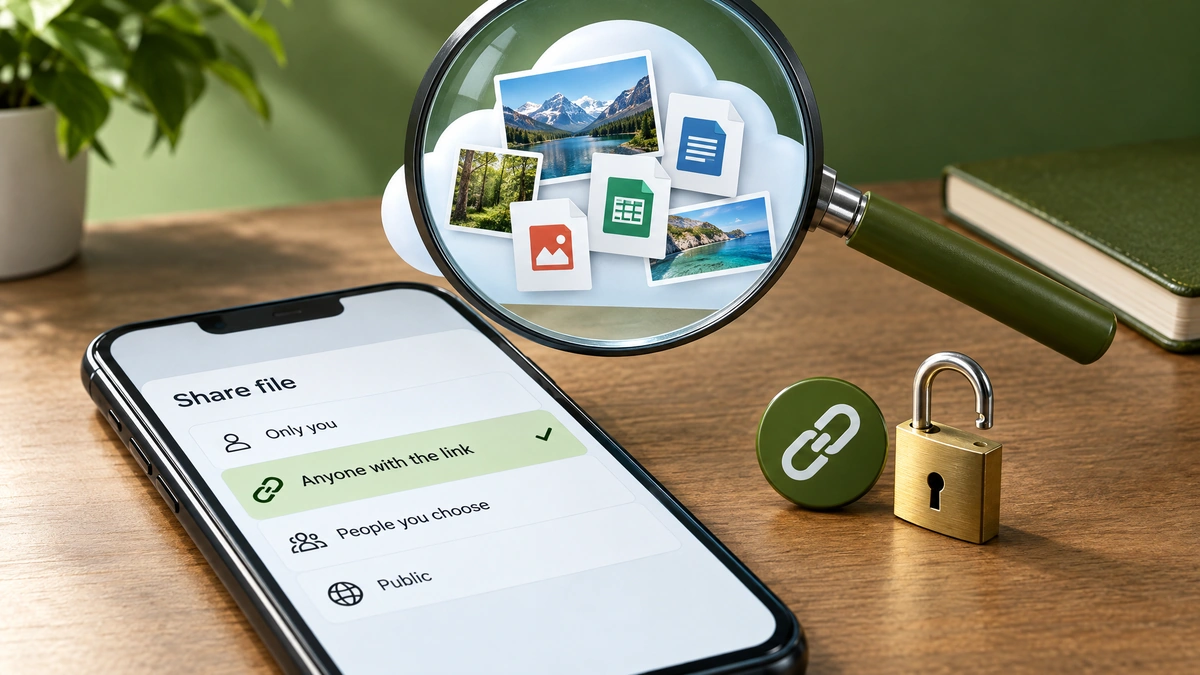
Starting with version 27.3 of iOS, iPadOS, macOS and visionOS, Apple says items that iCloud users share through the "Anyone with the link" option "will be checked ... for harmful content." Apple posted the notice on November 3, the same day it released the first 27.3 betas to developers.
Apple does not define harmful content. If a user tries to upload harmful content, Apple says it may remove the content, block or disable the Apple Account and, "if necessary," involve law enforcement.
The change is the check, not the encryption. Apple says an item shared with "Anyone with the link" is not end-to-end encrypted, even when the owner or participants have turned on Advanced Data Protection. It has said since at least December 2023 that sharing content with "anyone with the link" does not support Advanced Data Protection.
The check covers links open to anyone, from version 27.3
Apple describes two ways to share an item stored in iCloud: Share a Link or Send a Copy. Under Share a Link, "People you choose" limits access to people the owner invites or approves, while "Anyone with the link" opens the item to anyone who has the link, "including Apple." Apple states the check only for that second option.
Apple gives two examples, a photo in iCloud Photos and a file in iCloud Drive, and names no others: not Notes, Pages, Keynote, Numbers, Freeform or Shared Albums. Shared Albums carry link settings of their own: on iCloud.com, an album can be set to "People You Choose" or "Anyone with the Link," and for some albums a Public Website option lets anyone view it there.
So far, Apple has released 27.3 only as betas. The latest public version of iOS and iPadOS is 27.2, released October 26. Apple gives no public date for 27.3. MacRumors and Bitdefender each expect the public release in December.
Apple's terms name harm to children; the notice names no method
Apple names no method for the check: no hash matching, classifier or human review, and no word on whether it runs on the device or on Apple's servers. Apple explains that selecting "anyone with a link" when enabling collaboration makes content available to Apple servers under standard data protection, because the servers need to provide access to anyone who opens the URL.
Apple's own legal texts give the word more shape. The iCloud Terms let Apple "screen, move, refuse, modify and/or remove Content at any time, without prior notice" if it is illegal, breaks the agreement, is "harmful to children" or is otherwise objectionable. They describe systems that "might include blocking functions and controls on sharing Content between users," meant to minimize the time serious illegal content, including child sexual exploitation and abuse content, stays on the service.
In its Privacy Policy, updated July 30, 2025, Apple lists "prescreening or scanning uploaded content for potentially illegal content, including child sexual exploitation material" among its security uses of personal data. The 27.3 notice is the narrower text, tying a check to link-shared items.
MacRumors says harmful content "could mean malware, malicious files, and/or" child sexual abuse material, given Apple's mention of law enforcement.
Advanced Data Protection does not change the check on open links
With Advanced Data Protection on, Apple says 25 categories of iCloud data are end-to-end encrypted, including iCloud Backup, Photos and Notes. The feature keeps shared content end-to-end encrypted as long as every participant has it on, in Shared Photo Library, iCloud Drive shared folders, shared Notes and Freeform collaboration. Keynote, Numbers and Pages collaboration and Shared Albums don't support it.
For users without Advanced Data Protection, Apple says, the keys for most data sit in its data centers so it can help with data recovery, and iCloud content shared with other people is not end-to-end encrypted.
What Apple says it checks would leave out invite-only sharing and anything unshared; the notice does not mention checking an unshared Photos library, iCloud Backup or files kept private. Send a Copy carries a caveat of Apple's own: a Freeform board sent that way is stored unencrypted while its sharing link is active, regardless of the account's encryption setting. Apple does not say whether Send a Copy items are checked.
Apple may remove the content or act against the whole Apple Account
Apple's wording begins "If you try to upload harmful content." Beyond removing the item and disabling the account, Apple may block the creation of a new Apple Account with the same email address or phone number. Gizmodo notes that Apple describes no process for challenging a decision.
The Register says Apple did not respond to its questions. Apple does not mention the check in its iOS and iPadOS 27.3 developer release notes.
Apple does not say whether links created before 27.3 are checked, a question MacRumors and Bitdefender both raise. It does not say whether a user is told before or after Apple acts, or whether flagged content is reported to the National Center for Missing & Exploited Children (NCMEC) or any other authority. Nor does it name countries: the notice carries only Apple's generic line that "not all features are available in all countries or regions," and appears in English on Apple's sites, including the US, UK, German and French ones.
Apple cites no law
Apple's notice names no statute, regulator or order. In the United States, federal law requires providers to report apparent child sexual exploitation to NCMEC's CyberTipline "as soon as reasonably possible after obtaining actual knowledge." Section 2258A(f) says providers are not required to "affirmatively search, screen, or scan" for it.
In the European Union, Regulation (EU) 2026/1881, published July 28, 2026 and applying until April 3, 2028, lets providers of number-independent interpersonal communications services voluntarily detect and report online child sexual abuse. It does not apply to end-to-end encrypted communications. Google cites the earlier interim rule, Regulation (EU) 2021/1232, as the basis for hash matching in Google Chat, its messaging product. Permanent EU rules are still in negotiation. On September 29, Parliament and Council reached an agreement in principle on detection orders for large platforms covering public content, per the European Parliament; the next round is set for November.
Google and Microsoft may review stored content; MEGA and Tresorit say they cannot
Google says it identifies child sexual abuse material across its platforms with specialist teams, machine-learning classifiers and hash matching, and reports it to NCMEC. In its abuse policy for Docs Editors, Google says it "may review content for violations of these policies and take action," which may include reporting such material to NCMEC and disabling accounts. Neither Google text makes a distinction for link-shared files.
In its Services Agreement, Microsoft says that, "where applicable," it may use automated systems and humans to review content for illegal or harmful material. It uses hash matching such as PhotoDNA and MD5 to detect child sexual exploitation and abuse imagery, Microsoft reports, and it says it actioned 237,391 pieces of content and 22,651 consumer accounts tied to such imagery, including grooming of children, in 2025, across hosted consumer services such as OneDrive, Outlook, Skype and Xbox.
MEGA says a file is already encrypted on the user's device when uploaded, so MEGA "cannot know what it contains," and decryption happens only on the devices of the user or of people given the links and the keys created with them. Tresorit says not even Tresorit can access its users' files. MEGA still reserves the right to remove files and suspend accounts for serious breaches, such as sharing child sexual abuse material. On the companies' own descriptions, the difference is where the keys sit: MEGA says its keys are created when a link is created, while Apple's servers must be able to open an "Anyone with the link" item for anyone who has the URL.
Apple dropped a 2021 photo-matching plan in 2022
In August 2021, Apple announced a system that would match images on the device, before they were stored in iCloud Photos, against a database of known child sexual abuse material hashes provided by NCMEC and other child safety organizations. Past a match threshold, Apple would manually review each report, disable the account and send a report to NCMEC. Apple presented the design as an alternative to "scanning images in the cloud."
In a September 2021 update, Apple said it would take more time "based on feedback from customers, advocacy groups, researchers, and others." On December 7, 2022, in a statement shared with Wired and reproduced by MacRumors, Apple said it would not move forward with the tool and that "children can be protected without companies combing through personal data." The same day, it announced Advanced Data Protection.
In August 2023, in a letter to the Heat Initiative that Wired quoted, Apple's Erik Neuenschwander wrote that "scanning every user's privately stored iCloud data would create new threat vectors for data thieves to find and exploit." Apple decided not to proceed with its hybrid client-server proposal, concluding it "was not practically possible to implement without ultimately imperiling the security and privacy of our users," he wrote.