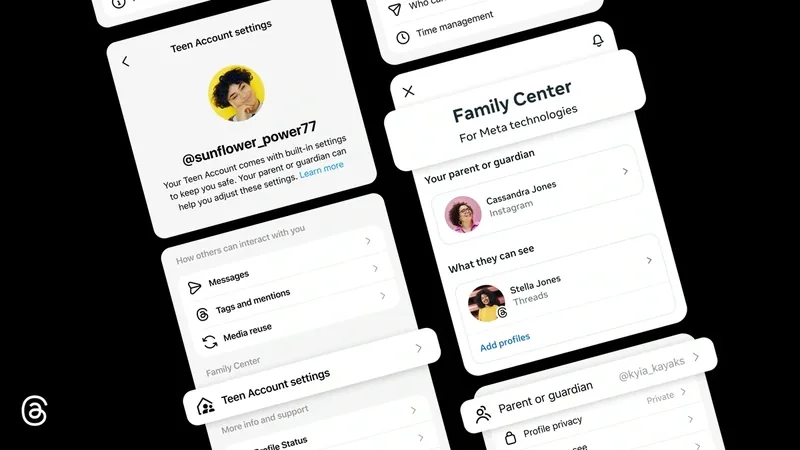
Meta is extending its AI age estimation to Instagram users worldwide. When the system suspects an account belongs to a teenager who entered an adult birthday, it moves the account into Teen Account protections, which limit who can contact the teen, what they see and how long they spend in the app. A teen under 16 then needs a parent's permission to make any of those settings less strict. Meta says it is still rolling the same technology out on Facebook and will begin a similar global launch on Threads later this year. US parents will also start seeing an Instagram notification this month that explains how teens are placed and how parents can help make sure a teen's age is right.
The step widens a system Meta has run market by market since April 2025, and Meta says it is encouraged by the results without publishing an accuracy rate. The company presents the expansion as building on its August settlement with US state attorneys general, and in Australia it has begun reading Apple's age-range signal as well.
What a placement changes, and the routes back out
Meta's 2024 list of Teen Account defaults covers private accounts, the strictest messaging settings, the most restrictive sensitive-content setting and limits on tags and mentions. Teens also get a reminder to leave after 60 minutes each day and a sleep mode from 10 p.m. to 7 a.m. that mutes notifications overnight. Private accounts apply to every teen under 16, and to older teens when they sign up.
In the US states that joined the settlement, the defaults go further. Meta lists a two-hour daily limit, counted across Facebook and Instagram, that teens can switch off only with a parent's permission. Night Mode blocks use from midnight to 6 a.m., and School Mode mutes notifications from 8 a.m. to 3 p.m. Direct messages are exempt from all three.
A teen placed by mistake has had a way out since the US test began: in April 2025 Meta said people would have the option to change their settings if it got an age wrong. Changing the birthday itself is harder. Anyone who tries to move a birthday from under 18 to over 18 while Meta suspects misrepresentation must verify with an ID or with Yoti's facial age estimation, a requirement Meta restated in May 2026. When it introduced the Yoti route in 2022, Meta said it sends Yoti only the image from a video selfie; Yoti estimates the age and returns the result, and both companies then delete the image. An uploaded ID, Meta said, is deleted within 30 days.
Suspected children face a harder line. An account Meta determines may belong to someone under 13 is deactivated, and the holder must prove their age through Meta's verification process to keep it from being deleted. In the settling states, the settlement adds a floor for adults caught in the net: as EFF quotes the text, users who say they were wrongly identified as minors must get a clear and conspicuous way to appeal, and a decision that comes with its basis.
What the AI reads, as Meta describes it
Meta's most detailed description of the signals came in May 2026, when Meta said its AI analyzes whole profiles for contextual clues such as birthday celebrations or mentions of school grades. It looks for them across posts, comments, bios and captions to judge whether an account likely belongs to someone underage.
Meta also added visual analysis then, in which AI scans photos and videos for visual clues about a person's age, and stressed that this is not facial recognition. At the time, visual analysis was available only in select countries. On July 31, 2026, Meta added a correction saying the AI does not use biometric data to identify whether a person is underage and does not create facial fingerprints.
Those signals sit in Meta's May account of underage enforcement, the work of removing children under 13. Engadget's reporting points the same way. After Meta clarified its approach, Engadget corrected its story to say that bone-structure analysis of photos and mentions of school grades or birthdays are used to detect and remove people under 13.
Four steps from a US test to a worldwide rollout
The approach started as a US test in April 2025, using AI to find suspected teens with adult birthdays and place them in Teen Account settings. On September 21, 2025, Meta widened the test to the UK, Canada and Australia. It said at the time that more than 9 in 10 active teen accounts on Instagram remained in protections, a retention figure, not an accuracy rate.
The third step came in May 2026, when teen placement on Instagram reached the 27 EU countries and Brazil and arrived on Facebook in the US. Meta said then that it aimed to expand the technology on Instagram globally through the rest of the year, and the November move fits that aim.
Teen Accounts themselves are older than the AI placement. They launched on Instagram on September 17, 2024, and by a June 2025 update had reached every country where Instagram is available. Until the estimation arrives in a market, a teen who signed up with an adult birthday could stay outside them unless caught another way.
The US settlement Meta cites, and where it binds
Meta describes the deal, made public on August 26, 2026, as an agreement with 52 attorneys general across US states, territories and the District of Columbia. California's attorney general, Rob Bonta, counts 51 in the coalition behind the proposed settlement. Bonta said it resolves California's 2023 lawsuit against Meta, which alleged illegal collection of data from children under 13, designs that drove excessive use and misleading statements about safety. Trial had begun on August 18 in the Northern District of California.
The two sides also count the money differently. Meta puts the payment at approximately $18 billion over 10 years, while Bonta's office says up to $17 billion over ten years. On August 27, Meta said a judge had approved the agreement. Under it, the protections will apply automatically to under-18s on Instagram and Facebook in participating states and territories, and most terms must stay in place for 10 years. Bonta said Meta would make the changes within months.
On age, Meta says it will invest in stronger technology to catch accounts that may belong to children under 13 and strengthen the technology that identifies 13- to 17-year-olds even when they give an adult birthday, while advocating that app stores verify age. Bonta describes the commitment as age assurance measures that detect users under 18 and identify and remove children under 13.
According to the settlement text EFF reproduces, Meta must adopt an age assurance framework within one year, applying one or more methods to users in the settling states. Accounts not yet age-assessed 14 days after creation are treated as teen users for the agreement's purposes, with a carve-out that routes accounts stating an adult age to a separate set of protections. Meta also pledges to consider age signals from Apple's and Google's operating systems and app stores. An independent auditor will review compliance every year for five years, Meta says.
On data, the text requires age-assurance information to be queued for deletion once a user's age status is settled and deleted after a "reasonable period of time," a period EFF notes is not defined. Metadata Meta keeps about the method used must be deleted within 90 days once it is no longer needed. EFF argues the deal makes age gates a legal mandate, embeds deeply flawed age estimation technology and threatens online anonymity and privacy for everyone.
Outside the settling states, the November expansion comes without the settlement's deadlines, audits or deletion rules.
Apple's age range in Australia, in Meta's words and Apple's
In Australia, Apple's age-range signal is now one more input, which Meta says it uses voluntarily. In Meta's telling, a parent setting up a teen's phone can have the app store confirm the user's age and assign an age range. Each time the teen downloads an app, Apple then passes that range to the developer to confirm whether the teen meets the app's age requirement.
Apple describes its Declared Age Range API in more conditional terms. Apps request a person's age range, and for children in Family Sharing a parent can choose to always share it, have the child asked every time or never share it. Apple says the data is based on information declared by a person or their parent, may be confirmed with a method like a credit card or government ID, and that developers alone are responsible for legal compliance.
Apple's age assurance Q&A adds that the API is available worldwide and that, outside places where the law requires otherwise, users decide whether to share. In certain regions where the law requires it, Apple uses age assurance methods to confirm an account holder's age and shares age categories as the law defines them. From iOS 26.5, the API returns a single confirmed value without saying which method confirmed the age. In Australia, Apple already confirms adults itself: it said that from February 24, 2026, it would block users in Australia, Brazil and Singapore from downloading apps rated 18+ unless they were confirmed as adults, a check Apple says the App Store performs automatically through reasonable methods.
Australia also sets a legal floor for social media itself. Its communications department said on December 11, 2025, that Australians must be 16 or older to hold a social media account, and named Facebook, Instagram and Threads among the platforms that must take reasonable steps to keep younger users off.
The Australian arrangement lets Meta press a long-held position. As long as sharing the signal stays optional for app stores and using it stays optional for developers, Meta argues, teens get inconsistent protection across apps, and one verified signal from the device would be more effective and more private than every platform checking age on its own. In May it said legislation should require app stores to verify age, citing support from 88% of US parents. Google has pushed back on the idea; in remarks quoted by Fortune, it said the proposal fails to cover desktop computers or devices shared within families and could be ineffective against pre-installed apps.
Meta calls on TikTok and YouTube to adopt the same practices, and its settlement puts money behind the appeal. About $5.3 billion of the payment, Meta says, is released only if YouTube and TikTok adopt a one-hour daily limit, Night Mode and age assurance, and each pay a matching amount.
What Brussels, London and Canberra already ask of an age check
Many teen-safety laws, Meta argues, are well-intentioned but do not explain how companies should determine a user's age; some require invasive checks for everyone, while others offer no guidance at all. Europe's rules are one place to test the claim. The Commission published its guidelines on protecting minors under the Digital Services Act on July 14, 2025. They rest on Article 28 of the act and appeared in the Official Journal on October 10, 2025.
The guidelines say self-declaration does not meet the requirements for accuracy. They treat age estimation as appropriate where a platform sets a minimum age below 18 on risk grounds, when the estimate comes from an independent third party or from systems independently audited for security and data protection. Estimation can complement verification, or serve as a temporary alternative where effective verification is not yet available, but only until the first review of the guidelines. The guidelines are voluntary, and Meta has not said whether its in-house system has had such an audit.
The Commission also sketches two designs that fall short. In one, a platform with a minimum age of 13 relies on an in-house model it says predicts age with a margin of error of two years either way, which the Commission calls not highly effective. In the other, a user rejected by an age estimate can only retry the same test, with no other method on offer and no way to challenge the result.
Brussels has also moved against Meta directly. PPC Land reported that the Commission issued preliminary findings on April 29, 2026, that Instagram and Facebook breached the DSA by failing to keep under-13s off the services. If the findings are confirmed, Meta could face fines of up to 6% of its worldwide turnover.
In the UK, Ofcom's January 2025 guidance says an age check counts as highly effective only if it meets four criteria, among them technical accuracy, reliability and fairness, and lists facial age estimation as a method capable of meeting that bar. Ofcom chose not to set a numerical accuracy threshold such as 99% at that stage. Australia's law asks for reasonable steps. In the US, state laws have turned to app stores: Apple said it would share age categories for new accounts when apps request them, in Utah from May 6, 2026, and in Louisiana from July 1, 2026.
How well age estimation reads teenagers
Independent testing covers facial age estimation, the technology behind the Yoti route for contested birthdays. None of the testing cited here measures Meta's profile-based AI.
NIST runs an ongoing evaluation of face-based age estimation software, and the summary error figure on its live results page averages ages 18 to 30, not teenagers. NIST's May 2024 report drew on about eleven million government photos. It mimicked a Challenge-25 check, in which anyone estimated under 25 gets a second look.
The false positive rate, the share of young subjects estimated at 25 or older, rose by an order of magnitude as they aged from 14 to 20. By NIST's account, 14-year-olds slip past such a check markedly less often than 17-year-olds. The same report warned that average error is not an appropriate metric for verification decisions, because it hides how many estimates are large overestimates, and found accuracy varied with algorithm, sex, image quality and region of birth.
Biometric Update, analyzing NIST's newer results in August 2026, puts the error of leading algorithms at about 1.25 to 1.55 years for children and teens. It found that two of the most accurate algorithms, one of them Yoti's, overestimate teenagers, so they tend to let through teens near an age threshold.
Australia's government-commissioned Age Assurance Technology Trial also found errors clustered near age gates, in both directions. Its final report, which Biometric Update quoted, describes a gray zone of two to three years either side of an age gate. At the 13+ gate, 22% of 13-year-olds were falsely rejected. By age 15 that rate had fallen to 6%. The report also acknowledged more false positives for darker skin tones and for people aged 16 to 20.
Yoti reports better numbers from its own internal testing, as Biometric Update relayed in July 2025. Yoti claims a mean error of 1.1 years for 13- to 17-year-olds. It also says it estimates 99.3% of that group as under 21. The under-21 test builds in a three-year buffer and says nothing about whether a 15-year-old lands in the right tier.
The settlement sets its own yardstick, in the text EFF reproduces, which EFF reads as counting one kind of error: minors judged to be adults, excluding circumvention. A licensed third-party method gets one year to bring that rate to 10% or less for 16- and 17-year-olds. For 13- to 15-year-olds the ceiling is 3%. EFF notes the agreement caps no error in the other direction, where an adult is judged to be under 18, and only requires the appeal.
A method Meta builds itself starts with more room. In year one it may miss 14% of the older group and 7% of younger teens. Within two years of the agreement taking effect those ceilings fall to 10% and 5%. They hold in the settling states only; elsewhere, the expansion comes with no error ceiling Meta has published.