Explainable AI is a machine learning methodology that surfaces the feature attributions and decision logic behind model predictions for engineers, auditors, and regulators.
That definition matters now because regulators are embedding disclosure requirements into law. The EU AI Act classifies high-risk systems by their impact on rights and safety, not by their architecture, and demands documented accountability for automated decisions. The NIST AI Risk Management Framework (NIST AI RMF) frames transparency as a measurable trustworthiness characteristic alongside accuracy and robustness. Engineers who cannot explain a model's output face both compliance exposure and operational blind spots when the model fails silently in production.
What Explainable AI Is
Explainable AI (XAI) is the practice of building or augmenting machine learning models so that their predictions come with human-readable justifications, not just a numeric output. The field splits into two technical branches: intrinsic interpretability and post-hoc explanation.
Intrinsic interpretability describes models whose internal structure is readable by design. A decision tree exposes its logic as a traversable graph. A linear regression encodes the relationship between inputs and output directly in its coefficients. Model interpretability at this level requires no additional tooling; the model itself is the explanation.
Post-hoc explanation applies a secondary method to a trained model after the fact. SHAP and LIME are post-hoc tools: they approximate explanation without altering the underlying model. This branch of explainable AI handles use cases where the highest-performing model for a task is architecturally opaque and retraining for transparency would reduce accuracy below acceptable thresholds.
Both branches serve the same goal: giving engineers, auditors, and affected parties a defensible account of why a model produced a given output. The practical choice between them depends on the task domain, the regulatory context, and the model architecture already in production.
How Black-Box Models Work
A black-box model is any ML architecture whose internal parameter space is too large or nonlinear for a human to trace a single prediction back to a specific input feature without external tooling. Three architectures dominate production deployments in this category.
- Deep neural network
- Stacks of nonlinear activation layers transform input features through millions or billions of parameters. No single weight maps cleanly to a human-readable concept. Gradient-based methods can attribute output to inputs, but the attribution is an approximation, not a trace through the network's actual computation graph.
- Gradient boosting (XGBoost, LightGBM)
- An ensemble of shallow decision trees, each correcting the residual error of the previous. Individual trees are interpretable; the ensemble of hundreds of trees produces an opaque decision boundary that is difficult to audit at the instance level without a tool like SHAP.
- Large language model (LLM)
- Transformer-based architectures with attention mechanisms distributed across billions of parameters. Attention weights are sometimes used as proxy explanations, but research has shown attention does not reliably correlate with feature importance for a given output token.
The risk profile of a black-box model compounds when the system makes consequential decisions: credit scoring, medical triage, content moderation, hiring screening. Without feature attribution tooling, an error is observable but not diagnosable, and a bias pattern may persist undetected across thousands of decisions. The AI bias, hallucination, and regulation risks article covers the failure modes that emerge when black-box systems operate without auditability controls.
XAI Methods: SHAP, LIME, and Feature Attribution
Three methods dominate practical XAI tooling: SHAP, LIME, and gradient-based feature attribution. Each targets a different layer of the explanation problem.
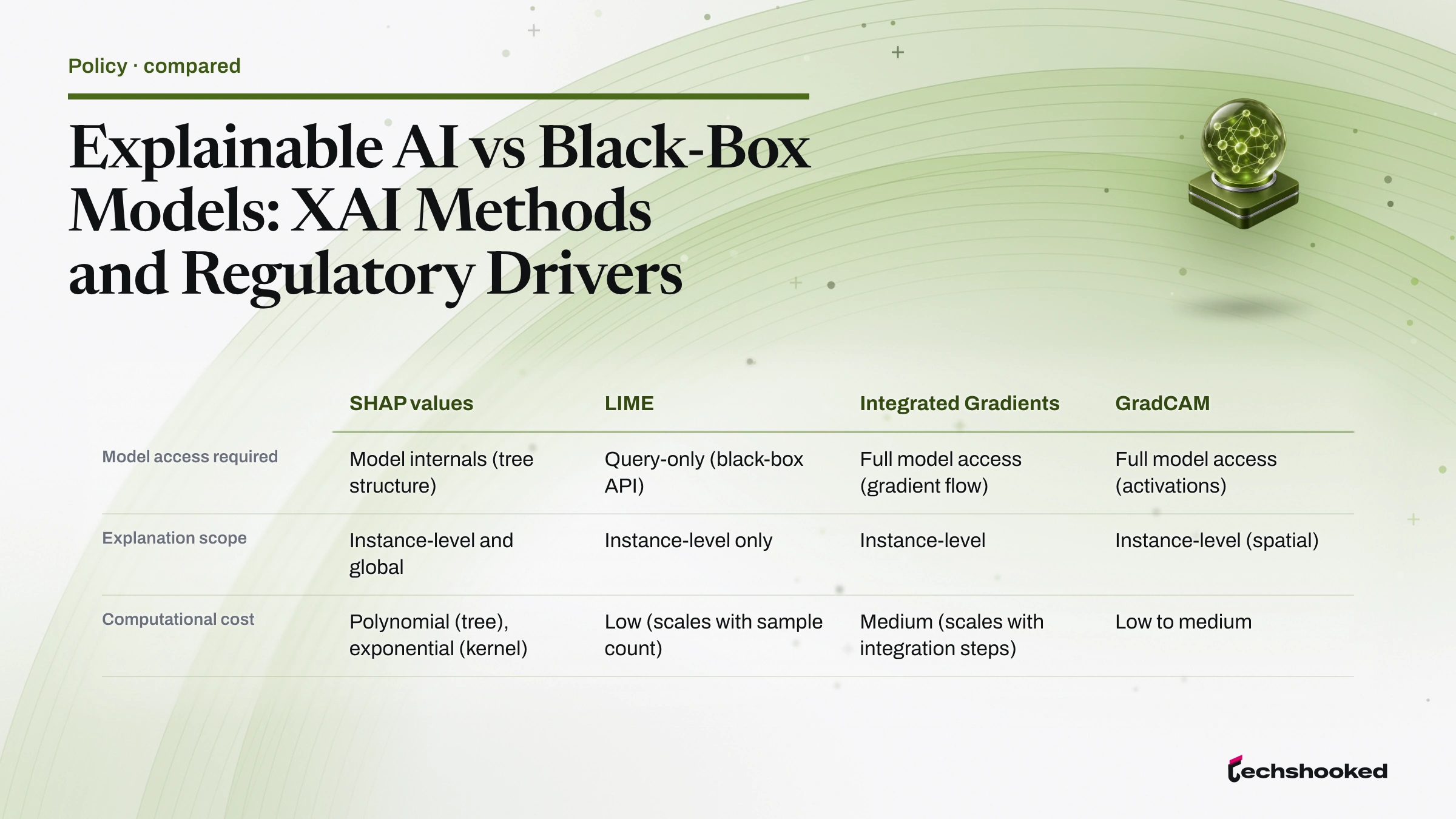
SHAP (SHapley Additive exPlanations) grounds feature attribution in cooperative game theory. Shapley values, borrowed from the economics literature, assign each feature a contribution score that represents its fair marginal contribution to the prediction across all possible feature subsets. SHAP values are additive: they sum to the difference between the model output for a given instance and the expected model output across the training distribution. The computational overhead is significant for tree-based models; the TreeSHAP algorithm reduces this from exponential to polynomial time for gradient boosting and random forests.
LIME (Local Interpretable Model-agnostic Explanations) takes a different approach. For a given prediction, LIME generates perturbed samples around the input, queries the black-box model for their outputs, and fits a locally linear surrogate model to the resulting input-output pairs. The surrogate's coefficients approximate feature importance in the neighborhood of that specific prediction. LIME is model-agnostic: it treats any model as a function mapping inputs to outputs and requires only the ability to query that function.
Gradient-based attribution methods, including Integrated Gradients and GradCAM for vision models, compute the gradient of the output with respect to the input and use it as a proxy for feature importance. These methods require access to model internals (weights and activations) and are most common in neural network contexts.
| Method | Model access required | Explanation scope | Computational cost |
|---|---|---|---|
| SHAP values (TreeSHAP) | Model internals (tree structure) | Instance-level and global | Polynomial (tree), exponential (kernel) |
| LIME | Query-only (black-box API) | Instance-level only | Low (scales with sample count) |
| Integrated Gradients | Full model access (gradient flow) | Instance-level | Medium (scales with integration steps) |
| GradCAM | Full model access (activations) | Instance-level (spatial) | Low to medium |
Regulatory Drivers: NIST AI RMF and EU AI Act

Two frameworks shape organizational obligations around explainable AI: the NIST AI Risk Management Framework and the EU AI Act. Their requirements overlap on AI transparency but differ in enforcement mechanism and jurisdictional scope.
The NIST AI RMF organizes AI governance into four functions: Govern, Map, Measure, and Manage. Three of those functions directly address black-box model risk. The Govern function establishes policies for documentation and disclosure. The Measure function defines how organizations score explainability as a trustworthiness characteristic alongside accuracy, privacy, robustness, and safety. NIST guidance under the Manage function states that legal requirements can mandate documentation, disclosure, and increased AI system transparency, and that tradeoffs between performance and transparency require regular assessment across the AI lifecycle (NIST AI RMF Playbook: Manage Function). The Govern and Measure playbooks operationalize those principles into testable controls (NIST AI RMF Playbook: Govern Function; NIST AI RMF Playbook: Measure Function).
The EU AI Act takes a risk-tiered approach. High-risk systems, as defined in Annex III of the regulation, must meet transparency and documentation requirements that include logging of automated decision-making, human oversight mechanisms, and information disclosure to affected persons. Systems used in employment screening, credit scoring, and critical infrastructure fall into this tier. The regulation does not mandate a specific XAI method; it mandates the outcome of explainability at the point of deployment and audit.
The FDA and EU AI regulations in healthcare article covers how these obligations translate into clinical AI governance specifically. For a broader view of accountability mechanisms, see the algorithmic accountability in AI systems explainer.
For engineering teams, the practical implications across both frameworks break down as follows:
- Document explanation methods at design time. Retroactively selecting a post-hoc method after deployment creates audit gaps. The NIST AI RMF Govern function expects AI transparency to be part of the system design record, not an afterthought.
- Map model risk tier before choosing an XAI method. The EU AI Act's risk classification determines which disclosure obligations apply. A model that does not meet the high-risk threshold has no mandatory explanation requirement under the regulation, though organizational risk appetite may still call for one.
- Score trustworthiness characteristics quantitatively. The NIST AI RMF Measure function calls for quantitative assessment of explainability alongside other trustworthiness characteristics. Log SHAP value distributions, LIME fidelity scores, or faithfulness metrics per model version and retain them for audit.
- Establish human review thresholds for automated decision-making. Both frameworks treat fully automated decision-making in high-stakes contexts as requiring explicit override mechanisms. Define and document those thresholds before deployment.
- Re-assess on model update. NIST guidance specifies that transparency tradeoffs require assessment across the AI lifecycle, not once at initial deployment. Treat explanation method validation as part of the model retraining pipeline.
Accuracy vs Interpretability: The Core Tradeoff
The assumption that explainable models always sacrifice accuracy is overstated; the tradeoff magnitude depends on the task domain and the explanation method chosen. Post-hoc explanation methods like SHAP and LIME sidestep the tradeoff entirely by operating on a trained black-box model without retraining it. The accuracy cost is zero because the model is unchanged; the overhead is computational, not predictive.
The genuine tradeoff emerges when model interpretability is required by design, not just by audit. A gradient-boosted ensemble trained on tabular data will typically outperform a single decision tree on the same dataset. Replacing it with the decision tree to achieve intrinsic interpretability reduces predictive accuracy by a margin that varies by domain and dataset complexity. In some domains, that margin is acceptable. In others, a post-hoc explanation of the black-box model is the right architectural choice for meeting regulatory requirements without conceding predictive performance.
| Approach | Accuracy impact | Explanation fidelity | Audit suitability |
|---|---|---|---|
| Intrinsically interpretable model (decision tree, linear model) | Potentially lower ceiling | Exact (model is explanation) | High: full trace available |
| Black-box model + SHAP post-hoc explanation | No impact (model unchanged) | Approximate (game-theoretic) | Medium: approximation, not trace |
| Black-box model + LIME post-hoc explanation | No impact (model unchanged) | Approximate (local surrogate) | Medium: locality limits global claims |
The AI impact on data privacy and ethics article addresses the broader ethical dimensions of model design choices that affect data subjects.
Choosing XAI Methods for Regulated Deployments
Selecting the right explainable AI method for a regulated deployment requires matching the explanation format to both the model architecture and the disclosure obligation. No single method covers every scenario; the choice is a function of three variables: model access level, explanation scope needed, and the regulatory standard in play.
For tree-based models in EU AI Act high-risk categories, TreeSHAP provides instance-level SHAP values with polynomial-time computation. The output maps directly to the feature attribution format that auditors expect: a ranked list of input features with signed contribution scores. This format satisfies the AI transparency requirement for individual decision disclosure under automated decision-making provisions.
For neural network models where gradient access is available, Integrated Gradients or GradCAM produce attribution maps at the input layer. These are harder to surface to non-technical auditors but satisfy the technical documentation requirement in the NIST AI RMF Govern function. For neural networks accessed only via API, LIME is the practical fallback, with the caveat that LIME explanations are local approximations and should not be aggregated into global model behavior claims.
Deployment decisions that involve automated decision-making affecting individuals require at minimum an instance-level explanation method, a retention policy for explanation logs, and a defined human review escalation path. The NIST AI RMF Manage function and the EU AI Act both treat these as non-negotiable for high-risk systems. Matching trustworthiness characteristics to the specific regulatory tier of the deployment is more defensible than applying a single method uniformly across all models in a portfolio.
- Classify the model under the EU AI Act risk tiers (or equivalent national regulation) before selecting an XAI method.
- Use TreeSHAP for gradient-boosted ensembles where instance-level feature attribution is required for audit.
- Use LIME for any model accessible only as a query API where gradient flow is unavailable.
- Use Integrated Gradients or GradCAM for neural networks requiring spatial or token-level attribution.
- Log explanation artifacts per prediction and version-control them alongside the model artifact.
Implementation Checklist
Before deploying a model in a regulated context, verify each of the following XAI implementation controls.
- Explanation method selected and documented in the system design record before deployment
- Post-hoc explanation or intrinsic interpretability matched to model architecture and regulatory tier
- Feature attribution output format validated against the disclosure requirement (instance-level vs global)
- SHAP value distributions or LIME fidelity scores logged per model version as part of the model interpretability audit trail
- Human review escalation path defined for automated decision-making outputs above defined risk thresholds
- Explanation method re-validation scheduled as part of the model retraining pipeline, consistent with NIST AI RMF lifecycle guidance
- Post-hoc explanation artifacts retained and version-controlled alongside model artifacts for audit access
References
- NIST AI RMF Playbook: Govern Function
- NIST AI RMF Playbook: Manage Function
- NIST AI RMF Playbook: Measure Function
- Rudin (2019): Stop Explaining Black Box Machine Learning Models for High-Stakes Decisions, Nature Machine Intelligence
- European Commission: European Approach to Artificial Intelligence
Further reading
Frequently Asked Questions
Does explainable AI always reduce model accuracy?
Not necessarily; the accuracy gap depends on the task domain and model family. Post-hoc methods such as SHAP and LIME add explanation overhead without retraining the underlying model, preserving accuracy. Intrinsically interpretable models like decision trees and linear regression do trade some predictive ceiling for transparency, making the tradeoff a design choice rather than an absolute constraint.
Which NIST AI RMF functions address black-box model risk?
The Govern, Manage, and Measure functions all address black-box risk directly. NIST guidance states that legal requirements can mandate documentation, disclosure, and increased AI system transparency, and that tradeoffs between performance and transparency require regular assessment across the AI lifecycle. Organizations use the Measure function to score explainability as a trustworthiness characteristic alongside accuracy and robustness.
What is the difference between interpretability and explainability in AI?
Interpretability means the model is transparent by design; explainability uses post-hoc methods to describe a black-box model after training. A linear regression is interpretable because its coefficients directly encode feature weights. A neural network explained via SHAP remains a black-box model at inference time; SHAP approximates which features drove each prediction without opening the model itself. The distinction matters for regulatory compliance because some frameworks require intrinsic interpretability, while others accept post-hoc explanation as sufficient.