AI error accountability is a governance framework that assigns documented responsibilities to developers, deployers, and operators for detecting, logging, and remediating failures in automated systems.
When an AI credit-scoring model denies a loan, when a medical-imaging classifier flags a false positive, or when a content-moderation system removes a legitimate post at scale, the question regulators and courts ask is the same: who was responsible, and what did they do when the failure was discovered? Without a structured accountability framework, that question goes unanswered, exposing every organization in the deployment chain to legal and reputational risk.
Why AI Error Accountability Matters Now
AI error accountability moved from a theoretical governance concern to a compliance obligation when the EU AI Act (Regulation EU 2024/1689) entered into force on 1 August 2024, as confirmed by the European Commission. At the same moment, the US Department of Justice made clear that automated systems do not dilute legal exposure, as software cannot excuse collusion or misconduct, and the same reasoning extends to AI-driven decisions with downstream harm.
Both developments converge on a single operational gap: most organizations have deployed AI systems without a matching accountability framework that covers the full lifecycle from training to decommission. Audit obligations, incident classification procedures, and role-specific documentation requirements now exist in binding law, not just voluntary best-practice guidance. The gap between deployed AI and documented risk management has become the primary compliance exposure for enterprises operating in regulated sectors.
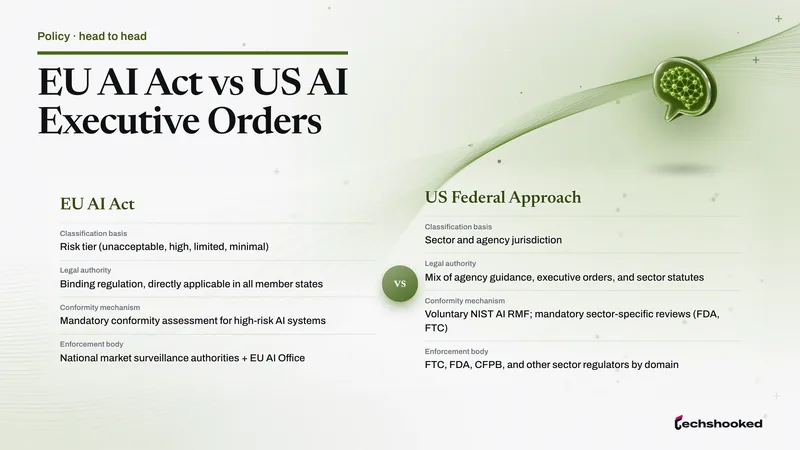
For the broader regulatory landscape comparing EU and US approaches, the EU AI Act vs US AI regulation comparison covers jurisdictional scope and enforcement differences.
The NIST AI RMF Govern Function Explained

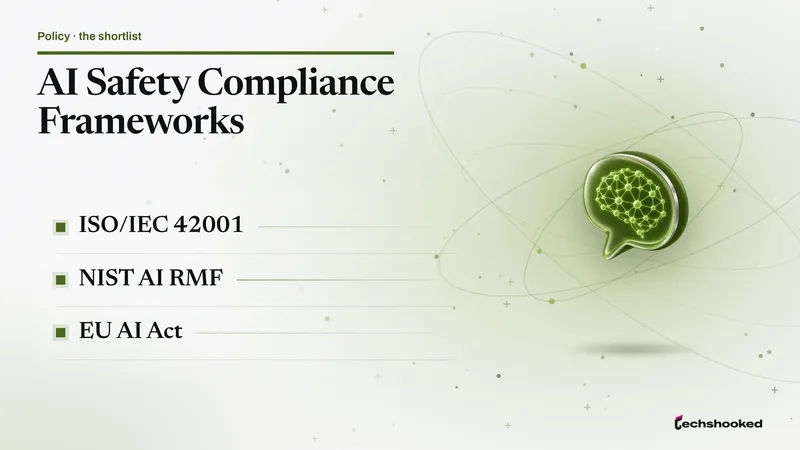
The NIST AI Risk Management Framework (AI RMF 1.0), published by the National Institute of Standards and Technology and available at nist.gov, organizes AI governance into four functions: Govern, Map, Measure, and Manage. Of the four, the Govern function is the structural foundation for AI error accountability because it defines the policies, roles, and oversight mechanisms that the other three functions depend on.
NIST AI RMF 1.0 treats the Govern function as the accountability backbone of an AI deployment program. The AI RMF Playbook for the Govern function identifies three structural requirements that operationalize accountability: clear chains of command, documented role assignments, and whistleblower policies that allow employees to surface AI failures without retaliation. Organizations that skip these structural requirements tend to discover the gap when an incident occurs and they cannot produce evidence of who was responsible for what.
The four Govern function pillars and their accountability roles break down as follows:
- Policies and procedures
- Written documentation specifying how AI systems are developed, approved, monitored, and retired. Policies establish the chain of command for escalating failures and define which system categories require human-in-the-loop (HITL) oversight at runtime.
- Organizational roles and responsibilities
- Explicit assignment of accountability to named roles: AI developers hold responsibility for model design and training data quality; deployers own configuration and integration; operators maintain runtime monitoring and audit logs. The AI RMF Govern function states that undefined roles weaken risk management and undermine post-incident traceability.
- Culture and accountability incentives
- Internal feedback mechanisms, whistleblower channels, and review cadences that make it safe and routine to report AI errors before they escalate. The NIST AI RMF Playbook recommends tiered reporting paths so that frontline operators can flag anomalies without bypassing management layers.
- Engagement with external stakeholders
- Disclosure obligations to affected users, regulatory bodies, and third-party auditors. For high-risk AI deployments, external engagement is not discretionary: the EU AI Act and US sector regulators both require documented disclosure processes.
The bias auditing guide for hiring algorithms examines how the Govern function's role-assignment requirements apply specifically to recruitment AI, where liability allocation between HR teams and vendors is a frequent audit finding.
EU AI Act High-Risk Obligations for Accountability
Under the EU AI Act, high-risk AI systems must satisfy strict requirements covering risk-mitigation controls, high-quality training data, clear user information, and mandatory human oversight. The regulation categorizes systems used in employment decisions, credit scoring, biometric identification, critical infrastructure, and several other domains as high-risk AI, subjecting them to obligations that go beyond general transparency requirements.
The accountability obligations for high-risk AI providers and deployers include the following requirements, as specified in the Commission's entry-into-force announcement:
- Conformity assessment: Providers must conduct a self-assessment or third-party assessment demonstrating that the system meets the Act's requirements before placing it on the EU market. The assessment must be documented and retained for post-market review.
- Technical documentation: Detailed records of system design, training datasets, intended purpose, performance benchmarks, and known limitations must be maintained and made available to regulators on request.
- Automatic logging of inputs: High-risk AI systems must log the inputs provided to them for a defined retention period so that post-incident audits can reconstruct the decision context. This is the regulation's most direct mandate for audit trail infrastructure.
- Human-in-the-loop controls: Deployers must implement HITL oversight mechanisms that allow natural persons to monitor system outputs, intervene when needed, and override automated decisions. The Act specifies that oversight must be effective, not merely nominal.
- Incident reporting to authorities: Serious incidents or malfunctions must be reported to the relevant national market surveillance authority. The Act defines reporting timelines and documentation requirements for this obligation.
- Post-market monitoring: Providers must actively collect and analyze performance data from deployed systems to detect emerging errors, distributional shift, and unintended harms, then act on findings within documented timeframes.
Healthcare deployments face an additional layer of sector-specific obligations; the FDA and EU AI regulations for healthcare AI covers how the EU AI Act's high-risk classification interacts with FDA Software as a Medical Device guidance.
Liability Allocation Across the AI Deployment Chain
AI error liability does not attach to a single actor; it distributes across the development, deployment, and operational lifecycle. Liability allocation is shaped by which actor had control over the specific system element that failed, what documentation they maintained, and whether they followed applicable framework requirements. The table below maps primary accountability areas and documentation obligations by role.
| Role | Primary Accountability Area | Key Documentation Obligation | Reference Framework |
|---|---|---|---|
| Developer | Model architecture, training data quality, and known capability limits | Model cards, dataset provenance records, test evaluations, and limitation disclosures | NIST AI RMF Govern function; EU AI Act technical-documentation requirements for high-risk providers |
| Deployer | Context-appropriate configuration, integration into business processes, and human-oversight controls | Deployment records, configuration change logs, HITL override procedure documentation | EU AI Act high-risk deployer obligations; NIST AI RMF Manage function |
| Operator | Runtime monitoring, audit trail maintenance, and frontline incident reporting | Incident logs, anomaly reports, whistleblower channel records, escalation histories | NIST AI RMF Playbook (Govern); EU AI Act serious-incident reporting obligations |
| Third-party integrator | API access controls, data pipeline integrity, and downstream harm from integration decisions | Integration agreements, data-processing records, access audit logs | Contractual liability allocation; NIST AI RMF supply-chain risk management guidance |
A key principle in liability allocation is that contractual indemnification agreements between developers and deployers do not shield either party from regulatory enforcement. The DOJ's position, outlined in remarks on AI and privacy enforcement, is that accountability obligations run with the harm, regardless of upstream contractual arrangements. Organizations that rely solely on vendor indemnification without maintaining their own documentation expose themselves to independent regulatory liability.
Audit Trail Design for AI Incident Response
A well-designed audit trail is the evidentiary backbone of any AI error accountability framework. When a failure occurs, regulators, legal counsel, and internal review boards need the same thing: a complete, tamper-evident record of what the system received, what it produced, what harm resulted, and what the organization did in response. Without structured logging, incident response collapses into reconstruction from memory, which satisfies neither the EU AI Act's documentation mandates nor the NIST AI RMF's traceability requirements.
The minimum log fields that an AI incident response record must contain are:
- System version identifier: The precise model version and configuration state active at the time of the incident, including any fine-tuning layers, prompt templates, or post-processing rules applied.
- Input context: The data or prompt provided to the system, with sufficient detail to reproduce the decision context without relying on external memory. For systems processing personal data, input logs must comply with applicable data-minimization rules.
- Output produced: The system's response, decision, score, or recommendation, recorded verbatim. For high-risk AI systems, the regulation's logging mandate covers precisely this field.
- Harm or near-miss observed: A structured description of the adverse outcome or potential adverse outcome, classified against a pre-defined incident severity matrix. Near-miss logging is a NIST AI RMF Playbook recommendation that most organizations omit until a serious incident forces a retroactive review.
- Affected population: The number and category of users, customers, or third parties impacted by the error. This field drives severity classification and determines whether the EU AI Act's serious-incident reporting threshold is met.
- Remediation taken: The corrective actions applied, with timestamps: system rollback, model update, HITL override, user notification, or regulatory disclosure. Remediation records are the primary evidence that the organization met its post-incident obligations under both the AI RMF and the EU Act.
Retention periods for audit logs should be set by the most stringent applicable requirement. The EU AI Act specifies input logging retention as part of post-market monitoring obligations, and sector-specific regulations (financial services, healthcare, critical infrastructure) may impose longer periods. A defensible baseline for high-risk AI deployments is ten years for incident records and three years for routine decision logs, though legal counsel should confirm against the applicable regulatory regime.
Implementing Human-in-the-Loop Controls
Human-in-the-loop controls are the operational mechanism that gives accountability frameworks practical enforcement at runtime. Designing HITL oversight as a compliance checkbox produces controls that are present on paper but inert in practice. Effective implementation requires four concrete engineering and operational decisions.
- Override trigger design: Define the conditions under which the system must pause and route the decision to a human reviewer. Triggers should be based on confidence thresholds, decision impact classifications, or affected-population size, not ad hoc judgment. Document the trigger logic in version control alongside the model code so that audit trail records can reference the specific trigger version active during an incident.
- Escalation path documentation: Map the organizational chain of command for each trigger type: who receives the escalation, what information accompanies it, what the review window is, and what authority the reviewer holds. The NIST AI RMF Playbook's Govern function guidance requires these paths to be written down, not merely understood informally. An undocumented escalation path is an audit finding.
- Operator training requirements: HITL controls fail when operators lack the domain knowledge to evaluate the system's output. Training requirements must specify the minimum competency for reviewers, the frequency of refresher training, and how competency is assessed. For high-risk AI systems under the EU AI Act, deployers bear explicit responsibility for ensuring operator training is adequate.
- Review cycle cadence: Periodic review of HITL trigger thresholds and escalation paths is part of the accountability framework's maintenance requirement. As system behavior drifts or deployment context changes, trigger logic calibrated at launch becomes miscalibrated. A documented review cycle (quarterly for high-risk AI, annually at minimum for lower-risk systems) closes this drift gap.
A common failure mode is implementing human-in-the-loop controls that technically route decisions to a human but give reviewers neither the time nor the information to make a meaningful decision. Rubber-stamp review is not HITL oversight under the regulation's effective oversight standard. The accountability framework must specify minimum review quality, not just review occurrence.
Building an AI Accountability Policy Template
A reusable AI accountability policy template should codify six elements that satisfy both NIST AI RMF Govern and EU AI Act high-risk requirements. Organizations that build these six elements into a standing policy avoid reconstructing governance documentation reactively when a regulator or auditor requests it.
- Role definitions: Named accountability assignments for each actor in the deployment chain, with explicit statements of what each role owns, what decisions each role may make unilaterally, and which decisions require escalation. Role definitions are the starting point for liability allocation in any post-incident review.
- Incident classification matrix: A tiered taxonomy of AI failures mapped to response protocols. At minimum: severity levels (near-miss, low, medium, high, critical), response timelines for each level, and the escalation path triggered at each threshold. The matrix should align with the EU AI Act's serious-incident definition so that reporting timelines are unambiguous.
- Audit trail schema: The standardized log record format, mandatory fields, data types, retention periods, and access controls for incident and decision logs. A documented schema is the prerequisite for audit trail records that hold up under regulatory review. Version the schema alongside model releases so that logs can be parsed accurately regardless of when they were generated.
- Escalation paths: Written descriptions of the chain of command for each incident severity level, including who has authority to trigger external regulatory disclosure, halt system operation, or initiate a third-party audit. For risk management programs that cross organizational boundaries, escalation paths must name specific roles at each entity, not just generic job titles.
- Review cadence: A documented schedule for revisiting role assignments, incident classification thresholds, audit trail schemas, and HITL trigger logic. Governance debt accumulates when policy documents are written once and left unchanged as systems evolve. The NIST AI RMF treats ongoing review as a Govern function obligation, not an optional improvement.
- Whistleblower channel: A documented, protected reporting mechanism for employees and contractors to raise AI error accountability concerns without retaliation risk. The NIST AI RMF Playbook specifies this as a Govern function component. The channel must be operationally distinct from standard management reporting lines, with documented protections against retaliation and a defined review process for received reports.
Organizations can adapt this template to sector-specific requirements by layering additional obligations on top of the six-element baseline. Financial services firms subject to model risk management guidance, healthcare providers subject to FDA Software as a Medical Device requirements, and critical infrastructure operators subject to sector-specific cybersecurity rules all face additional documentation obligations that fit within this structural model. The six elements provide the accountability framework skeleton; sector-specific requirements provide the flesh.
References
- NIST AI Risk Management Framework (AI RMF 1.0), National Institute of Standards and Technology
- NIST AI RMF Playbook, Govern Function, AI Resource Center
- EU AI Act Enters Into Force (1 August 2024), European Commission
- DOJ Remarks on AI and Algorithmic Accountability, Department of Justice
- DOJ Remarks on AI and Privacy Enforcement, Department of Justice
Further reading
Frequently Asked Questions
Does NIST AI RMF compliance satisfy EU AI Act high-risk obligations?
No. NIST AI RMF 1.0 is voluntary US guidance, while the EU AI Act (Regulation EU 2024/1689) is binding law with enforceable penalties. Aligning with the RMF Govern function covers similar ground on documentation and oversight but does not substitute for a formal conformity assessment under the EU Act. Organizations deploying high-risk AI in EU markets must satisfy both frameworks independently.
Who is the accountable party when an AI system causes harm?
Accountability splits across the deployment chain: developers own system design and training data quality, deployers own configuration and human-oversight controls, and operators own audit trail maintenance at runtime. The NIST AI RMF Govern function explicitly states that unclear chains of command weaken risk management, so documented role assignments are the first governance requirement.
What records does an AI incident response process require?
At minimum, an AI incident log should capture the system version, input context, output produced, the harm or near-miss observed, the affected population, and the remediation taken. The NIST AI RMF Playbook recommends whistleblower-safe reporting channels alongside formal incident registers. EU AI Act high-risk provisions add mandatory logging of inputs to the AI system for a defined retention period to support post-incident audit.