AI safety compliance is a structured engineering discipline that aligns AI system design, governance controls, and conformity assessments with internationally recognized frameworks such as ISO/IEC 42001 and the NIST AI RMF. Organizations building or deploying AI systems face obligations from multiple instruments simultaneously: a voluntary risk management framework like the NIST AI Risk Management Framework (AI RMF), a certifiable management system standard in ISO/IEC 42001, and binding product-level law under the EU AI Act. Each instrument addresses a different layer of the governance stack, and a coherent compliance program treats them as complementary rather than redundant.
The AI Safety Standards Landscape

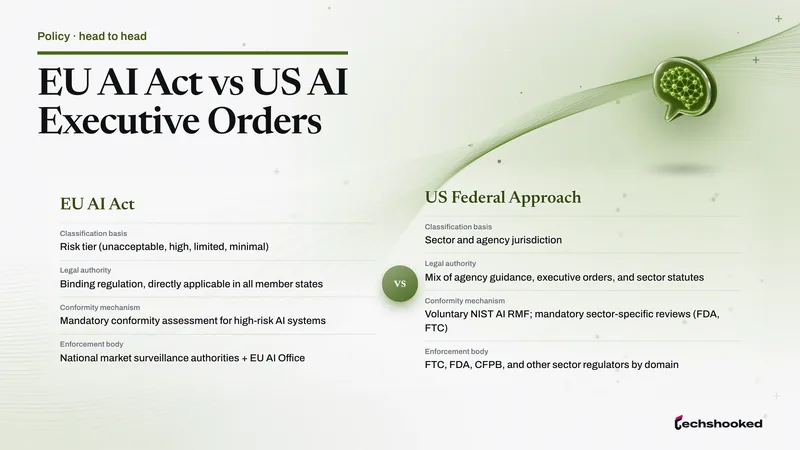
No single global certification covers every AI use case; instead, three complementary instruments define the current AI safety compliance landscape: ISO/IEC 42001 for management system certification, the NIST AI RMF for risk governance, and the EU AI Act for legally binding product obligations. Understanding where each instrument's authority starts and stops prevents over-reliance on any one framework. ISO/IEC 42001 certifies organizational management controls, not individual model outputs. The NIST AI RMF provides a structured methodology for identifying, measuring, and managing AI risk, with no certification artifact attached. The EU AI Act imposes statutory requirements on providers and deployers based on a system's risk classification. Coverage for FDA and EU AI regulations in healthcare adds further sector-specific layers on top of these foundations.
| Framework | Type | Certifiable | Scope | Issuing body |
|---|---|---|---|---|
| ISO/IEC 42001 | Management system standard | Yes, third-party audit | Organizational AI governance | ISO/IEC |
| NIST AI RMF | Voluntary guidance framework | No NIST-issued certificate | AI risk identification and management | NIST |
| EU AI Act | Binding regulation | Conformity assessment required for high-risk | AI products placed on EU market | European Union |
ISO/IEC 42001 Certification Requirements
ISO/IEC 42001 specifies requirements for establishing, implementing, maintaining, and continually improving an AI management system within an organization. Published in 2023, the standard (ISO/IEC 42001:2023 overview) follows the ISO Annex SL high-level structure common to ISO 27001 and ISO 9001, which means organizations with existing management system certifications can integrate AI management system (AIMS) controls into their existing governance architecture rather than building a separate silo. The certification process runs through an accredited third-party certification body that audits conformance against the standard's requirements and its Annex A control set. Annex A provides 38 controls spanning AI system impact assessment, data governance, human oversight, and system performance monitoring.
Certification scope definition is the first substantive decision. Organizations must define which AI systems, processes, and organizational units fall inside the AIMS boundary before any gap analysis begins. A narrowly scoped AIMS covering only one product line is achievable faster but provides less assurance to customers operating across multiple deployments. The technical documentation produced during scoping, risk treatment, and control selection feeds directly into the evidence package presented to the certification auditor. Certification to ISO/IEC 42001 does not, on its own, satisfy EU AI Act conformity assessment obligations for high-risk systems, though control overlap between Annex A and Act requirements is substantial.
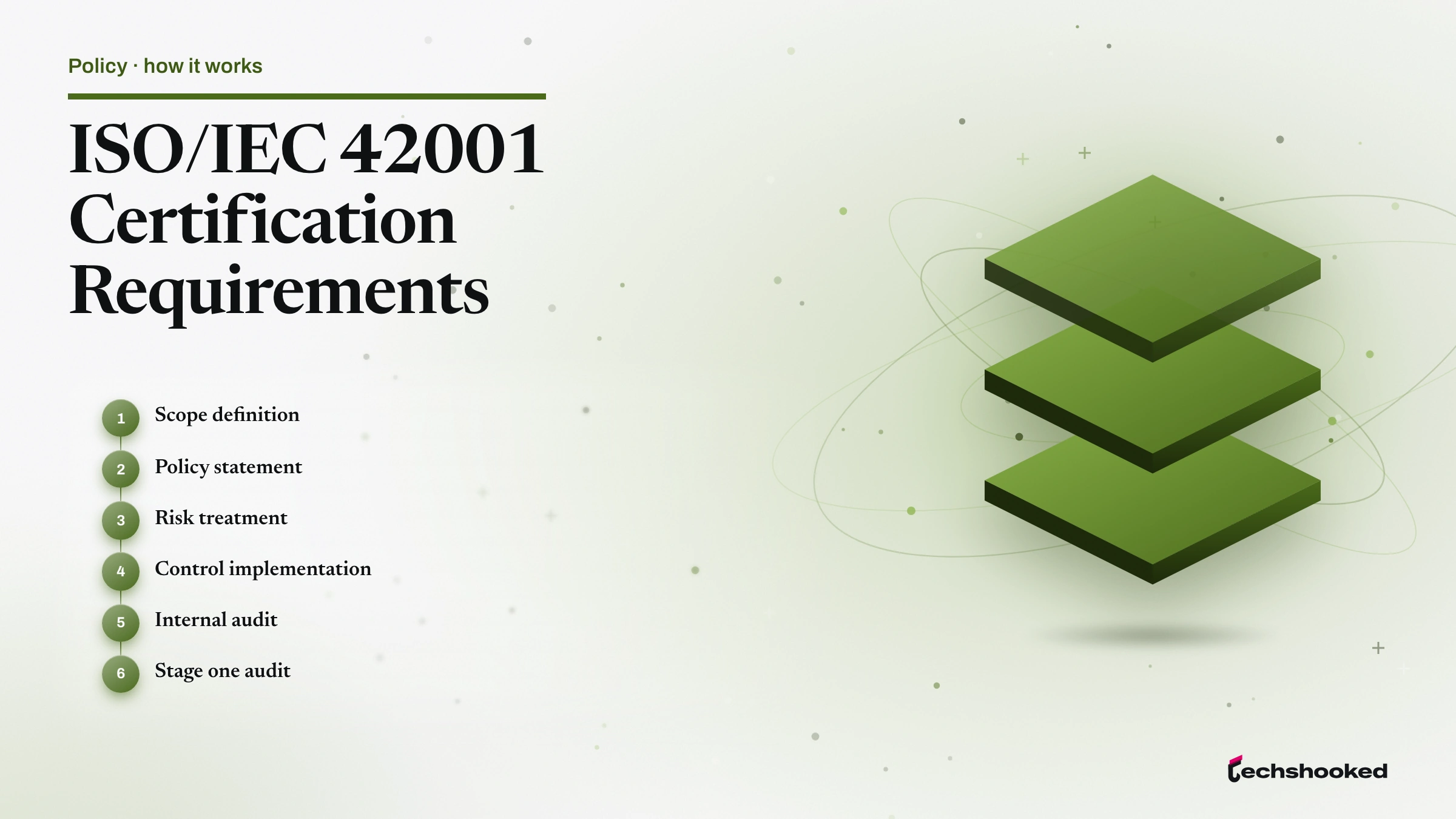
The certification sequence follows these steps:
- Scope definition: Identify which AI systems and organizational units fall within the AIMS boundary and document the rationale.
- Policy statement: Establish a written AI policy approved by top management that sets objectives, risk appetite, and accountability assignments.
- Risk treatment: Conduct an AI system impact assessment and select controls from Annex A to treat identified risks to acceptable residual levels.
- Control implementation: Deploy selected controls covering data governance, human oversight, model performance, and incident response procedures.
- Internal audit: Run a documented internal audit cycle against all standard clauses and Annex A controls before engaging external auditors.
- Stage one audit: Certification body reviews documentation and readiness; major nonconformities identified at this stage must be closed before Stage two.
- Stage two audit: On-site (or remote) evidence review and conformity determination; successful completion results in ISO/IEC 42001 certification.
Applying the NIST AI RMF Govern-Map-Measure-Manage Cycle
The NIST AI RMF 1.0 organizes AI risk management around four core functions: Govern, Map, Measure, and Manage. Released by the National Institute of Standards and Technology in January 2023 (NIST CSRC AI RMF resources), the risk management framework is voluntary guidance, not a regulatory mandate. No NIST-issued certificate exists; adoption is self-declared or confirmed through third-party audits using the accompanying AI RMF Playbook. The framework is designed to be sector-agnostic and applies equally to organizations building foundation models, deploying third-party AI components, or procuring AI-enabled services.
- Govern
- Establishes organizational policies, accountability structures, and culture for AI risk management. Govern activities define who owns AI risk decisions, how risk tolerance is set, and which processes apply across the AI lifecycle. Without functioning Govern controls, the other three functions lack coordination.
- Map
- Identifies and categorizes AI risks in context. Map activities produce a risk inventory covering intended uses, stakeholder impacts, data dependencies, and potential failure modes for each AI system. The output feeds the Measure function with a concrete scope of risks to evaluate.
- Measure
- Applies quantitative and qualitative methods to assess the severity and likelihood of identified risks. Measurement approaches include bias evaluations, adversarial robustness testing, explainability assessments, and performance benchmarking across deployment conditions.
- Manage
- Implements risk treatment decisions: accept, mitigate, transfer, or avoid. Manage activities include deploying technical controls, documenting residual risk acceptance, and maintaining post-market monitoring routines that detect performance degradation or new risk vectors after deployment.
The four-function cycle is iterative. Organizations that complete a Manage cycle feed findings back into Govern policy updates and Map scope revisions, creating a continuous improvement loop. Teams using the NIST AI RMF alongside ISO/IEC 42001 often map AIMS Annex A controls to AI RMF subcategories to reduce duplication in evidence collection.
EU AI Act Conformity Assessment Pathways
The EU AI Act imposes legally binding obligations on providers and deployers of AI systems, with the strictest requirements applied to high-risk AI systems listed under Annex III. Adopted in 2024 with a phased implementation schedule, the Act stratifies AI systems into four risk tiers: prohibited systems, high-risk systems, limited-risk systems, and general-purpose AI (GPAI) models. Each tier carries distinct obligations, and misclassifying a system's risk tier is itself a compliance failure. The conformity assessment process differs depending on whether a notified body (an accredited third-party assessor) must be involved or whether self-assessment is permissible.
Key obligations by risk tier:
- Prohibited systems: Banned outright regardless of mitigation controls. This category includes real-time remote biometric identification in public spaces (with narrow law-enforcement exceptions), social scoring systems, and AI that exploits psychological vulnerabilities to manipulate behavior.
- High-risk AI systems (Annex III): Subject to full conformity assessment before market placement. Requirements include a risk management system, data governance controls, technical documentation covering design and development decisions, human oversight mechanisms, accuracy and robustness measures, and post-market monitoring obligations. Domains covered under Annex III include critical infrastructure, employment and worker management, education, essential services access, law enforcement, migration management, and administration of justice.
- Limited-risk systems: Face transparency obligations only. Providers of chatbots and AI-generated content must disclose the AI origin to users; no conformity assessment is required.
- GPAI models: General-purpose AI model providers face separate obligations scaled by model capability, including transparency reporting and, for models posing systemic risk, adversarial testing and incident reporting requirements.
For high-risk systems, technical documentation must be maintained throughout the system lifecycle and updated whenever the system undergoes a substantial modification. Human oversight requirements mean providers must design systems so that natural persons can understand, monitor, and where necessary override AI outputs. Post-market monitoring plans must be submitted as part of the conformity assessment package and activated from the date of market placement.
Cross-Framework Compliance Workflow
Organizations operating across jurisdictions typically need to satisfy obligations from more than one framework simultaneously, which requires a unified internal governance structure rather than three separate compliance tracks. AI safety compliance built around three independent workstreams creates duplicated evidence, inconsistent risk registers, and control gaps at the seams between frameworks. The more efficient approach maps shared control objectives to a single policy layer and produces evidence artifacts that satisfy multiple frameworks from one source. Topics such as algorithmic accountability in AI systems sit directly at this intersection, requiring governance decisions that span the AIMS, the AI RMF, and the Act simultaneously.
A unified compliance workflow follows this sequence:
- Asset inventory and classification: Catalog all AI systems in scope. Assign each system an EU AI Act risk tier, an AIMS scope designation, and an AI RMF risk category. This step produces the master AI inventory that all three frameworks require in different forms.
- Unified risk register: Merge risk assessment outputs from ISO/IEC 42001 Clause 6 (planning), the NIST AI RMF Map function, and the Act's Article 9 risk management system requirements into a single risk register. Control cross-references prevent teams from treating the same risk three times under different labels.
- Data governance framework: Establish data governance policies covering training data quality, lineage documentation, and access controls. ISO/IEC 42001 Annex A controls on data, the AI RMF Govern subcategories on data management, and the Act's Article 10 data and data governance requirements share significant overlap; one policy set satisfies all three.
- Technical documentation package: Build a single technical documentation repository structured to meet ISO/IEC 42001 internal audit requirements, AI RMF Measure evidence standards, and EU AI Act Annex IV documentation requirements. Version-control the repository so updates trigger a review against all three frameworks.
- Human oversight and monitoring controls: Implement human oversight procedures and post-market monitoring protocols once, then map them to the relevant clause in each framework. ISO/IEC 42001 Annex A.6 covers human oversight; the Act's Article 9 and Article 72 specify monitoring and reporting obligations; the AI RMF Manage function governs residual-risk acceptance and ongoing surveillance.
- Audit and continuous improvement: Run a single integrated internal audit cycle that generates findings relevant to ISO/IEC 42001 Stage one/2 audit preparation, AI RMF self-assessment, and EU AI Act conformity assessment readiness. Schedule reviews to precede each framework's external assessment cycle.
Gaps and Limitations of Current AI Safety Standards
Current AI safety standards address organizational governance and product conformity, but leave several technical areas without settled requirements. Practitioners building an AI safety compliance program should understand where the frameworks stop rather than assume full coverage from any combination of them.
- No universal AI safety certification: No single credential certifies an AI system as safe across all jurisdictions and use cases. ISO/IEC 42001 certifies the organizational AI management system; the EU AI Act conformity assessment certifies a specific system's conformance with Act requirements for a defined intended purpose. A system deployed in a new context may require a fresh assessment even if existing certifications are current.
- Model-level technical gaps: ISO/IEC 42001 Annex A does not specify technical benchmarks for model robustness, fairness thresholds, or explainability depth. Organizations must source these from domain-specific standards (IEEE, sector regulators, NIST guidance documents) and reference them within their AIMS control framework.
- NIST AI RMF is guidance only: The risk management framework carries no regulatory authority. Adopting it fully does not create a legal safe harbor under the EU AI Act or any other jurisdiction's AI regulation. Courts and regulators evaluate actual risk outcomes, not framework adoption status.
- Sector-specific overlay requirements: High-risk AI systems in medical devices, aviation, nuclear, and financial services face sector-specific regulations that operate independently of the Act's general conformity assessment pathway. The EU AI Act explicitly preserves existing sector regimes; providers must satisfy both the Act and the applicable sector law simultaneously.
- Standards lag model capability: ISO/IEC 42001:2023 and NIST AI RMF 1.0 were developed against the AI capability landscape of their publication period. Large language models, multimodal systems, and autonomous agents present risk profiles, such as emergent behavior and indirect prompt injection, that post-date both documents. Standards bodies are revising and extending guidance, but gaps remain for frontier AI AI safety compliance.
- Post-market monitoring maturity: The EU AI Act requires post-market monitoring systems for high-risk AI, but neither the Act nor existing standards specify minimum monitoring frequency, alert thresholds, or incident severity classifications in operational detail. Organizations must operationalize these requirements using internal engineering judgment until sector-specific technical specifications are finalized.
References
- ISO/IEC 42001, Information technology: Artificial intelligence management systems (ISO)
- ISO/IEC 42001:2023 Overview, PUB200427 (ISO)
- NIST CSRC: Risk Management Framework Courses and Resources (NIST)
Further reading
Frequently Asked Questions
What is ISO/IEC 42001 and who needs it?
ISO/IEC 42001:2023 is a certifiable AI management system standard that any organization developing or deploying AI systems can pursue. It defines controls for risk management, data governance, and human oversight. Third-party certification bodies audit conformance against the standard. Unlike a product-level approval, it certifies the organizational management system, not an individual AI model.
Does NIST AI RMF certification exist?
NIST AI RMF 1.0 is voluntary guidance, not a certification regime. Organizations adopt the framework internally to structure their AI risk management practices across four functions: Govern, Map, Measure, and Manage. There is no NIST-issued certificate; conformance to the RMF is self-declared or verified through third-party audits using the accompanying Playbook.
Which AI systems require EU AI Act conformity assessment?
High-risk AI systems under Annex III of the EU AI Act require a conformity assessment before market placement. This covers systems used in critical infrastructure, employment screening, education, law enforcement, and similar domains. Lower-risk systems face transparency obligations only; general-purpose AI models have separate provider obligations under the Act.