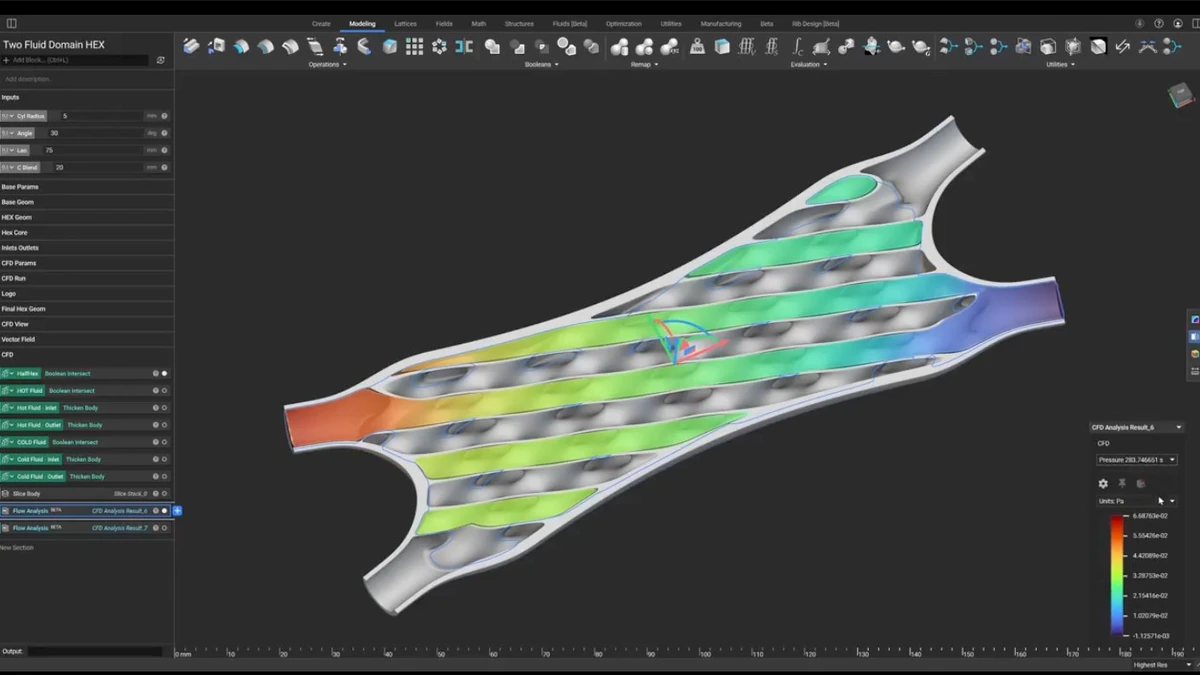
CoreWeave and nTop ran 10,000 large-eddy computational fluid dynamics simulations of a drone wing in just 32 hours, a pace that clears a stretch goal from NASA's CFD Vision 2030 Study years ahead of the study's own timeline. The joint project paired nTop's GPU-native CFD solver, nTop Fluids, with CoreWeave's NVIDIA GPU cloud to test how much simulation work a single aerodynamicist could get through in roughly a day.
The team built a fully parametric long-endurance fixed-wing drone in nTop, then generated 2,400 planform geometry variants and tested each across five angles of attack, for 10,000 total Large-Eddy Simulations (LES). LES is the higher-fidelity alternative to the Reynolds-Averaged Navier-Stokes methods most engineering teams default to. RANS averages turbulence into statistical shortcuts, which is fast but loses detail; LES resolves the large turbulent structures directly, at far greater compute cost. That expense is why LES has traditionally stayed confined to one-off capability studies rather than large design sweeps.
That NASA benchmark called for engineers to be able to "conceive, create, analyze, and interpret a large ensemble of related simulations in a time-critical period (e.g., 24 hours)." According to CoreWeave, the entire 10,000-run campaign executed headless, with no manual intervention needed to work around software or infrastructure failures along the way.
nTop, whose solver generated and simulated the drone geometries, published its own account of the collaboration, framing the run as evidence that GPU-native geometry generation can keep pace with high-fidelity CFD at scale rather than bottlenecking it. Both companies point to the same underlying shift: cloud-native GPU infrastructure taking on workloads that used to require dedicated on-premise HPC clusters.
Beyond the raw simulation count, CoreWeave frames the exercise as a data-generation problem. A design sweep this large, run at LES resolution, is big enough to train machine-learning surrogate models that predict aerodynamic performance from geometry parameters alone, without a fresh simulation for every query. CoreWeave positions that surrogate-modeling step as the bridge from classical CFD into what it calls physical AI, pairing its bare-metal GPU clusters and Weights & Biases experiment tracking with simulation-heavy engineering workloads in aerospace, automotive, and energy.
The work is a proof of concept rather than a shipped product, and the published dataset covers one drone airframe class across a fixed design-of-experiments grid rather than the open-ended design problems engineering teams actually face. It is nonetheless a concrete data point for cloud providers courting engineering-simulation customers who have historically stayed on dedicated HPC hardware, and for nTop's pitch that a GPU-native solver can outrun CPU-bound CFD tools on throughput alone.