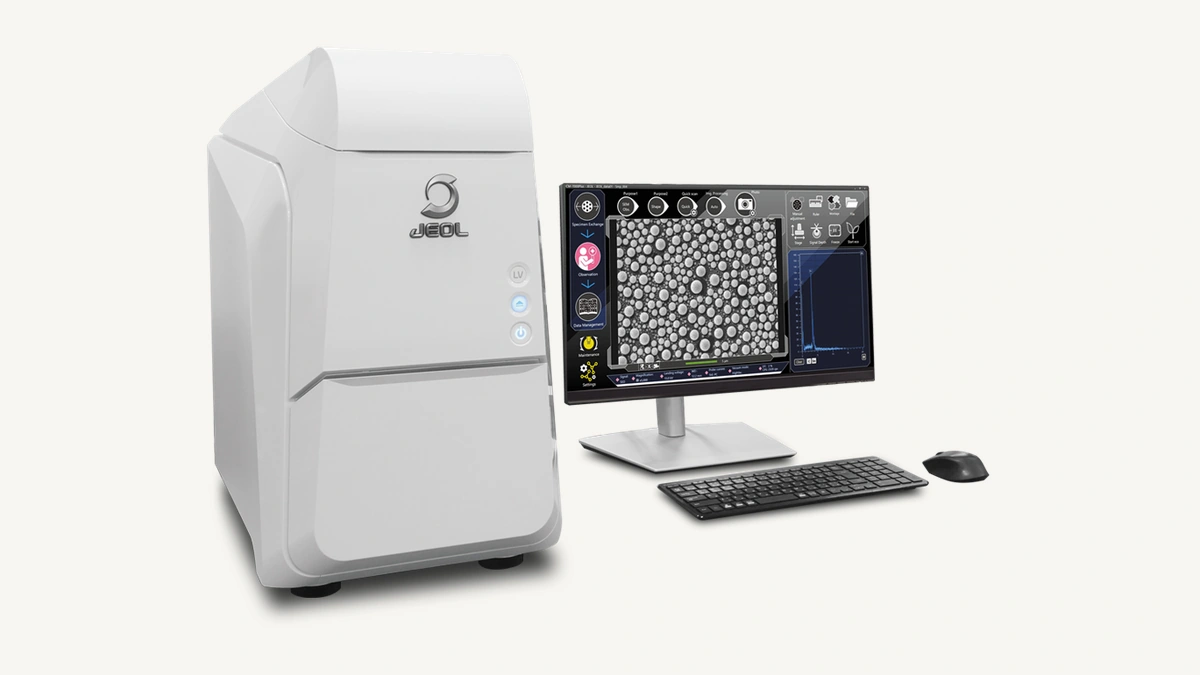
JEOL has updated the benchtop scanning electron microscope it sells for factory quality control and teaching labs, adding a higher accelerating voltage that the company says tightens resolution to 6 nanometers. The revised instrument is the JCM-7000Plus NeoScope, which JEOL began selling on September 1.
Benchtop scanning electron microscopes trade the resolution and configurability of a floor-standing instrument for a unit that sits on a desk and runs from a simple interface, which has made them common in contamination and failure analysis, production inspection, and school and university labs. JEOL sells its line as the NeoScope, and frames the JCM-7000Plus NeoScope as a way to move closer to research-grade imaging without adding operator training.
The main hardware change is the higher accelerating voltage. JEOL lists a new 20 kV landing voltage and says the added energy improves resolution to 6 nm for secondary-electron images and 8 nm for backscattered-electron images. The company also lists a new backscattered-electron detector that it says improves image quality. Higher accelerating voltages generally resolve finer detail, but they can worsen charging and beam damage on non-conductive or fragile samples, one reason compact instruments have tended to keep the setting lower.
On the software side, JEOL carried over the JCM-7000 interface, including Zeromag, which switches from an optical view to an electron image as the operator zooms in. The Plus adds Neo Action, an automation mode JEOL says can step through imaging conditions, adjust focus, and move the stage on a preset routine with no operator present. Alongside the existing Live Analysis, Live Map, and Live 3D functions that run measurements during observation, it adds Live Particle, which sizes and counts particles while the sample is on screen, and Live Report, which gathers data across a moving field of view and produces a report. JEOL says Live Report is normally reserved for high-end field-emission systems.
JEOL has not published a price for the JCM-7000Plus, which is usual for laboratory instruments quoted directly to buyers. It has set a sales target of 300 units a year, pointing to a mainstream lab tool rather than a specialist release. The open question is whether a faster accelerating voltage and more automation are enough to hold buyers who might otherwise put the same budget toward a used floor-standing SEM that still out-resolves any benchtop.