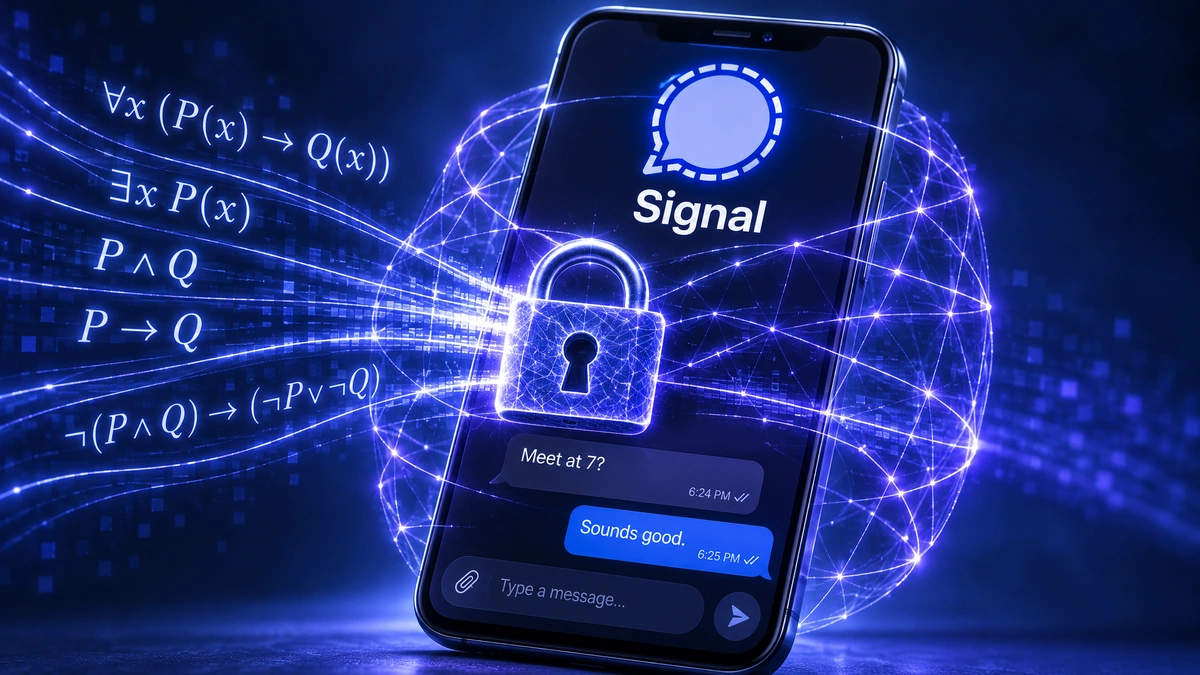
Google DeepMind says AI agents have produced machine-checked mathematical proofs that a compiled build of libsignal, the open-source library that implements the Signal protocol, keeps key security promises of Signal's one-to-one chats. Earlier formal proofs about Signal mostly examined the protocol's design or parts of its code; these make their claims about the machine code itself. According to DeepMind, human experts and AI models agreed on what to prove, and agents running its Gemini 4 Carbon model then wrote the proofs in Lean, an open-source proof language whose small trusted kernel checks every proof.
The technical paper names the properties. Forward secrecy means a key stolen today cannot unlock earlier messages. Post-compromise security means a conversation locks out an intruder who stole its state once fresh keys are exchanged, provided the intruder stays passive during that exchange. Authentication means each side is talking to who it thinks it is. The proofs cover the PQXDH handshake that sets up a Signal session and the Triple Ratchet that keeps changing its keys. The result is much narrower than a proof that Signal is secure, and the paper says so.
The proofs describe a command-line build of libsignal, not the Signal apps
The theorems describe one program: libsignal-cli, a small command-line test program the researchers built around libsignal, compiled for Linux on 64-bit Arm. The theorems cover starting a session, sending and receiving; key generation is not verified. Group messaging is left as future work.
The authors link the unmodified libsignal code into the test program, compile it with the standard Rust compiler, and state their theorems about runs of that executable rather than about the Rust source. That means the compiler no longer has to be trusted: according to the paper, a compiler or Rust bug that broke a formalized property would make the proofs fail.
DeepMind's two accounts of the reach differ. DeepMind says the agents proved the properties "down to the exact code running on devices." The paper says its results concern its own build, "not Signal's own applications." It adds that Signal's Android and iOS apps run the same Rust code, and that the theorems carry over as long as those environments preserve the behavior the test program exercises. The proofs do not establish that carry-over. It depends on trusting the compiler settings, the linking and the operating system.
Two proofs cover two kinds of attacker, and only one addresses quantum computers
The paper proves security twice, in the field's two standard styles. A symbolic proof treats the cryptographic primitives as perfect black boxes and checks the protocol's logic against every move an attacker could make. A computational proof bounds an efficient attacker's chance of success by how hard the underlying mathematics is to break. The symbolic attacker controls the network and the server and can steal long-term keys, prekeys or a party's whole session state. Against it, ten theorems establish forward secrecy and post-compromise security of message keys, handshake authentication, resistance to an attacker who uses a stolen key to impersonate others to its owner, and a handshake key that stays secret even if a quantum attacker later breaks the classical Diffie-Hellman exchange.
In the symbolic scenario, each party already holds the other's genuine identity key, so the step where an app accepts a contact's key on first sight is never exercised. It covers two honest parties, leaves out single-use post-quantum prekeys, and does not cover the quantum-resistant recovery that SPQR, the post-quantum ratchet Signal added in October 2025, is meant to provide.
The computational proof bounds a classical attacker's advantage against confidentiality and authenticity for PQXDH composed with the Triple Ratchet. The paper says the bounds give no guarantee against a quantum adversary, do not model multiple devices, and stop saying anything useful for a single session of about 25,000 messages in the worst case it considers. Within these proofs, protection against a future quantum computer comes only from the symbolic handshake result.
Humans approved every specification, and Gemini agents wrote all of the proof code
DeepMind says human experts reviewed every specification, the formal statements of what the code must guarantee. Per the paper, researchers drafted them with agents powered by Gemini Carbon and Anthropic's Claude Opus, an agent from another model family checked each draft for faithfulness and strength, and only approved specifications became proof targets.
The authors write that most of their effort went into those specifications, and that none of them wrote any proof code. Gemini Carbon agent teams produced about 6.5 million lines of machine-checked Lean proof (over six million in DeepMind's announcement). DeepMind says the agents then flagged one percent of the codebase for a second human look, and that the verification took four weeks; the paper credits the proof work to a team of five.
AlphaProof Code shares its name and its use of Lean with AlphaProof, the DeepMind system that, together with AlphaGeometry 2, reached silver-medal standard on International Mathematical Olympiad problems in July 2024. DeepMind says formal verification can be paired with agents such as CodeMender, which fixes software vulnerabilities.
The proofs rest on about 26,000 lines that must be trusted and 37 routines taken as given
A machine-checked proof is only as meaningful as the statement it proves. The paper says its proof rests on about 26,000 lines of trusted specifications and AArch64 (64-bit Arm) semantics. The specification cannot be checked automatically, the paper says, and a flaw in it could weaken the guarantee. Lean itself, a model of how a Linux program runs and a set of cryptographic assumptions are trusted too. Side channels are out of scope in the paper's attack model.
The proof also does not look inside 37 routines the program calls; each is replaced by a written statement of what it is assumed to do. They include the low-level cryptography (the SHA-2 hash compression steps, AES encryption, the X25519, Edwards-curve and Kyber operations, and libcrux's ML-KEM and HMAC code in SPQR), plus error formatting, a few memory and string routines and the output functions. Cryspen says its libcrux ML-KEM code is formally verified to never panic and to compute the right result. DeepMind's paper lists connecting its contracts to such verified code as future work.
Karthikeyan Bhargavan of Cryspen has written that in his own verified projects, bugs kept appearing in unverified stubs, wrappers and interface code, and twice in the specification itself. He also says libcrux carries no formal guarantee of side-channel resistance for the compiled executable. DeepMind's approach does not remove the specification, the assumed routines or the hardware model from that list.
Put back into the code, two old libsignal bugs were proved insecure
To test whether the specifications could tell good code from bad, the team used two since-fixed libsignal bugs found by Cheval, Jacomme and Richards, researchers at Oxford, Inria and LORIA. Their ProVerif analysis of Signal's ratchet, published at IEEE S&P 2026, uncovered three attacks on forward secrecy, two of them confirmed in the main implementation.
The first bug, weak state, let libsignal try a setup message that failed on its new session against older sessions; if that succeeded, it stored the new, unconfirmed session's state, including a copy of the signed prekey secret. The second, small subgroup, skipped a validity check on the key sent by the party starting the chat, so a replayed handshake with a manipulated key could create a second session with the same shared secret. With each bug reintroduced into an isolated copy, DeepMind says, the system produced machine-checked proofs that the code was insecure.
Those refutations hold against the symbolic theorem only. Refuting the computational one, the paper explains, would amount to proving the underlying hardness assumptions themselves, an unsolved problem. The test shows the specification can catch two known, published bugs. It does not show the specification captures every property worth having; an unknown bug is ruled out only if it breaks a formalized property.
Earlier proofs covered Signal's design and parts of its code
Formal work on Signal goes back about a decade, mostly on the protocol design. Cohn-Gordon and colleagues analyzed it in 2016 and found no major flaws. In October 2023, researchers from Inria and Cryspen working with a Signal developer machine-checked PQXDH with two protocol analysis tools and found no serious design issues, warning that their results hold only for models that miss some low-level implementation details.
At the code level, Signal said it translates SPQR's Rust code into a proof language on every build, proving core parts correct and the whole crate panic-free; Cryspen, its partner on that work, said verifying the full codebase was still some distance away. Verified building blocks from the HACL* project ship in Firefox and the Linux kernel, but they are single cryptographic routines, not a messaging protocol. Outside Signal, Arquint and colleagues in 2022 verified a substantial part of WireGuard's official Go key exchange against a Tamarin model and showed that the model's security properties carry over to that code.
Against that record, DeepMind claims the first time AI has formally verified a widely deployed cryptographic protocol at this depth, and the first time such a protocol's implementation has been formally verified by any method. The paper's related-work section hedges it: "To our knowledge," these are the first proofs of protocol-level security properties for the unmodified code of a widely deployed implementation. It says the SPQR proofs and those for Amazon's s2n TLS library do not prove protocol-level security of the code, and that it does not aim to prove more about Signal's design at the symbolic level, only to connect that design to the machine code. The WireGuard work also proved protocol security properties for real implementation code, though for part of it, at the source level and, per DeepMind's paper, on a version modified for verification.
The proofs are public, and Signal Shot lists what is left
Signal's chief technology officer, Ehren Kret, says in DeepMind's announcement that the verification "gives us even greater confidence that our code delivers on its privacy guarantees."
The closest thing to a Signal-side response comes from Signal Shot, an effort to formally verify the Signal protocol and app in Lean, led by the Beneficial AI Foundation and the Lean Focused Research Organization, the team behind Lean, and launched on April 20, 2026; one organizing co-chair is a Signal research engineer. Signal Shot calls DeepMind's work complementary, noting that DeepMind assumed correct its Dalek elliptic-curve verification and its ongoing SPQR library work. It warns against formal-washing, headlines that overstate what was proven and play down the assumptions, and says DeepMind itself described the result accurately.
Its list of remaining work is specific. DeepMind has not formalized Signal's anonymous credentials system. The AArch64 semantics, created during the project and part of the roughly 26,000 trusted lines, would need independent validation. The results would need replicating on other architectures such as x86-64, with a continuous process to keep Signal verified across frequent updates. The paper's authors want to reduce how much has to be trusted, extend the work to group messaging, sealed sender and the server, and verify new libsignal releases before they ship.
The material for that independent check is already out. The code-verification repository holds both proofs, the AArch64 semantics, a map from the paper's sections to the code, and the exact libsignal v0.105.4 and spqr v1.6.0 source with the test program. DeepMind's code is under the Apache 2.0 license; the copied libsignal code keeps its AGPL-3.0-only license. Compiling libsignal and rechecking the default proofs takes several hours and about 15 to 34 GiB of peak memory, according to the repository.