
AI career transition is a deliberate reskilling process that shifts engineers and analysts from task execution to judgment-driven roles that AI tools cannot yet perform autonomously.
For working software engineers, the stakes are concrete. AI coding agents now handle boilerplate generation, test scaffolding, and routine refactoring at speeds no human can match. The engineers who move fastest into durable positions are those who learn to direct and evaluate these tools rather than compete with them. The distinction between those two postures determines which roles remain high-value over the next decade.
How AI Is Reshaping Engineering Work
AI is reshaping engineering work by automating routine coding tasks and elevating judgment-intensive responsibilities that require domain context. The effect shows up most clearly in observed exposure, a metric from Anthropic's labor market research that scores how much of a role's task bundle falls within reach of current AI capability. Anthropic's labor market impact analysis places software engineers in a high-observed-exposure category because code generation, documentation, and test writing are all tasks that large language models handle with acceptable accuracy. That does not mean the role disappears; it means the composition of the role shifts.
The day-to-day experience of this shift is visible in how teams use AI-augmented workflow tooling. A coding agent integrated into an IDE can produce a working function from a natural-language spec, flag security issues in a pull request, and suggest refactors aligned with team conventions. The senior engineer's job in that context becomes requirements definition, output evaluation, and architectural steering. Routine observed exposure tasks move down the stack while design-level judgment moves up. The AI-driven tools for business efficiency landscape makes this dynamic visible across industries, not just software teams.
Which Roles Hold Durable Value
AI career transition planning starts here: roles built around system architecture, AI infrastructure, and data engineering remain the most durable because they require cross-stack judgment AI cannot yet replicate. The software developer who can design a resilient microservices topology, choose an appropriate data storage layer, or reason about failure modes across a distributed system is solving problems that resist automation because those decisions require organizational context, constraint negotiation, and multi-system awareness.
The following categories represent where durable value concentrates across the current AI transition:
- AI Infrastructure Engineer
- Designs and operates the pipelines that connect model APIs, vector databases, and retrieval systems to production applications. Requires fluency in MLOps tooling, latency budgeting, and cost modeling. Distinct from ML research; closer to platform engineering. See the machine learning platform selection comparison for an orientation to the major platforms.
- Data Infrastructure Engineer
- Builds and maintains the data infrastructure that AI systems depend on: ingestion pipelines, feature stores, schema contracts, and data quality frameworks. AI models degrade when their input data is inconsistent; this role holds value precisely because it prevents that degradation.
- Systems Architect / Staff Engineer
- Owns system design decisions across service boundaries. Evaluates build-versus-integrate tradeoffs for AI capabilities, sets reliability targets, and navigates hardware-software co-design constraints when latency or cost require on-premise or edge inference.
- Security Engineer (AI Attack Surface)
- Audits and hardens systems where AI-generated code, model outputs, or agent actions create new attack vectors. Prompt injection, model exfiltration, and supply-chain risks in AI dependencies are emerging disciplines with too few practitioners.
- Software Developer (Integration Specialist)
- Connects AI capabilities to production systems through well-typed APIs, fallback logic, and observability. The software developer in this role evaluates AI outputs for reliability before they reach end users, a human-in-the-loop function that remains essential until autonomous quality assurance matures significantly.
Skills That Complement AI Tools
A successful AI career transition depends on acquiring skills that direct, evaluate, and constrain AI output rather than produce artifacts that AI can generate on its own. AI-resilient skills share a common trait: they require judgment that depends on context, history, and stakes that the AI tool cannot access.
The following skill categories hold durable value because they sit above or around what current AI models do reliably:
- System design: Architecting distributed systems, setting consistency and availability tradeoffs, and designing for failure. AI tools can propose architectures, but validating them against real operational constraints requires experience that is not in the training data.
- Prompt engineering and AI integration: Writing structured prompts, managing context windows, chaining model calls, and evaluating output reliability. Prompt engineering is now a production discipline, not a curiosity, and practitioners who understand model behavior have a measurable advantage in building reliable AI-augmented products. Google's AI developer platform treats prompt design and tool-use patterns as first-class engineering concerns in its API documentation.
- Code review and output evaluation: AI-generated code passes syntax checks but fails domain-specific correctness tests. Engineers who can quickly identify logic errors, edge case gaps, and security antipatterns in generated code are a scarce resource on teams that have scaled up AI tool use.
- Domain knowledge depth: Finance, healthcare, logistics, and infrastructure domains carry regulatory and operational complexity that AI tools navigate poorly without expert guidance. A software developer who understands the domain produces better specifications and catches AI-generated errors that a generalist would miss.
- Distributed systems operations: Debugging latency spikes, tracing failures across service meshes, and tuning distributed systems under load are skills AI tools assist with but cannot own. These remain AI-resilient skills because production systems fail in ways that require hands-on diagnostic reasoning.
- Technical communication: Writing clear requirements, architecture decision records, and post-mortems remains a human-owned workflow. AI tools can draft these artifacts, but the judgment that makes them accurate and actionable belongs to the engineer with operational context.
Mapping Your AI Career Transition
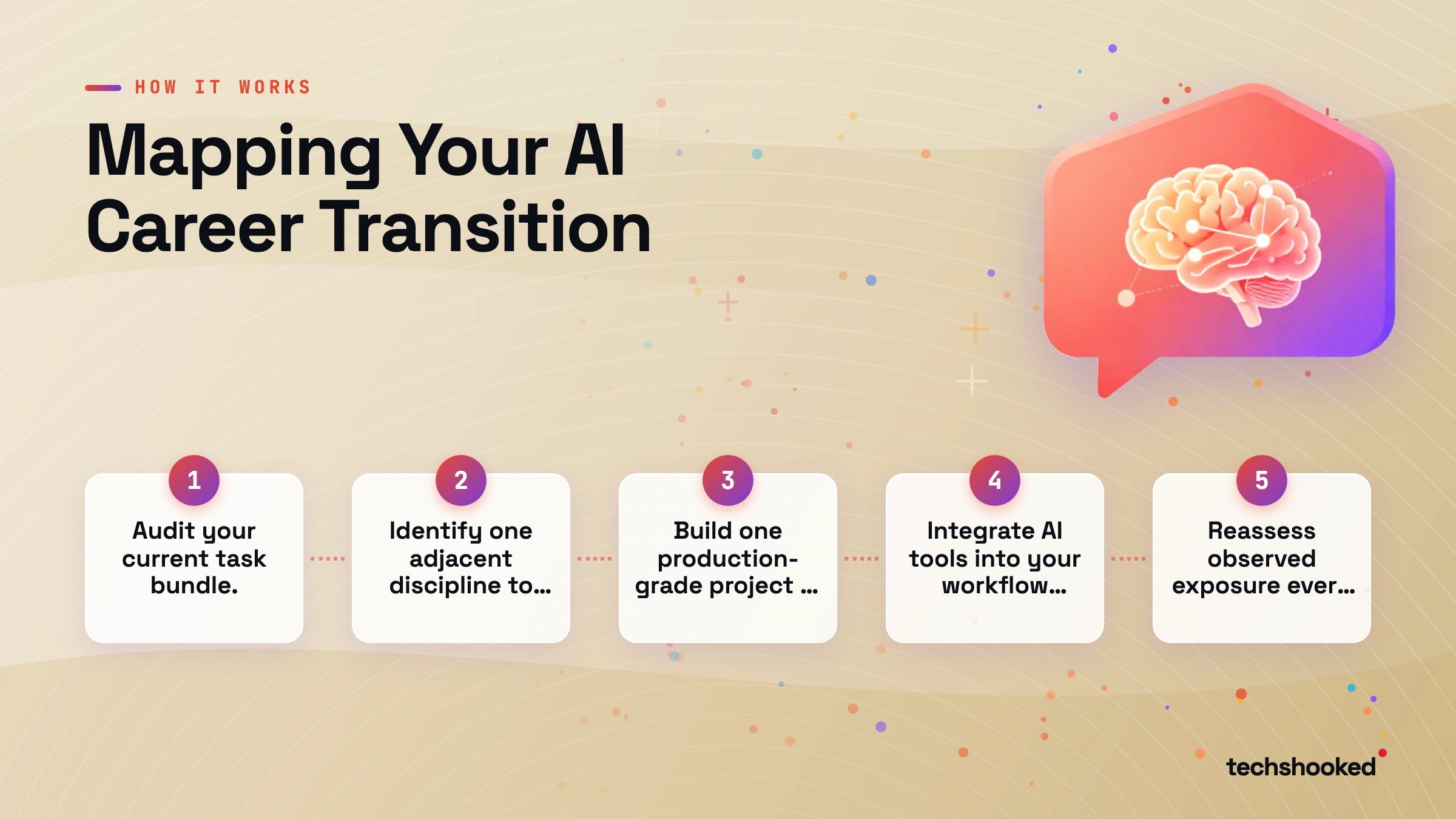
Mapping an AI career transition starts by identifying how much of your current role consists of tasks that fall under high observed exposure. Anthropic's Economic Index report breaks down occupational task bundles by AI exposure level, giving engineers a concrete starting point for self-assessment rather than relying on vague industry forecasts.
A practical reskilling for AI path follows a four-step sequence:
- Audit your current task bundle. List the ten tasks that fill most of your week. Mark each one: does a coding agent or AI tool already do this with acceptable quality? Tasks that score yes are high-observed-exposure targets. Tasks that score no are your anchor skills, the ones to deepen rather than replace.
- Identify one adjacent discipline to move toward. Pick from AI infrastructure, data infrastructure, system design, or security engineering based on your existing foundation. A backend engineer with database experience moves most naturally toward data infrastructure. A platform engineer moves naturally toward AI infrastructure and MLOps.
- Build one production-grade project in that discipline. Deploy a retrieval-augmented generation pipeline, build a data quality monitoring layer, or design a multi-service architecture with defined failure modes. Portfolios that show production reasoning are more credible than course certificates alone, and they force the specific AI-resilient skills that the discipline requires.
- Integrate AI tools into your workflow deliberately. Use a coding agent for the routine parts of your build. Track where it produces incorrect or insecure output. Documenting these failures builds the evaluation instinct that employers prize in AI-augmented workflow roles. Openai's published engineering role requirements reference AI tool integration and output validation as explicit competencies. (OpenAI software engineer role requirements)
- Reassess observed exposure every six months. AI capability advances faster than most reskilling timelines. A task that required human judgment twelve months ago may be reliably automatable now. Periodic reassessment keeps the transition on track rather than anchoring to a snapshot that quickly becomes outdated.
AI-Augmented Workflows in Practice
AI-augmented workflows in practice reveal what an AI career transition looks like at the task level: less like replacement and more like a shift in where engineers spend their time. The concrete difference shows up when comparing a pre-AI workflow with the AI-augmented version for the same type of engineering task:
| Task Type | Pre-AI Workflow | AI-Augmented Workflow | Where Engineer Time Goes |
|---|---|---|---|
| Feature implementation | Write code from scratch; reference docs manually | Coding agent generates initial implementation from spec | Spec definition, output review, edge case handling |
| Test coverage | Write unit and integration tests by hand | Prompt engineering produces test scaffolding automatically | Evaluating coverage gaps and correctness of assertions |
| Code review | Read every line; flag issues manually | AI flags common antipatterns; engineer reviews flagged items plus logic correctness | Domain-specific correctness, security, and architecture fit |
| Documentation | Write API docs and architecture notes from scratch | AI drafts from code and comments | Accuracy review, domain context injection, edge cases |
| Incident response | Search logs, correlate errors, diagnose manually | AI surfaces correlated signals and candidate causes | Confirming root cause, applying domain knowledge, writing post-mortem |
The pattern across every row is the same: the coding agent or AI tool compresses the production time for the artifact, and the engineer's value concentrates in the judgment steps that surround it. Teams that build AI-augmented workflow conventions explicitly, rather than letting engineers use tools ad hoc, report faster onboarding and more consistent output quality, because the judgment checkpoints become part of the team's process rather than individual habit.
Learning Paths and Resources
The most effective learning paths for reskilling pair hands-on AI tool use with depth in system design, infrastructure, or a vertical domain. Certificate programs that focus on AI theory without production context develop limited transferable skill for the AI career transition; programs that require deploying and debugging real systems close that gap. The following sequence reflects a practical reskilling for AI path grounded in current role demand:
- Build fluency with a major model API. Work through the prompt engineering documentation and tool-use tutorials on the platform your target employers use. Both Google's AI developer platform and the major inference providers publish structured learning paths covering context management, function calling, and output evaluation that map directly to production integration work.
- Complete a cloud AI infrastructure course with labs. AWS SageMaker, Google Vertex AI, and Azure ML each offer certification paths that cover model deployment, monitoring, and scaling. The lab components build the data infrastructure and AI infrastructure muscle that job descriptions reference explicitly.
- Study distributed systems through primary texts. Martin Kleppmann's Designing Data-Intensive Applications covers the consistency, replication, and failure-mode reasoning that underlies both traditional data infrastructure and AI pipeline design. This depth is difficult to acquire through tutorials alone and distinguishes engineers who can handle production complexity.
- Contribute to an open-source AI tooling project. Repositories in the LangChain, LlamaIndex, or vector database ecosystems accept contributions at the integration and testing layer. Contributing forces familiarity with real production patterns and produces portfolio evidence that is more credible than course completion.
- Practice AI-resilient skills weekly. Spend time each week on system design exercises, code review of AI-generated outputs, and writing architecture decision records. These activities do not require new tools; they require deliberate practice of the judgment skills that high-exposure-role transitions depend on.
Reskilling for AI is most effective when it targets the gap between what a coding agent does reliably and what production systems actually require. Engineers who close that gap with depth in AI infrastructure, distributed systems, and evaluation skills move into roles where observed exposure works in their favor, because they direct the tools rather than compete with them.
References
- Anthropic: Labor Market Impacts of AI
- Anthropic: Economic Index Report
- Google AI Developer Platform
- OpenAI: Software Engineer Role Requirements
- BLS: AI Impacts in Employment Projections (March 2025)
- BLS Monthly Labor Review: Incorporating AI Impacts in Employment Projections
Further reading
Frequently Asked Questions
Which engineering skills hold the most value as AI automates routine coding tasks?
System design, AI integration, and infrastructure skills hold the most value. Roles centered on architecting AI pipelines, evaluating model outputs for correctness, and maintaining data infrastructure remain durable because they require judgment that AI coding agents cannot yet exercise independently.
Do I need to learn machine learning to stay relevant as a software engineer?
No, but you need to know how to integrate AI tools into production systems. Understanding prompt engineering, API tool use, and how to evaluate AI-generated code for reliability are more immediately useful than training models from scratch, which remains a specialized sub-discipline.
How do I reskill if my current role has high AI exposure?
Shift from task execution toward task evaluation and system ownership. Invest time in areas where AI augments rather than replaces: defining requirements, reviewing AI-generated outputs, building the data pipelines AI systems depend on, and handling edge cases that require domain knowledge.