AI in cybersecurity is the use of machine learning models that detect anomalous behavior, automate threat response, and surface false positives for analyst review. The phrase covers a layered defensive stack: supervised classifiers on endpoint telemetry, unsupervised anomaly detection on network flows, large language models reading raw alerts, and decision-tree scorers that rank threat indicators. Vendors such as Microsoft Security Copilot, CrowdStrike Falcon, and Darktrace each frame AI-driven security around these primitives, while agencies including CISA and NIST treat AI as a tool that augments existing controls rather than replacing them. CISA operational pilots have already tested AI-enabled vulnerability detection and published their findings as primary evidence, per the CISA pilot report.
How AI in Cybersecurity Works
AI in cybersecurity applies supervised and unsupervised machine learning (ML) models to ingest telemetry from endpoints, networks, and SIEM platforms, then classify events as benign or potentially malicious faster than rule-based filters. Supervised classifiers train on labeled malware samples and known attack patterns; unsupervised models such as isolation forests and autoencoders learn the baseline behavior of a host or user and flag deviations. For background on how supervised and unsupervised machine learning differ, the distinction matters because each technique fits a different defensive role. A Security Information and Event Management platform aggregates the raw signals, and the ML layer scores them before they reach a human analyst.
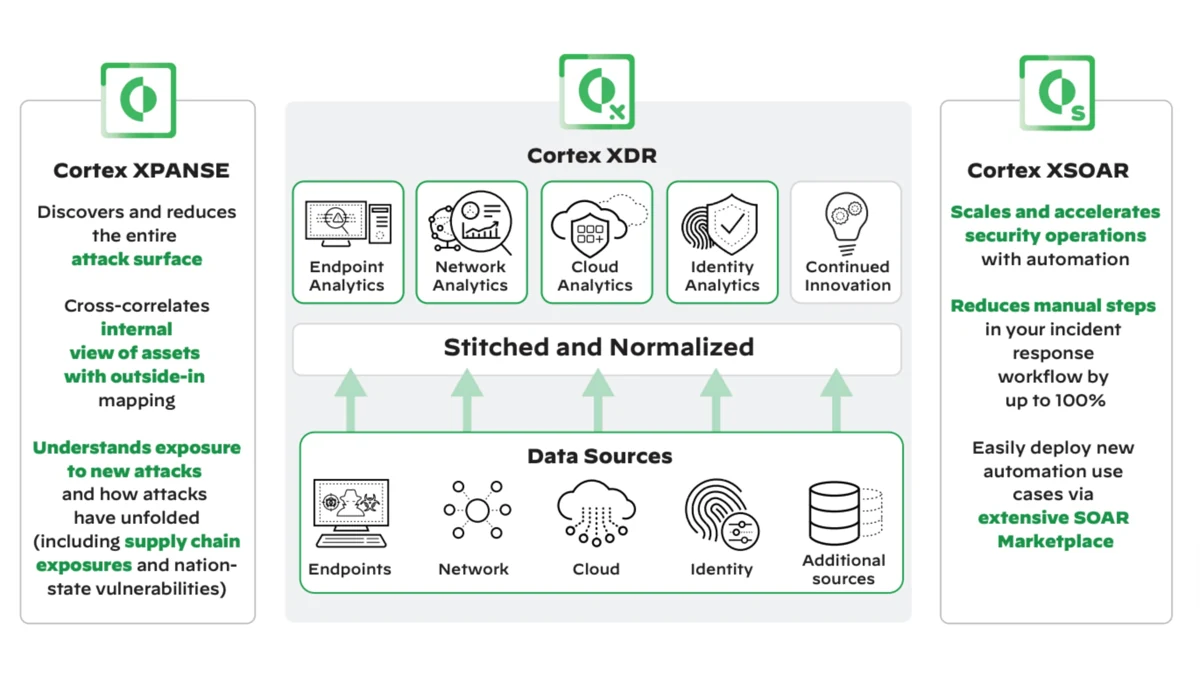
NIST frames the field as two-sided: AI may augment defensive capabilities and improve threat hunting, but the same techniques expose new attack surfaces and reliability concerns, per the NIST Cybersecurity, Privacy, and AI Program page dated 2025-05-09. The practical stack runs across four layers: data collection from EDR agents and network sensors, feature extraction, model inference, and analyst-facing output. See the related explainer on how SIEM and SOAR platforms handle threat detection and response for the orchestration layer beneath the model.
- Supervised classifier
- Trained on labeled malicious and benign samples; outputs a probability score per event.
- Unsupervised anomaly detection
- Learns the normal baseline for a host or user and surfaces statistical outliers without prior labels.
- Large language model triage
- Reads raw alert text, correlates context, and drafts an analyst-readable summary.
- Decision-tree confidence scoring
- Assigns weighted confidence to threat indicators feeding a SIEM, the technique CISA documents in its Automated Indicator Sharing pipeline.
AI-Powered Threat Detection Techniques
AI in cybersecurity enables several distinct threat detection techniques that each address different attacker behaviors across the kill chain. Endpoint Detection and Response agents from CrowdStrike, SentinelOne, and Microsoft Defender for Endpoint use behavioral classifiers to spot process-injection chains that signature scanners miss. Network detection products such as Darktrace and Vectra AI apply unsupervised anomaly detection to east-west traffic, flagging beaconing and lateral movement against a learned baseline. NIST notes that AI-based threat hunting may increase detection rates but can also increase the number of false positives, per the NIST cybersecurity-insights blog, which is the central trade-off teams tune in production.

Mapping detections to the MITRE ATT&CK framework gives analysts a common vocabulary for tactics, techniques, and procedures, and most modern detection tools surface ATT&CK tags alongside model output. CISA itself reports using deep learning to assist malware reverse engineering and natural language processing to flag personally identifiable information in cybersecurity data, per its AI Use Case Inventory refresh of December 16, 2024. For a deeper look at evaluation criteria, see how to choose a real-time threat monitoring tool.
- Behavioral endpoint classification. Models score process trees, command-line arguments, and parent-child relationships to catch living-off-the-land attacks that bypass signature-based antivirus.
- Network anomaly detection. Unsupervised baselines on NetFlow, DNS, and TLS metadata flag command-and-control beaconing that blends into encrypted traffic.
- Phishing and email classification. Natural language processing on headers, body text, and sender reputation catches lookalike domains and brand impersonation patterns.
- Vulnerability detection. Large language models scan source code and binaries for CWE-style weaknesses, the focus of the CISA operational pilot from late 2023 to early 2024.
- Threat indicator scoring. Decision-tree models assign confidence to shared indicators of compromise so downstream SIEM rules can weight evidence rather than treating every IOC as equal.
Automating Incident Response with AI
AI in cybersecurity accelerates incident response (IR) by automating the triage steps that previously required a tier-1 analyst to read raw alerts, cross-reference threat intel, and decide whether to escalate. Microsoft Security Copilot summarizes a multi-stage attack into a single analyst-readable narrative; CrowdStrike Falcon Charlotte AI produces investigation playbooks from natural-language queries; Splunk and Sentinel embed similar assistants inside the SIEM workspace. The automation layer does not make the final containment call, but it shortens the gap between alert and informed analyst action.
CISA offers Incident Response training free to government employees and contractors, educational and critical infrastructure partners, and the general public, per the CISA Incident Response Training program, and that curriculum still treats the human analyst as the decision authority. The pattern matters because AI assistants in a Security Operations Center (SOC) work best inside an established playbook, not as a substitute for one. A typical AI-assisted IR sequence looks like the following.
- Alert ingestion. The SIEM or XDR forwards a correlated alert with raw telemetry to the AI assistant.
- Context enrichment. The model pulls threat intelligence, asset criticality, and prior incidents for the affected user or host.
- Narrative summary. The assistant produces a short timeline of the attack and tags relevant MITRE ATT&CK techniques.
- Recommended actions. The model proposes containment steps such as host isolation, credential reset, or firewall rule changes, drawn from the SOC playbook.
- Analyst confirmation. A human approves, modifies, or rejects the suggestion; SOAR automation then executes the approved action.
- Post-incident learning. The model logs analyst overrides as training signal for the next iteration of the detection pipeline.
SIEM Augmentation: Where AI Fits Today
AI in cybersecurity integrates with SIEM platforms to add behavioral baselines on top of static correlation rules, which reduces the volume of false positives analysts must investigate each shift. Splunk Enterprise Security, Microsoft Sentinel, IBM QRadar, and Elastic Security each ship native ML modules that augment hand-authored correlation rules. The augmentation works in two directions: anomaly detection catches signals that no rule anticipated, and probability scoring suppresses noisy rules that produce a high false positive rate. See the related coverage of how SIEM and SOAR platforms handle threat detection and response and how SOC team roles and tools are structured for the staffing context.
The trade-off is concrete: behavioral models catch novel attacks that signatures miss, but they also flag benign activity that correlation rules would ignore. CISA notes that AI tools are increasingly pivotal components of its security toolkit, per the CISA AI Use Case Inventory, while also warning that AI tools can be unpredictable in ways that are difficult to troubleshoot. The comparison below summarizes how the two detection styles interact inside a modern SIEM.
| Detection mode | Strength | Weakness | Typical tooling |
|---|---|---|---|
| Static correlation rules | Deterministic, auditable, low false positive rate on known patterns | Misses novel attacks and variants outside the rule signature | Splunk ES, QRadar, Sentinel analytic rules |
| ML anomaly detection | Catches deviations from baseline without prior labels | Higher false positive rate; baseline drift requires retraining | Darktrace, Vectra AI, Splunk UBA |
| LLM triage assistant | Summarizes context and drafts analyst narrative quickly | Output requires human verification; prompt-injection risk | Microsoft Security Copilot, Charlotte AI, Sentinel Copilot |
| Confidence-scored indicators | Weights threat intel so high-noise feeds do not flood the SIEM | Scoring model needs frequent recalibration against new IOCs | CISA AIS, MISP scoring plugins, ThreatConnect |
The Risks: Adversarial Attacks and Model Limitations
AI in cybersecurity introduces its own attack surface: adversarial machine learning techniques allow attackers to craft inputs that evade model-based detectors, and CISA pilots found AI tools can be unpredictable in ways that are difficult to troubleshoot. The CISA operational pilot from late 2023 to early 2024 examined whether AI-enabled vulnerability detection products outperform non-AI products, and concluded that the best use of AI for vulnerability detection lies in supplementing existing tools rather than replacing them, per the CISA pilot findings. The same report flagged that analyst learning time can outweigh incremental gains in some contexts.
NIST identifies a parallel concern: AI-enabled cyber threats and the need to protect AI systems themselves, per its Cybersecurity, Privacy, and AI Program. Adversarial techniques fall into a small set of named categories that defenders should understand before deploying any detection model in production.
- Evasion attacks. Attackers perturb malware binaries, phishing email text, or network payloads so the classifier scores them as benign, bypassing the detector without triggering an alert.
- Data poisoning. Adversaries inject crafted training samples into a vendor's update pipeline so the deployed model later misclassifies a specific attack family.
- Model inversion. An attacker queries an exposed model to reconstruct sensitive training data, including credentials or proprietary network configurations.
- Prompt injection. Crafted strings hidden in logs or alert text manipulate a large language model triage assistant into producing misleading analyst summaries.
- Operational unpredictability. Beyond targeted attacks, model drift, training-data staleness, and opaque failure modes raise the troubleshooting burden CISA flagged in its pilot report.
- False positive load. NIST warns that AI-based threat hunting may increase detection rates while also raising the false positive count, a budget consideration for any understaffed SOC.
Deploying AI-Driven Security in Practice
AI in cybersecurity delivers the most measurable value when integrated incrementally into an existing security operations center workflow rather than deployed as a standalone replacement for established controls. CISA's pilot concluded that the best use of AI for vulnerability detection lies in supplementing existing tools, per the pilot report, and that guidance generalizes across detection, phishing defense, and incident response. The recommended sequence below mirrors how mature security teams onboard AI capabilities without disrupting the controls that already work. For broader context on enterprise applications, see how AI use cases map across enterprise technology domains, and for the governance side, AI risks including bias, hallucination, and regulatory exposure.
- Audit the existing detection stack. Inventory SIEM rules, EDR coverage, and email gateway filters before adding any AI layer, so the new capability has a measurable baseline.
- Pilot on a single use case. Start with one well-scoped problem such as phishing triage or alert summarization, the pattern CISA followed in its vulnerability detection pilot.
- Define success metrics upfront. Measure mean time to triage, false positive reduction, and analyst override rate against the pre-AI baseline.
- Train analysts on the assistant's failure modes. Document where the model hallucinates, where it under-scores known patterns, and how to recognize prompt-injection attempts in alert text.
- Wire the assistant to the SOAR playbook. The AI proposes; automation executes only after analyst approval for any disruptive containment step.
- Retrain on analyst feedback. Every accepted, modified, or rejected suggestion becomes training signal that improves the next iteration of the detection pipeline.
- Re-evaluate quarterly. Drift in attacker tactics, model performance, and the underlying threat intelligence feed all require periodic recalibration rather than set-and-forget deployment.
What Comes After Automation
AI in cybersecurity will increasingly handle the high-volume, low-ambiguity detection layer while human analysts focus on adversarial edge cases, cross-system correlation, and decisions that require organizational context. NIST frames the program as adapting defensive activities to thwart AI-enabled cyber-attacks and protecting AI systems and their components, per the NIST program page, which captures both sides of the defender-attacker arms race. CISA's seven active reportable AI use cases, refreshed on December 16, 2024, illustrate the practical scope: PII flagging, threat indicator confidence scoring, and malware reverse engineering all share a common shape of human-supervised automation rather than autonomous response.
- Detection scales, judgment does not. Models handle the routine alert volume; analysts retain authority over containment, communication, and post-incident learning.
- Adversarial robustness becomes a procurement criterion. Buyers will increasingly ask vendors how their detection models behave under evasion and poisoning, alongside benchmark accuracy.
- Defensive AI and AI security converge. Protecting an organization's own ML pipeline from prompt injection and model theft sits inside the SOC's remit, not outside it.
- Vendor claims meet primary evidence. CISA and NIST publications give buyers a way to test marketing against operational pilots rather than accepting performance numbers at face value.
References
- CISA: Pilot: Artificial Intelligence-Enabled Vulnerability Detection
- CISA: AI Use Case Inventory (refreshed December 16, 2024)
- CISA: Incident Response Training program
- NIST: Managing Cybersecurity and Privacy Risks in the Age of Artificial Intelligence
- NIST: Cybersecurity, Privacy, and AI Program (page dated 2025-05-09)
Further reading
Frequently Asked Questions
Does AI in cybersecurity replace human analysts in a SOC?
AI in cybersecurity augments SOC analysts rather than replacing them, per CISA operational pilots which found AI works best as a supplement to existing tools. Analysts still handle edge cases, confirm or dismiss alerts, and apply judgment that supervised models cannot replicate.
What is a false positive in AI-driven threat detection?
A false positive occurs when an anomaly detection model flags benign activity as malicious, generating an alert that consumes analyst time without a real threat. NIST notes that AI-based threat hunting may increase detection rates but can also increase the number of false positives, which is a core trade-off teams must tune.
How does MITRE ATT&CK relate to AI-based threat detection?
MITRE ATT&CK is a knowledge base of adversary tactics and techniques that SOC teams use to map AI-generated alerts to known attack patterns, improving triage precision. Tools such as Microsoft Security Copilot and CrowdStrike Falcon surface MITRE tactic tags alongside detections so analysts can prioritize response actions.
What are adversarial machine learning attacks in cybersecurity?
Adversarial machine learning attacks manipulate model inputs so an AI misclassifies malicious traffic as benign, bypassing automated defenses without triggering an alert. Defenders counter this by retraining models on adversarial examples and running red-team exercises against their own detection pipelines.
Can AI in cybersecurity improve phishing detection?
AI in cybersecurity applies natural language processing to email content and sender signals, reducing false positives on phishing filters compared to static rule sets. Models trained on header anomalies, lookalike domains, and brand-impersonation patterns catch variants that signature lists miss within the same mail-gateway pipeline.