Machine learning is a branch of artificial intelligence that trains algorithms to identify patterns in data without being explicitly programmed for each task. The field splits cleanly along one decisive axis: whether the training data carries labels. That single question determines which algorithms are eligible, how the model is evaluated, and what kind of business problem the system can actually solve.
supervised technique predicts known outputs from labeled training data. Unsupervised learning finds structure inside unlabeled data without a target variable. A third paradigm, reinforcement learning, optimizes sequential decisions through environmental feedback and sits outside the labeled-versus-unlabeled binary. Choosing among them is rarely a question of algorithm sophistication. It is a question of what data you have, what it costs to label more, and what answer the business actually needs.
What Machine Learning Does: Core Concepts
Machine learning (ML) fits inside a stack of overlapping disciplines that practitioners often conflate. Statistical modeling sits beneath it, deep learning sits inside it, and reinforcement learning (RL) sits beside it. Holding those distinctions straight is the first step toward picking a sensible algorithm. Deep learning is a subset of ML that uses multi-layer neural network architectures to learn hierarchical feature representations directly from raw inputs, which is why image and speech systems converged on it after 2012. Classical ML, by contrast, still dominates tabular problems, low-data regimes, and any setting where interpretability matters more than raw accuracy. Practitioners weighing those tradeoffs at deployment time should also factor in tooling cost, which is the subject of our companion piece on ML platform selection.
- Supervised learning: Trains on labeled training data where each input has a known correct output. Optimizes a loss function that measures prediction error against ground truth.
- Unsupervised learning: Operates on unlabeled data and discovers latent structure such as clusters, low-dimensional manifolds, or outlier patterns. No target variable, no labeled benchmark.
- Reinforcement learning: An RL agent learns a policy by interacting with an environment and receiving scalar rewards. Used for robotics, game-playing systems, and adaptive control where the correct action is not known in advance.
- Deep learning: A neural network architecture family with many hidden layers. A modeling technique that can be applied within supervised, unsupervised, or reinforcement-learning settings.
How ML Supervised Models Train on Labeled Data
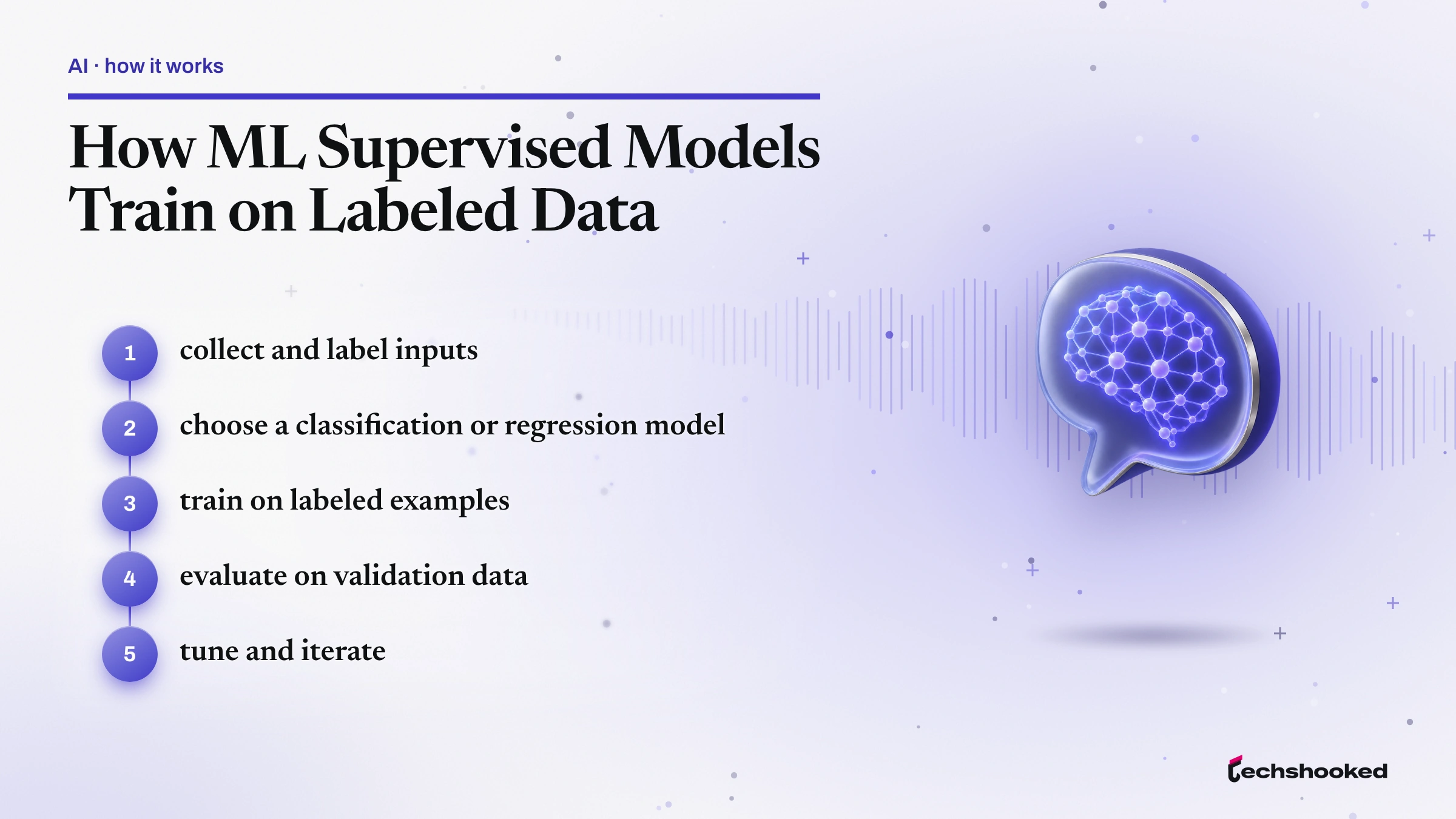
ML supervised pipelines all share a five-step training loop, regardless of whether the underlying model is a logistic regression or a 100-million-parameter transformer. The loop is procedurally simple. The difficulty lives in the data preparation, the choice of loss function, and the discipline applied to evaluation. A peer-reviewed survey in IEEE Transactions on Neural Networks and Learning Systems documents how the bias-variance tradeoff governs nearly every architectural decision inside this loop, and why high-capacity models without sufficient labeled training data systematically overfit the training data distribution.
- Collect and label the inputs. Each example pairs an input feature vector with a ground-truth output. Label quality caps the achievable accuracy of every downstream model, and the supervised learning project budget often lives or dies on this step.
- Choose a classification algorithm or regression model. Classification algorithm families include logistic regression, decision tree, support vector machine, random forest, and gradient boosting. Regression model variants include linear regression, ridge, and gradient-boosted regression trees.
- Define the loss function. Cross-entropy loss governs most classification work, mean squared error governs continuous regression, and ranking losses cover learning-to-rank problems. The loss function is what the optimizer minimizes.
- Iterate until convergence. Stochastic gradient descent or a quasi-Newton optimizer updates model parameters across mini-batches. Early stopping prevents overfitting once held-out error stops improving.
- Evaluate model generalization on held-out data. Cross-validation, calibration plots, and confusion matrices verify the model performs on inputs drawn from the same training data distribution but never seen during fitting.
The classification algorithm versus regression model split is not cosmetic. Classification predicts discrete categories such as spam or fraud labels. A regression model predicts a continuous quantity such as a credit score or a sale price. Mixing the two during evaluation, for example treating a calibrated probability as a hard label without choosing a threshold, is one of the most common production bugs in early supervised learning systems.
Machine Learning Unsupervised Techniques: Clustering and Beyond
ML unsupervised methods operate without any target variable. The model receives unlabeled data and is asked to surface structure that a human analyst can then interpret. An ACM Computing Surveys review of clustering algorithms catalogs how the major technique families differ in their assumptions about data geometry, scale, and noise tolerance. The practical menu collapses to four families that cover roughly every problem encountered in production analytics.
- Clustering algorithm families: K-means partitions data into a fixed number of centroids and assumes roughly spherical groupings. DBSCAN identifies arbitrary-shaped clusters from density and labels stray points as noise. Hierarchical clustering builds a nested tree that supports exploration without committing to a cluster count. Canonical use case: customer segmentation for marketing.
- Dimensionality reduction: PCA projects data onto orthogonal axes of maximum variance and supports feature extraction for downstream supervised models. t-SNE and UMAP preserve local neighborhoods for two-dimensional visualization of high-dimensional embeddings. Canonical use case: visualizing learned representations from a neural network architecture.
- Anomaly detection: Isolation Forest scores points by how easily a random tree separates them from the rest of the sample. One-class SVM learns a boundary around the normal-behavior region. Canonical use case: flagging fraudulent transactions or unusual network traffic.
- Association rule learning: Apriori and FP-Growth mine frequent co-occurrence patterns from transactional data. Canonical use case: market-basket analysis and product recommendation candidate generation.
Each family carries different evaluation problems. Clustering quality is typically scored with silhouette coefficients or the Davies-Bouldin index, since there is no ground-truth label to compare against. That absence is precisely what makes unsupervised work harder to defend in production: there is no accuracy number to put on a dashboard, and weak model generalization can hide inside what looks like a clean cluster boundary.
Comparing ML Supervised and Unsupervised Approaches
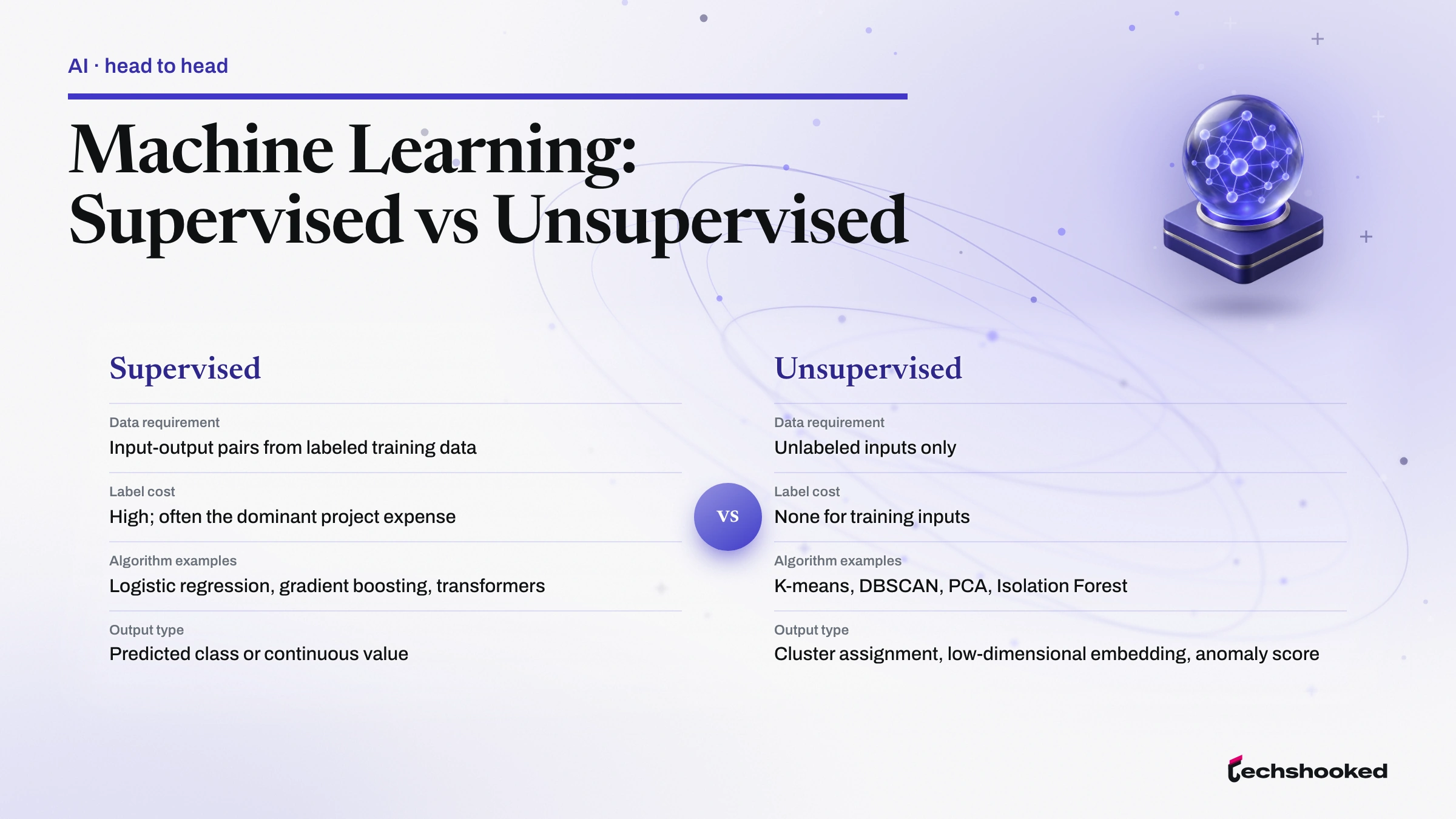
ML teams that compare supervised learning and unsupervised learning side by side rarely choose one paradigm permanently. They route specific problems to specific paradigms based on data availability, label economics, and the form of the required output. Google Cloud documentation on ML model types frames the same split for production deployment, with managed pipelines for each. The seven-axis matrix below is the decision surface most teams operate against.
| Attribute | Supervised | Unsupervised |
|---|---|---|
| Data requirement | Input-output pairs from labeled training data | Unlabeled inputs only |
| Label cost | High; often the dominant project expense | None for training inputs |
| Algorithm examples | Logistic regression, gradient boosting, transformers | K-means, DBSCAN, PCA, Isolation Forest |
| Output type | Predicted class or continuous value | Cluster assignment, low-dimensional embedding, anomaly score |
| Generalization approach | Held-out test set, cross-validation, calibration metrics | Stability under resampling, silhouette score, downstream task lift |
| Typical applications | Credit scoring, churn prediction, image classification | Customer segmentation, fraud anomaly detection, topic discovery |
| Compute demand | Scales with model size and label volume | Scales with dataset size and dimensionality reduction depth |
The label-cost row drives most architectural decisions. When labeling a million records would cost six figures, teams often start with a clustering algorithm to surface candidate segments, then pay to label only the boundary cases that would most improve a downstream classifier. Semi-supervised methods bridge the two paradigms by training on a small labeled set plus a much larger pool of unlabeled data.
When to Use Each Machine Learning Paradigm
ML paradigm selection is a decision that follows the data, not the algorithm shopping list. The NIST AI Risk Management Framework Govern function makes data quality and labeling provenance an explicit prerequisite for trustworthy deployment, which means the choice of paradigm is also a governance choice. The four-branch decision tree below covers the cases most teams encounter.
- Labeled dataset available and output is a known category or value. Use a supervised classification algorithm for discrete outputs or a regression model for continuous ones. Examples: predicting loan default, forecasting next-week demand, tagging support tickets by topic.
- Unlabeled inputs with structure discovery as the goal. Use a clustering algorithm or dimensionality reduction. Examples: segmenting users without predefined segments, mapping the topic structure of a document corpus, compressing high-dimensional sensor data for downstream modeling. Review candidate platforms in the AWS SageMaker vs Google Vertex AI vs Azure ML guide before committing.
- Streaming inputs with unknown anomaly patterns. Use anomaly detection. Examples: detecting novel attack signatures in network traffic, surfacing rare equipment failures from telemetry, flagging suspicious payment activity where fraud patterns mutate faster than labels can be applied.
- Sequential decision environment with delayed feedback. Use reinforcement learning. Examples: training a recommendation engine that optimizes long-term engagement, tuning a control policy for energy-grid balancing, building game-playing agents.
One caveat sits across all four branches. Labels reflect the values and edge cases of whoever produced them, which means a supervised system inherits whatever bias the labeling process encoded. Practitioners building credit, hiring, or healthcare systems should read the analysis of AI bias and hallucination risks before signing off on a labeled dataset.
Machine Learning Real-World Applications by Paradigm
Machine learning applications across industries map neatly to the paradigm split once you look at the data each industry actually owns. Microsoft Azure ML documentation catalogs reference patterns for both paradigms in enterprise deployments. A peer-reviewed Nature Medicine overview of ML in healthcare documents both the supervised diagnostic systems and the unsupervised patient-stratification work that increasingly drives precision medicine. Hub context for finance applications appears in the AI in Finance Applications overview.
| Industry | Supervised Use Case | Unsupervised Use Case |
|---|---|---|
| Finance | Credit scoring with a classification algorithm trained on default-labeled accounts | Fraud anomaly detection over transaction streams |
| Healthcare | Disease diagnosis from labeled imaging or pathology corpora | Patient-cohort clustering for stratified treatment research |
| Retail | Demand forecasting via regression on historical sales and price | Recommendation candidate generation via collaborative filtering |
| Cybersecurity | Malware family classification from labeled binary feature extraction | Network intrusion outlier detection across packet metadata |
The pattern repeats: when the outcome label exists and is stable, supervised models win. When the patterns shift faster than labels can be produced, or the goal is discovery rather than prediction, unsupervised techniques carry the load. The strongest production systems combine both, using unsupervised feature extraction or pretraining to enrich a downstream supervised classifier and improve its model generalization across the long tail of the training data distribution.
Further reading
- How to choose a machine-learning platform
- AWS SageMaker vs Google Vertex AI vs Azure ML
- AI bias and hallucination risks
- AI in finance applications
Frequently Asked Questions
What is the main difference between supervised and unsupervised learning?
Labeled-data approach requires labeled inputs where each example is paired with a known correct output, while unsupervised method works with unlabeled data and discovers hidden structure on its own. The practical implication is cost. Labeling large datasets is expensive, which is why unlabeled-data techniques have grown in importance for exploratory analysis and pretraining.
What are the most common techniques used in unsupervised ML?
The three dominant families are clustering methods such as K-means, DBSCAN, and hierarchical clustering; dimensionality reduction methods such as PCA, t-SNE, and UMAP; and anomaly identification models such as Isolation Forest. Each family serves a different structural goal. Clustering groups similar instances, DR compresses feature space, and outlier identification flags outliers against a learned baseline.
When should I choose unsupervised over supervised methods?
Choose the unsupervised path when labeled training data is unavailable, prohibitively expensive to produce, or when the objective is pattern discovery rather than predicting a specific output. Common trigger conditions include customer segmentation without predefined segments, fraud detection where attack patterns shift continuously, and exploratory data analysis before any labeling investment.