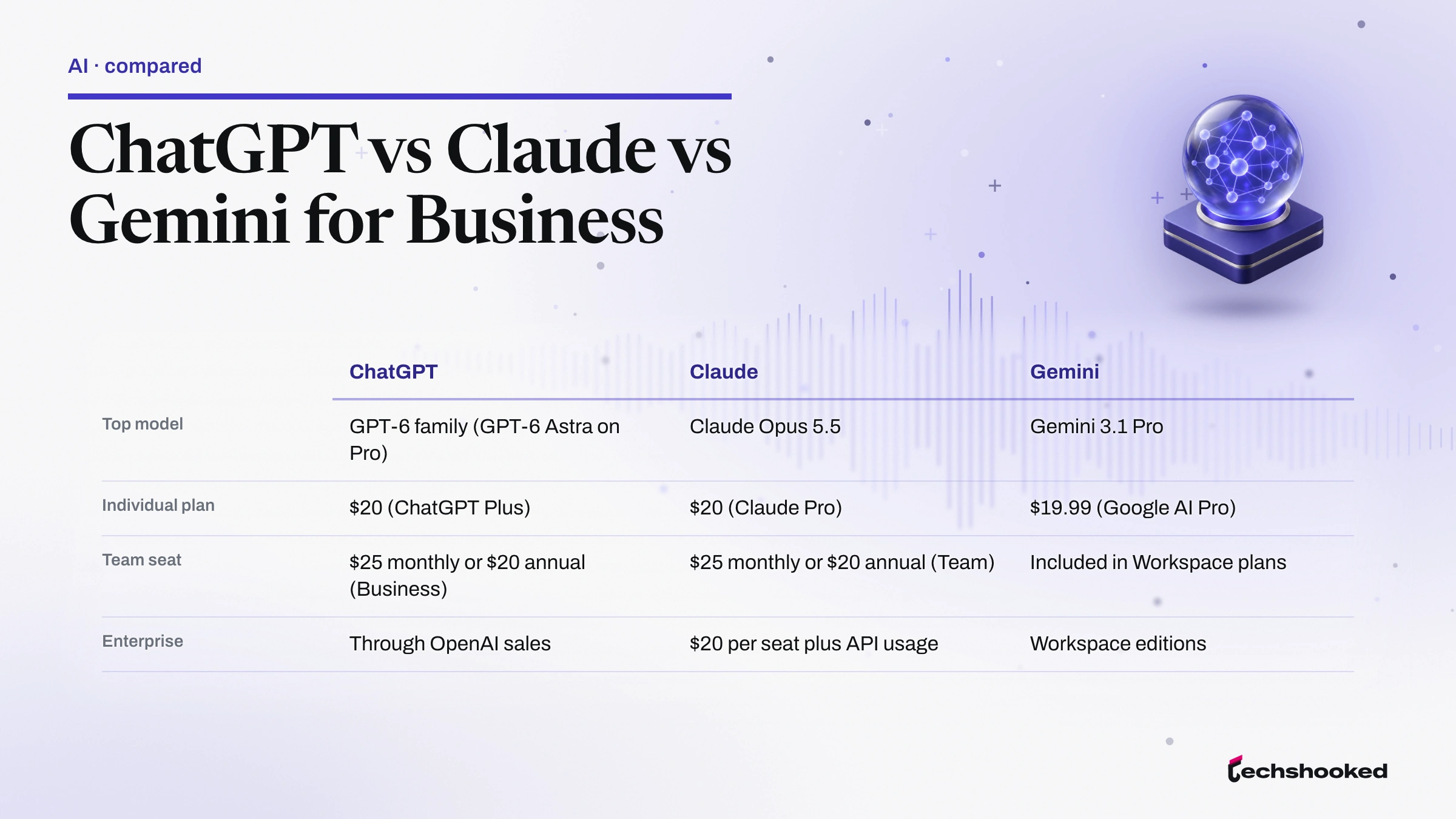
ChatGPT vs Claude vs Gemini is a business software comparison that weighs OpenAI, Anthropic, and Google assistants on seat pricing, admin controls, suite fit, and governance for mid-market teams. The three vendors package similar capabilities in different ways: OpenAI and Anthropic sell dedicated workspaces with team and enterprise seats, while Google folds Gemini into Google Workspace. Each vendor publishes plan pages with prices and named controls, and this comparison relies on those pages alone. Where a page is silent, the article says so and turns the gap into a question for the vendor.
The Three Assistants and the Models Behind Them
ChatGPT vs Claude vs Gemini starts with three vendors, OpenAI, Anthropic, and Google, that each sell a business assistant built on their own large language model families. Each vendor sells both a chat workspace and model access. The table below lists the model names each vendor gives on its own pages. It omits benchmark scores, context windows, and any other figure the plan pages do not publish. Background on how a large language model produces its output is in the generative AI explainer.
| Vendor and assistant | Top model family named by the vendor | Faster or lower-cost option | Where the vendor places it |
| OpenAI ChatGPT | GPT-6 family; OpenAI lists GPT-6 Astra as the model behind Pro reasoning (GPT-6 Pro) | GPT-5.6 Luna, the fastest and lowest-cost model in the GPT-5.6 family, which runs ChatGPT Free | Plus adds advanced reasoning with GPT-6; Pro reasoning is powered by GPT-6 Astra; GPT-6 Pro is available to Business users |
| Anthropic Claude | Claude Opus 5.5, Anthropic's leading model | Claude Sonnet 5.5, a faster, lower-cost complement | Pro, Max, Team, and Enterprise plans |
| Google Gemini | Gemini 3.1 Pro, with higher access on Google AI Pro | Gemini 3.5 Flash, which Google brought to AI Plus, Pro, and Ultra at Google I/O | Google AI Pro and Ultra for individuals; Gemini included in Workspace business plans |
Sources: OpenAI's ChatGPT pricing page and Pro tiers article and its GPT-6 Pro help article, Anthropic's pages for Claude Opus 5.5 and Claude Sonnet 5.5, and Google's Google AI subscriptions announcement.
Seat Pricing from Individual Plans to Enterprise
ChatGPT vs Claude vs Gemini pricing follows a shared ladder of individual plans, team seats, and sales-led enterprise contracts, except that Gemini rides inside Google Workspace. The table gathers seat pricing from each vendor's own pages: OpenAI lists ChatGPT Plus, the Pro tiers, and the ChatGPT Business overview; Anthropic lists Claude plans; Google lists Gemini subscriptions and Workspace pricing.
| Vendor | Individual paid plan | Higher-usage individual plan | Team seat (monthly or annual billing) | Premium seat | Enterprise |
| ChatGPT | Plus, $20 per month | Pro 100 ($100), Pro 200 ($200), Pro 500 ($500) per month | Business Standard, $25 per user monthly or $20 annually; starts at 2 users | Business Premium, $125 monthly or $100 annually | ChatGPT Enterprise, sold through OpenAI sales with invoicing options |
| Claude | Pro, $20 per month or $17 per month billed annually | Max from $100 per month, at 5x or 20x Pro usage | Team, $25 per seat monthly or $20 annually, for 2 to 150 people | Premium seats at $100 or $125 depending on billing term | Enterprise, $20 per seat per month billed annually plus usage at API rates |
| Gemini | Google AI Pro, $19.99 per month | Google AI Ultra, $100 or $200 per month (the $200 plan was cut from $250) | Included in Google Workspace business plans; optional paid AI Expanded Access add-on for higher usage limits | Not applicable | Priced by Workspace edition |
Three points shape how to read the table.
- ChatGPT Business is the plan OpenAI renamed from ChatGPT Team on August 29, 2025, so older Team pricing quoted elsewhere maps to it.
- ChatGPT Business is separate from the API platform, and API usage is billed separately. Claude Enterprise works the other way: it adds usage at API rates on top of the seat price. On API pricing, Anthropic lists Claude Opus 5.5 at $4 per million input tokens and $20 per million output tokens, per Anthropic. OpenAI and Google set API pricing separately from these seat plans.
- Google's Workspace page says the former $30 Gemini add-on no longer applies, because Gemini is included in Workspace business plans.
No plan here is cheaper overall. Gemini's cost inside Workspace is part of the Workspace edition price, so compare full edition prices on Google's Workspace pricing page.
Microsoft 365, Google Workspace, and API Access
ChatGPT vs Claude vs Gemini integration decisions start with the productivity suite your staff already works in, then extend to whether a plan includes API usage. For shops already on Workspace, Google includes Gemini in the business plans they buy, with an optional AI Expanded Access add-on for heavier usage.
OpenAI says ChatGPT Business includes ChatGPT, ChatGPT Work, and Codex, and starts at 2 users. Anthropic lists Claude Team with single sign-on (SSO), central billing, and enterprise search.
For Microsoft 365, enterprise integration differs by vendor: OpenAI lists Excel, Word, PowerPoint, and Google Sheets extensions for ChatGPT, and Anthropic lists Claude in Microsoft 365 on its paid plans, while Gemini lives inside Google Workspace. Test each assistant against your own Microsoft 365 tenant in a pilot before assuming parity.
Chat seats and API access are also separate purchases. ChatGPT Business excludes API usage, and Claude Enterprise adds usage at API rates. Teams planning custom builds should treat enterprise integration work as its own budget line.
Governance, Data Handling, and Admin Controls
ChatGPT vs Claude vs Gemini governance comparisons turn on which controls each plan tier names in writing, because data handling terms differ between individual, team, and enterprise contracts. The table maps the controls the vendor pages name to plan tiers. Cells marked as not stated are questions for the vendor, not evidence of absence. Data retention and admin controls are the two areas where written answers matter most.
| Control area | ChatGPT (OpenAI) | Claude (Anthropic) | Gemini (Google) |
| Use of customer data for training | OpenAI does not train on Business or Enterprise data by default | Team lists no model training on your content by default | Google does not use Workspace data to train its AI models without permission |
| Single sign-on and billing | Centralized billing across users on Business | Team includes SSO and central billing | Managed in the Workspace admin console, with DLP and rights-management controls |
| Audit, retention, and certifications | Enterprise audit logs through the Compliance API; retention controls for qualifying organizations; SOC 2 audited | Enterprise adds audit logs, SCIM, and custom data retention | SOC 1/2/3 and ISO 42001 certified |
| HIPAA | BAA for sales-managed Enterprise and Edu accounts only, not Business | Enterprise lists a HIPAA-ready offering | Gemini in Workspace is covered under Google's HIPAA BAA |
Sources: OpenAI's Business overview and pricing page, and Anthropic's Claude pricing page. OpenAI's enterprise privacy page and BAA guidance, and Google's generative AI privacy hub and Workspace AI page, cover the training, certification, admin controls, and HIPAA rows. Organizations that also need a responsible-use policy for staff can start from the AI ethics guidelines for organizations.
Put these questions to every vendor before signing:
- What is the data retention period for prompts and outputs on each plan tier?
- Is customer content used for training, and where is that written?
- Can audit logs be exported, and in what format?
- What is the breach notification commitment?
Strengths by Business Use Case
ChatGPT vs Claude vs Gemini strengths split along business use case lines, with each vendor describing its own models for different jobs. Each bullet below is the vendor's own description, not an independent test.
- ChatGPT: OpenAI lists advanced reasoning models with GPT-6, expanded deep research, projects, scheduled tasks, and custom GPTs on ChatGPT Plus, and lists GPT-6 Astra as the model behind Pro reasoning.
- Claude: Anthropic describes Claude Sonnet 5.5 as strongest at well-scoped everyday tasks, fixing bugs, and creating documents, slides, and spreadsheets, and names Claude Opus 5.5 as its leading model.
- Gemini: Google says Google AI Pro gives higher access to Gemini 3.1 Pro and Deep Research.
Document-heavy back-office work is the business AI use case where these differences matter most, and finance teams evaluating assistants can see wider context in AI in financial services. The vendors publish no like-for-like benchmark on these plan pages, so every business AI use case should be piloted with the buyer's own files.
How to Choose: A Mid-Market Decision Framework
ChatGPT vs Claude vs Gemini reduces to a mid-market decision framework built on four questions about suite, seats, governance, and workload. This decision framework fits mid-market teams of roughly 2 to 150 seats, the range that spans the ChatGPT Business 2-user minimum in OpenAI's Business overview and the Claude Team ceiling of 150 people on Anthropic's pricing page.
- Name the suite. Google Workspace teams start with the Gemini already included and price the AI Expanded Access add-on only if usage limits bite. Microsoft 365 teams shortlist on connector tests.
- Price the seats. Standard-tier seats at ChatGPT Business and Claude Team match at $25 monthly or $20 annually, so seat pricing rarely decides. Premium seats and usage limits do.
- Check the governance table. Compare it against what your enterprise AI assistant contract must include, and put every blank cell to each vendor in writing.
- Pilot two assistants. Run them on your own documents for a fixed window with a scored rubric covering accuracy, edit time, and admin effort.
Many mid-market teams end up running two assistants for different jobs, which is a reasonable outcome when one enterprise AI assistant fits the suite and another fits the workload. Teams that want a wider field before the pilot can start from the OpenAI alternatives comparison. Whichever pair advances, the pilot rubric and the written answers to the governance questions matter more than list prices.
Frequently Asked Questions
What is the main difference between ChatGPT, Claude, and Gemini for business use?
The main difference is packaging: ChatGPT sells workspace seats, Claude sells team and enterprise seats, and Gemini comes included in Google Workspace business plans. Mid-market buyers usually decide on the productivity suite already in place, the admin controls each seat tier names in writing, and the workload mix. A short pilot on real documents settles what a vendor page cannot.
How much do team seats cost for ChatGPT Business and Claude Team?
Per OpenAI, ChatGPT Business Standard seats cost $25 per user per month billed monthly or $20 billed annually. Per Anthropic, Claude Team seats carry the same $25 monthly and $20 annual prices. Premium seats cost $125 monthly or $100 annually on ChatGPT Business, while Claude Team lists Premium seats at $100 or $125. ChatGPT Business starts at 2 users, and Claude Team covers 2 to 150 people. Claude Enterprise is $20 per seat per month billed annually plus usage at API rates, and ChatGPT Enterprise is sold through OpenAI sales.
Does a ChatGPT Business plan include API access?
No, ChatGPT Business is separate from the API platform, and API usage is billed separately. OpenAI describes Business as a shared workspace with centralized billing and says it will not train on a Business workspace's data. Teams building custom applications should budget API usage apart from seat fees.
Is ChatGPT Business the same plan as ChatGPT Team?
Yes, OpenAI renamed ChatGPT Team to ChatGPT Business on August 29, 2025. Older reviews that quote ChatGPT Team pricing describe the same plan family, so check seat prices against OpenAI's Business overview before budgeting.
Does Gemini cost extra inside Google Workspace?
Google includes Gemini in its Workspace business plans, with an optional paid AI Expanded Access add-on for higher usage limits. The earlier $30 Gemini add-on for Google Workspace no longer applies. Individual buyers outside Google Workspace choose Google AI Pro at $19.99 per month or Google AI Ultra at $100 or $200 per month.