
An OpenAI alternative is a large language model API that replicates or exceeds GPT-class capabilities while giving developers a different cost structure, licensing model, or deployment topology. The category covers proprietary endpoints from Anthropic and Google, open-weight families from Meta and Mistral, and the hyperscaler routes (AWS Bedrock, Vertex AI, Azure OpenAI) that resell them under enterprise terms. For most teams, the choice now turns on five measurable attributes rather than benchmark bragging rights: context window, token pricing, function calling, multimodal input, and whether the weights can be self-hosted.
Throughout this article we use the abbreviation LLM (large language model) interchangeably with the spelled form, and RAG (retrieval-augmented generation) for pipelines that ground a model on external documents. Pricing and version data shift on a quarterly cadence, so every figure below is anchored to vendor documentation. Treat the numbers as a snapshot and reconfirm against the linked pages before committing a production migration off the OpenAI API.
What Makes a Viable OpenAI Alternative
A credible OpenAI alternative has to match GPT-4 class reasoning on at least one developer workload while improving on cost, control, or context. A model that scores well on a leaderboard but lacks a stable developer API, predictable rate limits, or documented function-calling semantics will not survive a production migration. The five evaluation axes below carry through every section of this guide, from the head-to-head table to the migration checklist. They also map cleanly onto the procurement questions buyers raise when reviewing a foundation model shortlist for the first time.
- Context window
- Maximum tokens the model accepts in a single call. Drives feasibility for RAG, long-document analysis, and multi-turn agents.
- Token pricing
- Cost per million input and output tokens. Output tokens are usually three to five times the input rate, so generation-heavy workloads compound quickly.
- Function calling
- Native tool-use support with a documented JSON schema, parallel calls, and retry semantics. Required for agentic workflows.
- Open-source availability
- Whether weights are released under a permissive license that allows commercial use and on-premises hosting.
- Fine-tuning support
- Hosted fine-tuning, LoRA adapters, or full weight access. Determines how far the model can be specialized for a domain corpus.
Any developer API that scores acceptably on all five axes is a candidate. The next section ranks the leading large language model APIs against those columns directly. For teams still upstream of vendor selection, our companion piece on how to choose a machine learning platform covers the broader build-versus-buy decision.
Head-to-Head Comparison: Leading LLM APIs
The comparison below covers the five model families that draw the most developer API traffic outside OpenAI itself: Anthropic Claude (a foundation model family) Sonnet, Google Gemini 2.5 Flash, Meta Llama (a foundation model series) 3.1 405B, and Mistral Large 2, with GPT-4o included as the baseline. Context window figures are taken from each vendor's current model reference page. Token pricing reflects the published list rate per one million tokens at the standard API tier and excludes volume discounts available on Bedrock, Vertex AI, or Azure OpenAI commitments.
| Model | Context window | Input price (per 1M) | Output price (per 1M) | Function calling | Multimodal | Self-hosted |
|---|---|---|---|---|---|---|
| GPT-4o | 128K tokens | $2.50 | $10.00 | Yes | Text, image, audio | No |
| Claude Sonnet 4 | 200K tokens | $3.00 | $15.00 | Yes | Text, image | No |
| Gemini 2.5 Flash | 1M tokens | $0.30 | $2.50 | Yes | Text, image, audio, video | No |
| Llama 3.1 405B | 128K tokens | Varies by provider | Varies by provider | Yes | Text | Yes |
| Mistral Large 2 | 128K tokens | $2.00 | $6.00 | Yes | Text | Yes (research license) |
Two patterns jump out. Gemini Flash sits an order of magnitude below the proprietary field on input cost and offers the widest context window, which makes it the default choice for high-volume RAG and summarization. Claude Sonnet 4 is the most expensive option per output token, but its 200K window and citation discipline pay back on long-document workloads where competitors hit a context wall. Llama and Mistral are the only paths to a true self-hosted deployment and remove vendor lock-in for teams with the GPU budget to operate them.
Anthropic Claude: Safety-First Architecture for Production
Anthropic Claude is the proprietary OpenAI alternative most often selected for regulated workloads. The training method, branded Constitutional AI, applies a fixed set of written principles to reinforcement learning feedback, which yields a refusal profile that enterprise risk teams find easier to audit than ad-hoc RLHF. The 200K context window in Claude Sonnet 4 also reshapes RAG architecture: chunking strategies that exist to fit a 32K window become unnecessary, and entire contract sets, codebases, or research libraries fit in a single prompt.
Claude's tool-use API supports parallel function calling and a strict JSON schema, with documented behavior on malformed tool responses. That is the practical reason agent frameworks such as LangGraph and CrewAI ship first-class Claude adapters alongside their OpenAI ones. Token pricing remains the trade-off: at $15 per million output tokens, generation-heavy workloads cost roughly fifty percent more than the GPT-4o baseline. The premium is defensible only where the long the input length or the refusal behavior is load-bearing.
- Long-document analysis where the source corpus exceeds a 128K the window, such as contract review or clinical trial summaries.
- Code review across large monorepos where competing models force aggressive chunking and lose cross-file references.
- Citation-heavy generation, including legal memos and research synthesis, where Claude's grounding behavior reduces fabricated references.
- Customer-facing assistants in regulated industries where refusal predictability matters more than peak creative output.
The ChatGPT vs Claude vs Gemini comparison for business takes a broader product-level look at the same vendor across business surfaces.
Google Gemini API: Multimodal Depth and Vertex AI Integration
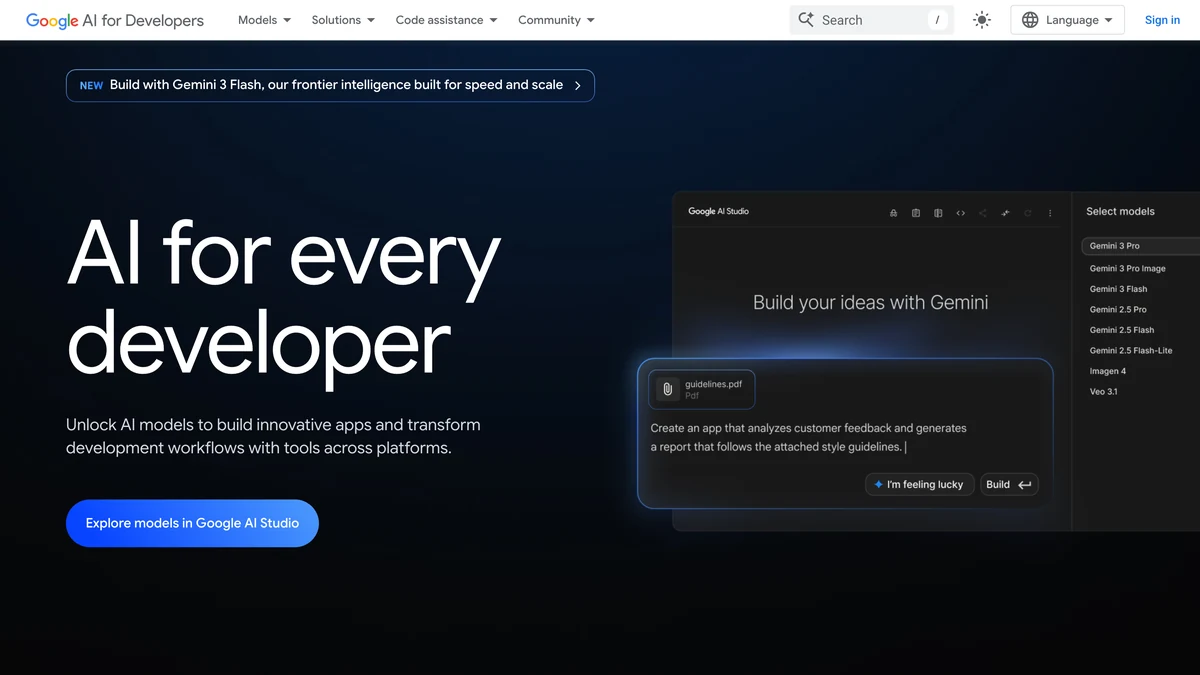
Google Gemini API is the cost-leader option among proprietary LLM endpoints and the only model family with native video input at the API tier. Gemini 2.5 Flash combines a one-million-token the prompt window with input pricing under one dollar per million tokens, which collapses the economics of large-scale document ingestion. Teams already operating in Google Cloud reach the same model through Vertex AI, which adds VPC service controls, customer-managed encryption keys, and committed-use discounts on top of the public API surface.
The Gemini SDK is intentionally similar in shape to the OpenAI SDK, so swapping providers in an existing RAG pipeline is mostly an endpoint and message-format adjustment rather than a rewrite. The ordered steps below cover the minimum changes for a Python implementation. The Gemini AI developer review covers the same model family in more depth, and the AWS SageMaker vs Google Vertex AI vs Azure ML comparison sets out the cloud-platform context.
- Install the
google-genaipackage and authenticate with an API key from Google AI Studio, or with application default credentials when targeting Vertex AI. - Replace the OpenAI client instantiation with
genai.Client()and point the model parameter atgemini-2.5-flash. - Convert the OpenAI
messagesarray into the Geminicontentsstructure, mappingsystemprompts to thesystem_instructionfield. - Re-declare any function-calling tools using the Gemini
Toolschema, which uses OpenAPI-style declarations rather than the OpenAI JSON variant. - Re-test rate limits and inference latency against your traffic profile, since Flash routes through different regional capacity than the OpenAI endpoints.
Open-Source Alternatives: Meta Llama and Mistral
Meta Llama 3.1 and Mistral are the two open-source model families that have reached GPT-4 class quality with permissive enough licensing to support commercial self-hosted deployment. Llama 3.1 405B remains the largest publicly downloadable LLM with a frontier-grade evaluation profile, while Mistral Large 2 trades a smaller parameter count for stronger multilingual performance and a tighter inference footprint. Both can be operated through managed endpoints at Together AI, Replicate, Groq, or Fireworks, which removes the GPU burden while preserving the option to repatriate inference later.
| Attribute | Llama 3.1 405B | Mistral Large 2 |
|---|---|---|
| License | Llama 3.1 Community License (commercial use under 700M MAU) | Mistral Research License; commercial license sold separately |
| Hardware (self-hosted) | Approximately 8x H100 80GB for full-precision inference | Approximately 2x H100 80GB |
| Fine-tuning support | Full weight access; LoRA and QLoRA paths documented | Full weight access under research license |
| Inference latency (TTFT) | Sub-second on Groq LPU; 2-4s on standard GPU stacks | Sub-second on optimized managed endpoints |
| Managed API providers | Together AI, Replicate, Groq, Fireworks, AWS Bedrock | Mistral La Plateforme, Azure AI Foundry, AWS Bedrock |
The operational case for an open-source model is rarely about beating proprietary quality on a benchmark. It is about removing vendor lock-in, fixing inference latency under your own SLO, and qualifying for data-residency regimes that no public API meets. For workloads bound by GDPR Article 28 sub-processor rules or by sector regulations such as HIPAA without a BAA, a self-hosted deployment of Llama or Mistral inside a customer-controlled VPC is often the only viable path. Hyperscaler routes such as AWS Bedrock and Vertex AI host both families with enterprise-grade fine-tuning support, which closes most of the operational gap with running weights yourself.
Choosing the Right Model for Your Use Case
No single LLM wins every workload, and the five evaluation axes from the opening section rarely all point at the same vendor. The decision sequence below resolves the most common tie-breakers in order. Walk through it from top to bottom and stop at the first criterion that genuinely binds your project.
- Cost-bound batch workloads. Default to Gemini 2.5 Flash for proprietary endpoints or Mistral on a managed provider when you need the lowest blended token pricing.
- Long-context retrieval-augmented generation. Default to Claude Sonnet 4 when documents exceed 128K tokens or when citation fidelity drives the user experience.
- Data sovereignty and regulatory containment. Default to self-hosted Llama 3.1 inside a controlled VPC when the workload cannot leave a jurisdiction or a tenant boundary.
- Ecosystem alignment. Match the model to your existing cloud: AWS Bedrock for AWS-native stacks, Vertex AI for GCP, and Azure OpenAI Service when Microsoft commercial terms govern procurement.
- Specialization through fine-tuning. Default to Llama or Mistral open weights when you need full LoRA control, custom tokenizers, or a fine-tuning support path that survives provider deprecation cycles.
Most production teams converge on a two-model architecture: a cheap, high-throughput LLM for ingestion and a higher-tier model for the final reasoning step. That pattern keeps token pricing predictable while preserving an API rate limit headroom on the premium endpoint for traffic spikes.
Migration Checklist: Moving Off OpenAI to an OpenAI Alternative
Switching providers is rarely as simple as swapping a base URL, because function-calling schemas, tokenization, and refusal behavior all differ. The checklist below is the minimum verification pass before flipping production traffic to a new developer API.
- Swap the endpoint URL and authentication header, and confirm the new SDK supports your streaming and batching modes.
- Re-tokenize representative prompts against the target model's tokenizer; token counts often shift 10 to 20 percent, which moves your cost projection.
- Re-run system prompts through the new model and patch any refusal or formatting regressions before they reach users.
- Audit every function-calling schema for compatibility; OpenAPI-style Gemini tools and Anthropic JSON tools both deviate from the OpenAI format.
- Project total cost on real traffic samples using the new input and output the price, including custom tuning fees if applicable.
- Verify your API rate limit headroom on the new provider against peak traffic, and request a tier upgrade before launch rather than after a throttling incident.
Run the checklist in a shadow-traffic environment for at least one full business cycle. Inference latency, refusal rates, and tool-call success rates all surface clearly in side-by-side traces long before they show up in user complaints.
Further reading
Frequently Asked Questions
Why consider alternatives to OpenAI?
Cost, data residency, and vendor lock-in are the three most common triggers. OpenAI's output API pricing can become significant at production scale; alternatives such as Gemini Flash or self-hosted Llama 3.1 offer lower per-token rates or zero marginal cost. Teams in regulated industries also prefer providers that offer EU data-residency commitments or fully on-premises deployment options that OpenAI's API does not support.
What factors should I evaluate when choosing a language model API?
Five attributes drive most selection decisions: the input window (how many tokens fit in a single call), input and output API pricing, function-calling and tool-use support, multimodal input availability. Whether the model weights can be self-hosted. For RAG workloads, the input window size and response time matter most; for cost-sensitive batch jobs, API pricing and API rate limits are the primary constraints.
Are there free or open-source alternatives to OpenAI's models?
Yes. Meta Llama 3.1 and Mistral are released under permissive open-weight licenses that allow commercial use and self-hosting. Running them requires GPU infrastructure (typically 80GB+ VRAM for the 405B Llama variant) or a third-party inference provider such as Groq, Together AI, or Replicate. These routes eliminate per-token API costs but introduce infrastructure and operational overhead.