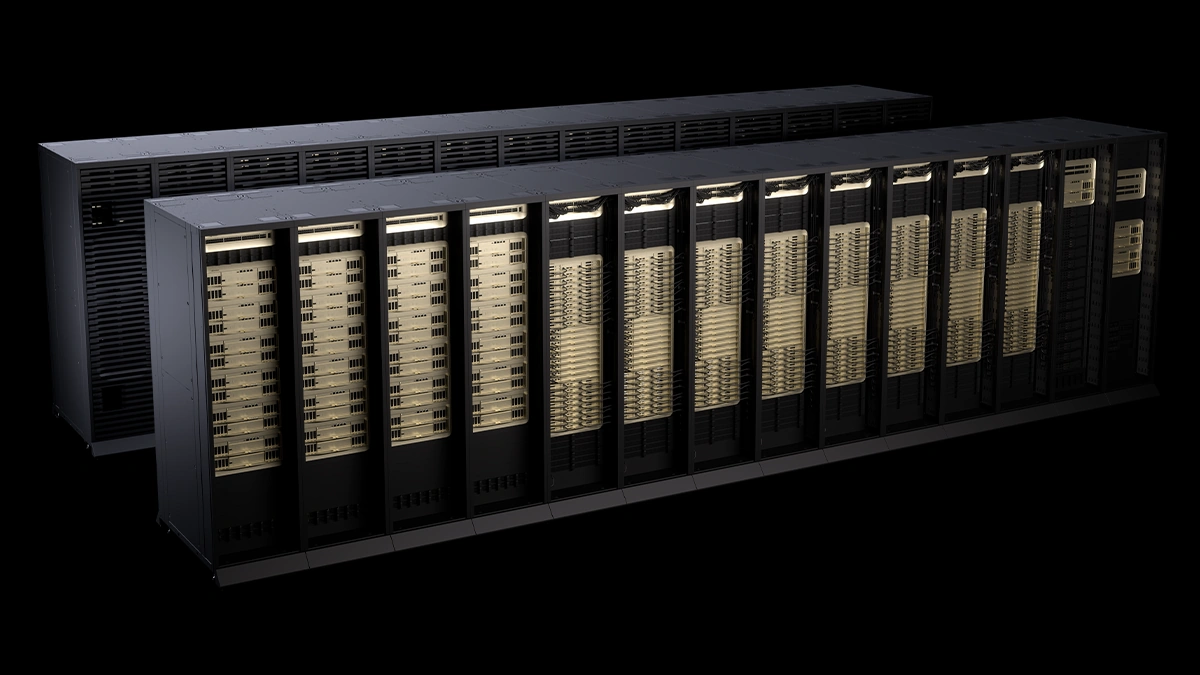
NVIDIA's Vera Rubin platform is built to run the continuous post-training loops that define agentic AI, with the company framing "intelligence per dollar" as the metric that governs agentic-era compute decisions beyond inference efficiency alone.
NVIDIA published the design rationale July 17, pointing to Nemotron 3 Ultra, an open-weight 550-billion-parameter mixture-of-experts model, as the benchmark anchor. The model scored 71.7 percent on SWE-bench Verified, producing a working patch for roughly seven in ten real software bugs drawn from open-source repositories, with each fix checked against the project's own test suite. The full post-training recipe runs on NeMo RL and is publicly disclosed, NVIDIA says, making the result reproducible. On the hardware side, NVIDIA says Vera Rubin trains MoE models at this scale with one-fourth the GPU count required by the Blackwell GB200 NVL72 generation.
The broader argument centers on two nested metrics. Cost per token measures the operating yield of inference: the all-in cost of delivering one million tokens. Intelligence per dollar sits one level up, capturing what it costs to build a model worth deploying and keep it current as its operating environment changes. Because agentic models must re-adapt to shifting tools, policies, and deployment environments continuously, post-training is no longer a one-time finishing step but a feedback loop that never stops. NVIDIA argues that lower cost per token reduces the overhead of every post-training cycle, which in turn raises the value of each token the model then serves.
Three production partners describe early Vera Rubin deployments. Prime Intellect, which continuously post-trains frontier open models, reported 30 percent greater CPU throughput on Vera CPUs compared with x86 alternatives when running reinforcement learning sandbox workloads, citing RDMA integration with Vera CPUs as a key driver. Perplexity runs an asynchronous RL stack across hundreds of NVIDIA GPUs, with a weight transfer engine that syncs trillion-parameter models in under two seconds between training and inference nodes; the resulting Qwen3 235B models are served on GB200 NVL72 systems. Together AI delivers post-training as a managed service on its AI Native Cloud platform, uses NVIDIA kernel libraries throughout, and plans to extend to Vera Rubin next.
The throughput and benchmark figures come from NVIDIA's own characterizations of partner results rather than independent testing. The "one-fourth the GPUs" comparison applies to MoE workloads at this scale, with rollout-token assumptions NVIDIA discloses only partially, so the figure should be read as a directional positioning claim rather than a general hardware specification.