NVIDIA introduced GR00T 2 at the Conference on Robot Learning in Austin, Texas, a world action model that predicts future video and robot actions together. The model is built on NVIDIA Cosmos and runs on parallel grippers, dexterous hands and humanoids.
Most of what GR00T 2 learned from is footage of people. According to NVIDIA Research, the pretraining mix holds 402,730 hours of egocentric human video and 23,500 hours of robot teleoperation. It adds 10,184 hours of handheld-gripper demonstrations across 2,897 tasks. Only 100,000 of the human hours are public, as the Human-1M-100K set on Hugging Face.
NVIDIA Research tested GR00T 2 on 50 tasks never seen on the target robot, a bimanual machine with two Sharpa hands. Given only the instruction, the model succeeds in 40% of trials and completes 40 of the 50 tasks at least once. One demonstration per task lifts average success to 71%; five, under three minutes of robot data, reach 95% after a 30-minute fine-tune on a single RTX 5090.
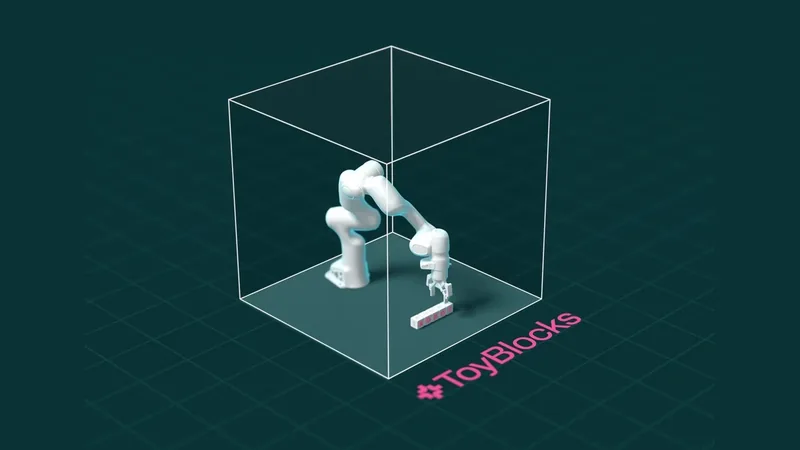
NVIDIA Research also tested GR00T 2 under agent control. When a reasoning model calls GR00T 2 through its API, a YAM arm finished at least 97 of 100 back-to-back assemblies for each of three toys, recovering from stalls along the way. On the YAM arm, marking grasp and release points on the model's camera view raised success on what-to-move-and-where instructions from 40% to 92%.
A smaller variant, GR00T 2 Turbo, trades size for speed. A smaller transformer and a more compact video representation let it run on the Unitree G1 humanoid's own Jetson Thor, at 124 milliseconds per prediction. Through the SONIC whole-body controller, it scooped and served popcorn in all 48 trials and cleared a table of mixed objects in 93% of trials. NVIDIA Research lists the GR00T 2 code as coming in December.
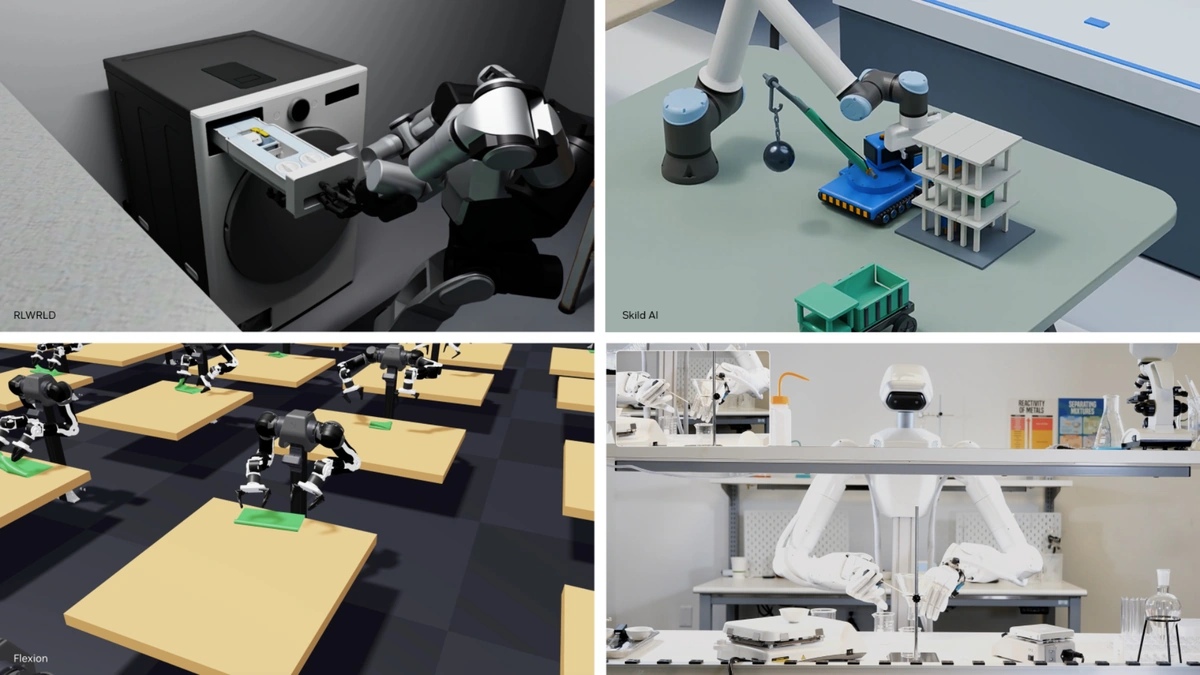
On benchmarks, NVIDIA says GR00T 2 ranks among the top three models across the vision language action and world action categories on RoboCasa365, RoboLab, RoboDojo and MolmoSpaces, with several leaderboard wins. Foxconn is applying it to server-manufacturing automation, Nexuni is testing it for laundry handling and Siemens is evaluating it for industrial use.
Alongside the model, NVIDIA shipped Isaac Lab 3.0, its open source robot-learning framework. Tighter integration with the Newton physics engine now lets it model deformable objects such as cables and cloth, and a new reinforcement post-training library targets foundation models like GR00T. On a vision-based dexterous manipulation benchmark, the Newton-backed release reached up to 2.5 times the training throughput of the 2.3 version on PhysX.