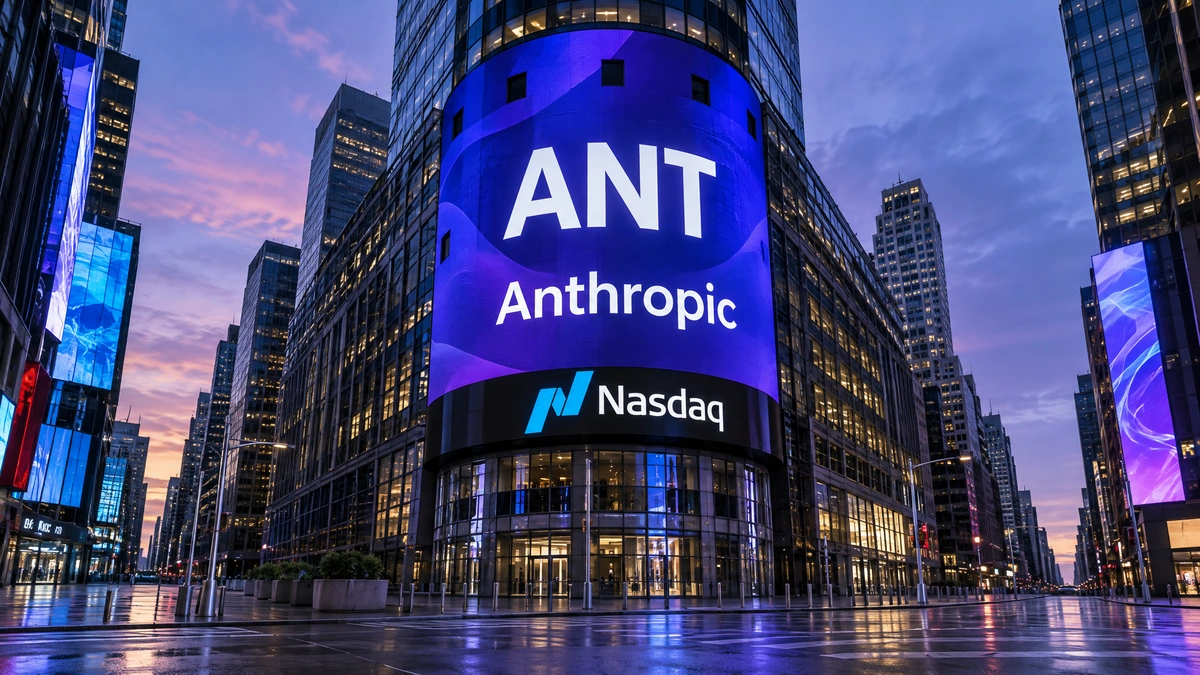
Anthropic, the company behind the Claude AI models, began the roadshow for its initial public offering on November 10: the round of presentations to investors that comes before a company sets its final share price. According to Anthropic, 825 million Class A shares are on offer at an expected $70 to $78 each, and it has applied to list them on the Nasdaq Global Select Market under the symbol ANT. Most of those shares are new stock from Anthropic, which at that range would raise about $56.1 billion to $62.5 billion before the banks' fees.
No share has been sold yet. The registration statement Anthropic filed with the SEC has not become effective, and until it does no shares can be sold and no offer to buy them can be accepted. The final price and the first trading day are still open. At the top of the range, TechCrunch and CNBC both put the company's value at about $1.4 trillion. The filings also set out who would run it: CNBC and Reuters report that the seven co-founders would control 50.1% of the vote for the foreseeable future, in CNBC's words, and the proposed charter lets a separate trust elect a majority of the board.
Anthropic itself would raise $56.1 billion to $62.5 billion
Of the 825,000,000 shares, Anthropic is selling 801,351,354. At $70 that is about $56.1 billion before underwriting fees. At $78 it is about $62.5 billion.
The other 23,648,646 shares are being sold by existing shareholders, and the $1.66 billion to $1.84 billion they would fetch goes to those sellers, not to Anthropic. That is why the $64.35 billion top figure for the whole sale, used by both TechCrunch and CNBC, is larger than what the company would receive.
TechCrunch reported that each of the seven co-founders is selling 3,378,378 shares. Each stake is worth just over $236 million at the bottom of the range and just under $264 million at the top. Seven times that share count is 23,648,646, the full selling-shareholder total in Anthropic's release, so the co-founders account for all of it. Reuters, reporting on the September filing, said the co-founders had pledged to give 80% of their personal Anthropic equity to charitable causes, a pledge Anthropic says dates to the company's founding.
Anthropic also expects to give the banks running the sale, the underwriters, a 30-day option to buy up to 123,750,000 more shares. A legal opinion filed with the November 10 amendment shows that all of those would be new shares from Anthropic. With those shares added to its own, the company's take before fees would rise to about $64.8 billion at $70. At $78 it would be about $72.2 billion. The June draft of the filing said the net proceeds would go to general corporate purposes.
A second sale sits beside the offering. CNBC and TechCrunch both reported a $26 billion private placement of nonvoting Class N stock, at the IPO price, to AMD, Broadcom, Google, Micron, Microsoft, Nvidia and TSMC. Google and Nvidia are putting in $10 billion each, TechCrunch reported. Google's agreement, dated November 10, sets its share count as $10 billion divided by the IPO price, rounded down and subject to an ownership cap. The placement closes only if the SEC declares the registration effective and the IPO itself closes.
A $1.4 trillion value at the top of the range
At $78 a share, TechCrunch put Anthropic's value at $1.404 trillion and CNBC at up to $1.405 trillion, both on a fully diluted basis, which counts every share that could be issued. That is up from $965 billion at the Series H round in May. Anthropic's own funding announcements trace the climb:
| Round | Date | Raised | Valuation after the round | Led by |
|---|---|---|---|---|
| Series E | March 3, 2025 | $3.5 billion | $61.5 billion | Lightspeed |
| Series F | September 2, 2025 | $13 billion | $183 billion | ICONIQ |
| Series G | February 12, 2026 | $30 billion | $380 billion | GIC and Coatue |
| Series H | May 28, 2026 | $65 billion | $965 billion | Altimeter Capital, Dragoneer, Greenoaks and Sequoia Capital |
The Series H total included $15 billion that cloud companies had committed earlier, $5 billion of it from Amazon.
CNBC set the deal against SpaceX, which went public about five months earlier in an offering CNBC said raised $85.7 billion. SpaceX priced 555,555,555 Class A shares at $135 on June 11, 2026, with trading expected on Nasdaq the next day. That base deal comes to about $75.0 billion before any option shares, against $64.35 billion for Anthropic's base deal at the top of its range.
$33.2 billion of revenue and a $104 billion loss in nine months
The registration statement, or S-1, is the document a company files with the SEC before selling shares to the public, and Anthropic's has come out in stages. Anthropic submitted a confidential draft on June 1 and filed publicly on October 26. Amendments followed on November 2 and November 10.
In the nine months to September 30, 2026, Anthropic took in $33.24 billion of revenue, CNBC reported from the amended filing. That is about 13 times the same period a year earlier; CNBC put the rise at roughly 1,200%. Third-quarter revenue alone was $17 billion, according to TechCrunch.
The net loss for those nine months was $104 billion, against $25.1 billion a year earlier. Most of it, per CNBC, came from changes in the fair value of convertible notes and derivative liabilities: a change in the value at which Anthropic carries those instruments on its books. TechCrunch put cash and short-term investments at nearly $132 billion.
From the October 26 filing, CNBC reported first-half 2026 revenue of $16.29 billion against $2.38 billion of cost of revenue, and calculated an 85% gross margin. The filing says operating margins are expected to fluctuate over time, particularly in periods when substantial new compute is delivered.
Anthropic also publishes run-rate revenue, a measure it defines itself rather than revenue under accounting rules. It was $14 billion at the Series G in February 2026, and Anthropic said it had crossed $47 billion by the Series H in May. CNBC and TechCrunch report that the amended filing puts it at roughly $81 billion at the end of October, about $10 billion higher than a month earlier.
What Anthropic has agreed to spend is far larger. The October filing showed about $417 billion of future payments owed to compute providers, CNBC reported. In the November amended filings, TechCrunch counted $900.9 billion of compute and infrastructure commitments, while a CNBC headline gave purchase commitments of $895.4 billion. TechCrunch's figure is about 27 times the nine-month revenue: $900.9 billion against $33.2 billion. The payments run for years. Per CNBC, the Amazon commitment runs through April 2036 and the Google chip commitment through 2033.
The three clouds that sell Anthropic compute also own part of it
The June draft named the overlap: Amazon, Google and Microsoft, through affiliates, have made significant equity investments in Anthropic. Its risk factors also cover compute itself. The October filing, as quoted by CNBC, warns that if Anthropic fails to secure enough compute, or to direct its limited compute well across its workloads, it risks "falling behind the technological frontier." It also warns, CNBC reported, that ongoing issues with the Trump administration and the Department of Defense could cause material revenue losses or business disruptions.
Amazon has invested $13 billion since 2023, CNBC reported from the S-1. Anthropic said on April 20, 2026 that Amazon was investing $5 billion that day on top of $8 billion before, and that up to $20 billion more could follow. The S-1 caps Amazon's stake at 12% and gives it nonvoting shares and no board or observer seat, according to CNBC.
Larger sums flow the other way. In the same April deal, Anthropic committed more than $100 billion over ten years to AWS for up to 5 gigawatts of new capacity. CNBC reported that the S-1 describes that April commitment as at least $110 billion with Amazon through April 2036, owed "regardless of actual usage."
Google's ties run through chips. Anthropic said in October 2025 that it would expand to up to one million Google Cloud TPUs, Google's AI chips. In April 2026 it said it had signed with Google and Broadcom for multiple gigawatts of next-generation TPU capacity expected from 2027. That same April, TechCrunch reported, citing Anthropic, that Google committed $10 billion with up to $30 billion more if Anthropic hits performance targets. CNBC put the TPU commitment in the S-1 at $114.5 billion through 2033.
Microsoft's deal dates to November 2025, when Anthropic committed to buy $30 billion of Azure compute and to contract up to one gigawatt more, with Microsoft and Nvidia agreeing to invest. CNBC reported that the S-1 shows the agreement since modified: Anthropic now intends to spend at least $44.9 billion with Microsoft between November 2026 and May 2033. In May, Anthropic's Series H announcement called AWS its primary cloud provider and training partner, with Claude available on all three clouds.
A voting majority for seven founders, the board majority for a trust
The proposed charter authorizes five classes of common stock (A, N, E, F and T); four of them shape the offering:
- Class A: the shares sold in the IPO, with one vote each in the June draft.
- Class N: no vote except where the law requires it. Amazon's shares, the $26 billion placement and the Public Benefit Fund described below are all in this class.
- Class F: the founders' class. Reuters described a single share, directed by a majority vote of the seven co-founders, carrying 50.1% of the vote on key corporate matters. CNBC reported that the co-founders will be the sole members of Founder LLC, a new entity holding 50.1% of the voting power.
- Class T: a single share held by the Long-Term Benefit Trust. Under the proposed certificate of incorporation, its holder alone elects the smallest number of directors that makes up a board majority.
Put together, the founders can determine the outcome of shareholder votes, CNBC reported, and the trust elects the board majority. Reuters reported that this means four of seven directors, with the founders and Class A holders electing the other three. The filing says this voting power is not derived from or proportionate to how much of the company the founders or the trust own, and that it won't be diluted. Because the trust chooses the board majority, Nasdaq's governance rules treat Anthropic as a controlled company, CNBC reported.
The filing spells out what that can cost shareholders. Reuters quoted its warning that the corporate setup could lead to decisions "that may conflict with short-, medium-, or long-term financial interests and business performance." Another passage, quoted by CNBC, says the structure may make it harder to replace directors and may deprive stockholders of a chance to sell at a premium.
Neither arrangement is permanent on paper. The founders can choose to end their control ten years after the IPO, TechCrunch reported. Under the proposed charter, it also ends 450 days after Founder LLC has had fewer than three qualifying members for 90 days in a row; Reuters described this as a transition period once two or fewer co-founders or their successors remain. The trust has an exit too. Under the proposed charter, once the founders' share has sunset, holders of 85% of outstanding Class A stock can vote to redeem the trust's Class T share, and a vote of 80% of the whole board together with the trust can also redeem it.
For a Class A holder, the vote is real but has little reach over board seats while the founders' share is in place and the founders agree among themselves; if they have no majority, TechCrunch reported, their shares are voted in proportion with common holders. Marco Mari, a PhD candidate at Bocconi University and a research fellow at NYU Law's Program in Corporate Law and Policy, wrote on October 2, before the public filing, that the plan gives the founders and the trust effective power to choose every director, leaving public investors no independent say over board seats.
How Anthropic has described the trust since 2023
When Anthropic introduced the Long-Term Benefit Trust in September 2023, it described five financially disinterested members who could select and remove a portion of the board that would grow over time, eventually to a majority, and said the trust would elect a majority within four years. It said it did not expect the trust to step into day-to-day decisions or ordinary commercial strategy, and that it was not yet ready to recommend the model to others.
The filings have caught up with that plan. The June draft said the trust could elect and remove certain members of the board. By October, the charter exhibit gave the Class T holder a board majority, and Anthropic's page on Christopher Stubbs joining the trust, dated October 21, 2026, said it has the authority to appoint a majority of the board.
The trust has four members, not five. As of an October 2026 update, Anthropic lists Neil Buddy Shah as the trust's chair, with Richard Fontaine, Ben Bernanke and Christopher Stubbs. Five earlier trustees have left, most recently Tino Cuéllar, who stepped down in August 2026 to join Anthropic as Chief Global Affairs Officer. Anthropic said in January 2026 that new trustees are chosen by existing trustees in consultation with the company and hold no financial stake.
The founders' share and the trust both sit inside Anthropic's status as a Delaware public benefit corporation, a company whose directors must weigh a stated public purpose alongside profit. The 2023 page and the proposed charter state the purpose in near-identical words: responsibly developing and maintaining advanced AI for the long-term benefit of humanity. Delaware attorney Lawrence Hamermesh told CNBC that the directors' duty is to balance that purpose against profit, and that if asked what balancing means, he would say "Good luck."
Anthropic has also set aside equity for the purpose. On October 18, 2026, it said that, subject to stockholder approval, 5% of its shares would go to a new Public Benefit Fund that it wholly owns. The board may add 2% each time the company's value rises another 50% above a set baseline. CNBC counted about 847 million Class N shares in the fund, roughly 5% of fully diluted shares as of June 30.
A reported November 18 pricing, and who may sell afterward
Goldman Sachs and Morgan Stanley represent the banks selling the shares, according to the form of underwriting agreement filed November 10, which also addresses Deutsche Bank in its header.
CNBC reported, citing unnamed people familiar with the details, that Anthropic plans to price on November 18, start trading on November 19 and direct about 20% of the offering to individual investors. Anthropic has not announced a pricing date. A November 2 filing, per CNBC, has Anthropic allocating some shares to brokerage customers of Charles Schwab, Fidelity, Robinhood, SoFi and Morgan Stanley's E-Trade.
The underwriting agreement also sets a lock-up, a period in which the company agrees not to sell more of its stock. It runs until the earlier of the 180th day after the prospectus date or the second trading day after Anthropic reports first-quarter 2027 results. Selling shareholders sign separate lock-up agreements. The seven chip and cloud companies buying $26 billion of Class N stock are outside those terms: the company said the placement shares are not registered in the offering and are not subject to lock-up agreements with the underwriters, CNBC reported.