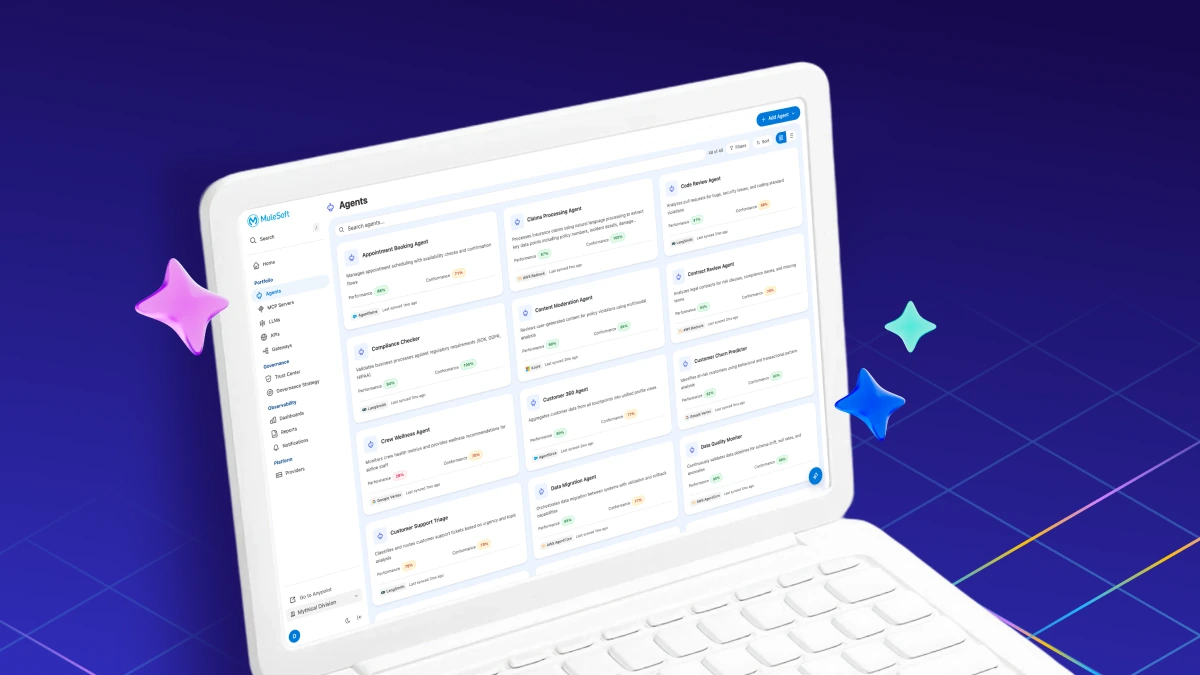
Salesforce Agent Fabric gained a large set of controls on April 15, 2026, built on a blunt premise: not every business process needs a fully autonomous agent, and not every task should be sent to the same expensive model. The expansion adds deterministic orchestration, centralized governance over which models get called, and wider discovery of the agents already running inside a company. Salesforce positions Agent Fabric as a control plane for a multi-vendor AI stack, the layer a team uses to see and steer agents it did not necessarily build itself.
The headline concept is guided determinism. A new capability called Agent Script, delivered through Agent Broker, lets customers pin down the fixed handoff rules of a process while leaving the reasoning between those steps to the models, which Salesforce says yields more consistent results than turning an agent fully loose. Underneath, LLM Governance on the company's AI Gateway standardizes token management and routing across models, and a Trusted Agent Identity feature can require a mobile approval before an agent takes a high-stakes action such as moving money. Automated scanners extend discovery to MCP servers and to platforms including Amazon Bedrock, Microsoft Foundry, and GoDaddy, and Expanded Model Choice lets customers pair Salesforce's own engine with OpenAI and Gemini.
Salesforce says Agent Fabric has coordinated hundreds of agents across diverse platforms for customers including Capita, Alcon, and Diabsolut since it launched in September 2025. Those are the company's own figures, describing its own customer base rather than independent measurement, and adoption counts say little about whether the orchestration holds up under load. The governance additions are the more concrete part of the release: the AI Gateway, MCP Bridge, and Trusted Agent Identity are generally available now, with the Agent Broker beta starting in April 2026 and full availability due in June.
The interesting move is where Salesforce is trying to stand. By governing OpenAI, Gemini, and its own models through one gateway, and by scanning agents that live on Bedrock and Foundry, it is claiming the neutral referee position above a market of rivals rather than betting the platform on a single model. That is a defensible place to be while enterprises are still hedging their model choices. It also depends on those rivals continuing to expose their agents cleanly through open standards like MCP, and on customers accepting a Salesforce layer as the place governance belongs instead of their cloud provider's. Whether guided determinism proves to be a real reliability gain or mostly a naming exercise will show once the Agent Broker beta meets processes messier than a demo.