An AI evaluation harness is a software framework that runs a language model against a defined set of benchmark tasks, formats the prompts, scores the outputs, and reports the results in a reproducible way. When a leaderboard shows one model ahead of another on MMLU or HumanEval, an evaluation harness is almost always the program that actually produced that number. EleutherAI's lm-evaluation-harness and Stanford CRFM's HELM are the two most cited examples, and they solve related but distinct problems: one is a runnable code framework, the other is a benchmarking methodology for structuring how results get reported. Neither is the benchmark itself. A benchmark defines what to test; a harness is the machinery that runs the test the same way every time.
Why an Evaluation Harness Exists Separately From the Benchmark
An evaluation harness exists because a benchmark like MMLU or GSM8K is only a fixed set of questions and answers. Turning that set into a fair comparison across models requires dozens of small decisions: how the prompt is worded, whether few-shot examples are included, how a partially correct answer is scored, and how many requests get batched together for inference. If every research team makes those decisions independently, two labs can report different scores for the same benchmark without either one being wrong. An evaluation harness fixes those decisions in code so the process is identical every time it runs. EleutherAI describes lm-evaluation-harness as providing "a unified framework to test generative language models on a large number of different evaluation tasks," according to the project's GitHub page. That unification, not any single benchmark, is the actual product.
This is also why evaluation with publicly available prompts matters. EleutherAI's documentation states that publishing the exact prompts used "ensures reproducibility and comparability between papers." A second team can rerun the same evaluation harness against a different model and trust that any score gap reflects a real difference in the model, not a difference in how the question was phrased.
How an Evaluation Harness Like lm-evaluation-harness Runs a Single Evaluation
An evaluation harness such as lm-evaluation-harness structures every evaluation task as a configuration file, typically YAML, rather than hand-written code, which is what lets it support over 60 standard academic benchmarks with hundreds of subtasks and variants, per its GitHub repository. The project's own configuration guide documents that YAML format and its examples. Running a single task follows a consistent pipeline from task definition to a scored result, with metric scoring as the step that turns a raw model output into a comparable number; a custom evaluation metric can replace the default metric scoring logic when a task author needs one.
- Load the task definition, which specifies the dataset, the prompt template, and which metric applies.
- Format each example into a prompt using that template, substituting the question and any answer choices.
- Apply few-shot examples if the task calls for few-shot evaluation, prepending worked examples ahead of the target question so the model sees the expected answer format before responding.
- Send prompts to the model backend in batched inference passes rather than one request at a time, which keeps large evaluation runs practical on both local hardware and commercial APIs.
- Score each output against the task's defined metric, whether that is exact-match accuracy, a calibration measure, or a custom evaluation metric supplied by the task author.
- Aggregate scores across the full task and, when running a task suite, across every task in the run, producing the results table a researcher or leaderboard maintainer publishes.
This AI evaluation harness supports models loaded via transformers, GPT-NeoX, and Megatron-DeepSpeed, along with fast inference through vLLM, commercial APIs including OpenAI and TextSynth, and adapters such as LoRA through Hugging Face's PEFT library, according to its README. The base installation provides only the core evaluation framework; model backends install separately using optional extras such as pip install "lm_eval[hf]" for the Hugging Face transformers backend or pip install "lm_eval[vllm]" for vLLM, a setup path documented in the project's configuration guide. That separation keeps a lightweight core while letting a user pull in only the inference stack their evaluation actually needs.
Model Backends an Evaluation Harness Can Target
An evaluation harness can point at very different kinds of model backend without rewriting its benchmark logic, because a task definition is kept separate from the inference code. The documented backend support in lm-evaluation-harness spans:
- Hugging Face transformers, including quantized loading through GPTQModel and AutoGPTQ
- GPT-NeoX and Megatron-DeepSpeed for large distributed training stacks
- vLLM for fast, memory-efficient batched inference
- Commercial APIs, including OpenAI and TextSynth
- Adapters such as LoRA through Hugging Face's PEFT library
- Local models and benchmarks run entirely offline
That backend flexibility is a large part of why lm-evaluation-harness became the backend for Hugging Face's Open LLM Leaderboard. A public leaderboard needs to evaluate a constant stream of newly submitted models without custom-coding a new pipeline for each one, and a harness with a stable task format and pluggable backends is built for exactly that. EleutherAI's repository states the harness "has been used in hundreds of papers" and is used internally by organizations including NVIDIA, Cohere, BigScience, BigCode, Nous Research, and Mosaic ML.
HELM Approaches Evaluation as a Reporting Framework, Not Just a Harness
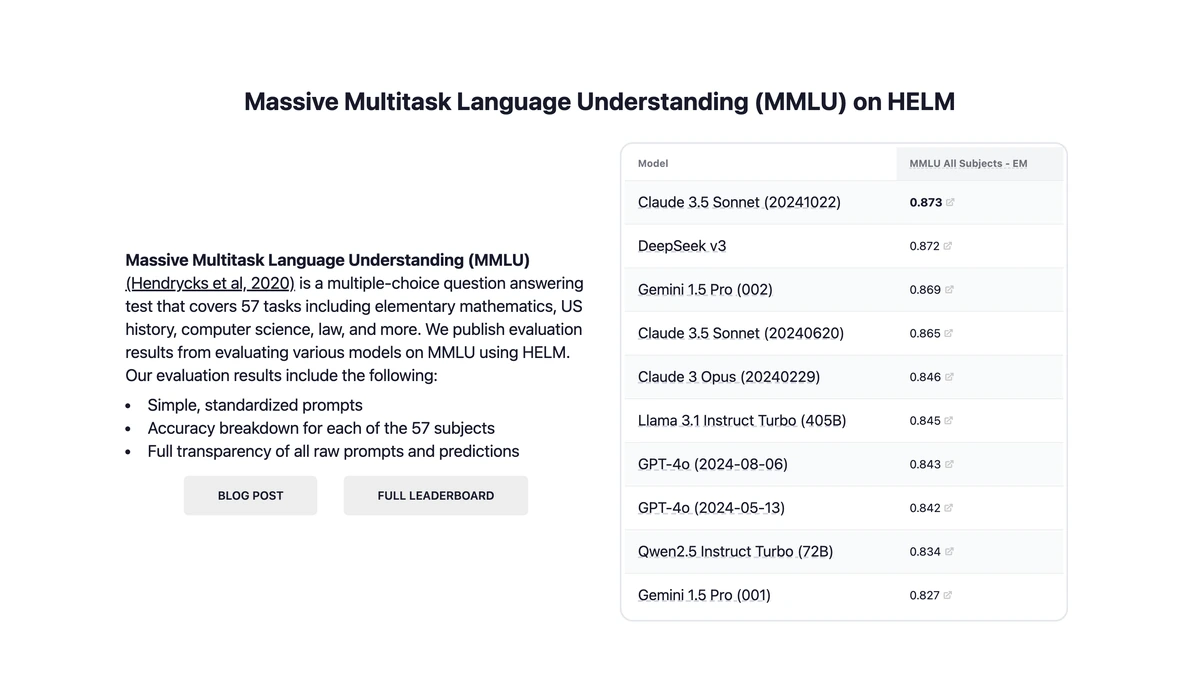
HELM takes a different approach from a pure evaluation harness. Stanford CRFM built HELM, Holistic Evaluation of Language Models, to address a related but different gap. Where lm-evaluation-harness is primarily concerned with running tasks consistently, HELM is concerned with making the resulting evaluation transparent and comparable across an entire field of models at once. Stanford CRFM writes that HELM "aims to provide the much needed transparency" and is intended "to serve as a map for language models, continually updated over time, through collaboration with the broader community," according to the announcement on the CRFM site (crfm.stanford.edu).
HELM's first version, as announced by Stanford CRFM at crfm.stanford.edu, measured 16 core scenarios across 7 metrics: accuracy, calibration, robustness, fairness, bias, toxicity, and efficiency. Stanford CRFM frames holistic evaluation around three elements: broad coverage and recognition of incompleteness, multi-metric measurement, and standardization. Beyond the core scenarios, HELM also runs 26 finer-grained targeted evaluations that isolate specific skills, such as reasoning and commonsense knowledge, and specific risks, such as disinformation and memorization or copyright exposure; each targeted evaluation narrows the scope to one capability rather than a broad scenario. Those figures describe the scope HELM launched with in 2022, not a fixed or final total; Stanford CRFM's own framing treats HELM as a continually updated project rather than a one-time release.
Evaluation Harness vs. Reporting Framework: lm-evaluation-harness and HELM Compared

An evaluation harness and a reporting framework like HELM do not usually force a research team to choose one over the other, because they answer different questions. The table below lays out where each tool's primary purpose sits.
| Aspect | lm-evaluation-harness | HELM |
|---|---|---|
| Built by | EleutherAI | Stanford CRFM |
| Primary purpose | Run task definitions against a model backend and score outputs | Report transparent, standardized, multi-metric results across many models |
| Core unit | A task definition (dataset, prompt template, metric) | A core scenario measured across multiple metrics at once |
| Typical user | A team benchmarking a specific model against many tasks | A reader comparing many models on the same standardized report |
| Output form | Per-task scores and a results table | A public, continually updated comparison map |
A team can use lm-evaluation-harness to run the underlying tasks and a HELM-style reporting structure to present those results in a standardized, comparable form. The two are not competitors with identical design goals; one is infrastructure for running an evaluation, the other is a framework for reporting one.
Why an Evaluation Harness Matters for Reproducibility
An evaluation harness matters for reproducibility because its core value is removing hidden variation from a claimed score. If a vendor reports a benchmark result without naming the harness, the prompt template, or the number of few-shot examples used, an independent reader has no way to reproduce that number, only to trust it. A shared, open evaluation harness that publishes its public prompts alongside a written configuration guide turns a self-reported score into a checkable claim: another team can install the same harness, point it at the same task with the same configuration, and compare its output against what was published. That is the practical meaning of reproducibility and comparability in this context: the same task, the same public prompt, and a score that can be independently rerun.
An evaluation harness also has a layer where its guarantees stop. A harness standardizes how a benchmark runs, not whether the underlying benchmark data is trustworthy. It cannot detect whether test questions leaked into a model's training corpus, and it will faithfully report whatever metric a task defines even when that metric is a weak proxy for real-world usefulness. Other tools in the AI evaluation and benchmarks space, including OpenAI Evals and BIG-bench, take a similar task-and-metric approach to running evaluations at scale, but every harness in this category runs whatever task it is pointed at with the same blind faith in that task's design. A harness answers "did the model get the defined tasks right," not "were the tasks worth asking."
Choosing How Deep to Look at Evaluation Harness Output
An evaluation harness's output is only as meaningful as its configuration, which is the practical takeaway for most readers comparing models. Two models "scoring" 80 percent on the same-named benchmark can still be incomparable if one run used zero-shot prompting and the other used a few-shot evaluation with worked examples, or if one used a different prompt template entirely. Reputable leaderboards, including Hugging Face's Open LLM Leaderboard, standardize on a specific evaluation harness and configuration precisely to remove that ambiguity. When a comparison matters, checking which harness produced a score, and under what configuration, is a faster way to judge its reliability than reading the headline number alone.
References
- Stanford CRFM: Introducing HELM, Holistic Evaluation of Language Models
- EleutherAI: lm-evaluation-harness on GitHub
- EleutherAI: lm-evaluation-harness README
- EleutherAI: lm-evaluation-harness documentation index
Further reading
Frequently Asked Questions
What is an AI evaluation harness?
An AI evaluation harness is a software framework that runs a language model against defined benchmark tasks and scores its outputs. EleutherAI's lm-evaluation-harness handles prompt formatting, few-shot examples, and metric scoring, and reports the results; it is a widely used example.
What is the difference between lm-evaluation-harness and HELM?
lm-evaluation-harness is a runnable code framework for executing evaluation tasks against a model backend. HELM, built by Stanford CRFM, is a benchmarking methodology focused on broad, multi-metric, standardized reporting across many scenarios. A team can use a harness to run tasks and a framework like HELM to structure how the results get reported and compared.
Why does an evaluation harness matter for comparing AI models?
A harness applies the same task definitions, prompt templates, and scoring code to every model it evaluates, which is what makes a leaderboard comparison meaningful. Without a shared harness, two teams could report different scores for the same benchmark simply because they formatted prompts or counted a correct answer differently.
Does an evaluation harness only work with open-source models?
No. lm-evaluation-harness supports models loaded through libraries like transformers and vLLM, but it also supports commercial APIs including OpenAI and TextSynth, so the same task suite can run against locally hosted and API-based models.
What are the limits of using an evaluation harness?
A harness standardizes how a benchmark runs, but it cannot guarantee the underlying data is free of training-set leakage. It reports whatever metric a task defines, even a weak proxy for real-world usefulness, so harness output is a controlled measurement, not a full picture of model quality.