
Benchmark contamination is a data integrity problem in AI evaluation that occurs when a language model has been exposed to evaluation questions or their answers during training, producing inflated and unreliable benchmark scores. Researchers also call it benchmark data contamination, BDC for short, or simply data leakage. The problem sits underneath every other evaluation method in this sub-pillar: an MMLU or HumanEval score, a Chatbot Arena ranking, or an agentic benchmark result is only meaningful if the model was not simply recalling memorized test material.
A 2024 survey on arXiv defines the mechanism precisely: benchmark data contamination "occurs when language models inadvertently incorporate evaluation benchmark information from their training data, leading to inaccurate or unreliable performance during the evaluation phase," according to the paper's abstract on arXiv. The survey frames benchmark contamination as a significant issue across large language models generally, not a defect isolated to any single vendor's models.
How training data ends up contaminated with benchmark answers
Most frontier language models train on a pretraining corpus built from a broad web crawl, commonly a Common Crawl snapshot supplemented with curated sources. Popular benchmarks like MMLU, GSM8K, and HumanEval have existed online for years before any given model's training cutoff, which creates the opening for data leakage. A benchmark's questions and reference answers get copied onto GitHub repositories, academic paper mirrors, course syllabi, technical blogs, and forum threads. When a web crawl later scrapes those pages into a training corpus, the model does not learn to solve the underlying task; it learns the answer key.
This is distinct from a second contamination pathway that OpenAI describes in its evaluation guidance. According to OpenAI's page on trustworthy third-party evaluations, contamination in a third-party evaluation setting means "overperforming because evaluation tasks, answers, or close variants appeared in training data or were discoverable during the evaluation, such as through browsing." That second clause matters: a model with live web access during a benchmark run can look up the answer to a question in real time, which produces the same inflated score as training-time leakage even though no data leakage into the training corpus occurred at all. Conflating the two pathways is a common evaluation mistake, since the fix for one, decontaminating the pretraining corpus, does nothing to stop the other.
The practical effect is the same either way: overfitting to a specific test set rather than demonstrating generalization. A model that has memorized GSM8K's arithmetic word problems, for instance, can post a high score without having improved at arithmetic reasoning in general. That gap between benchmark performance and real-world capability is precisely what makes leaderboard scores unreliable as a proxy for deployment readiness, and it is why frontier labs increasingly publish training cutoff dates alongside benchmark results, so a reader can at least check whether a benchmark predates or postdates a model's training corpus.
Detection techniques: how contamination gets caught
The arXiv survey organizes existing benchmark contamination research into two main categories: detection techniques and mitigation strategies, according to the paper's full text. Detection comes first, because a lab or an independent auditor has to establish that contamination happened before choosing a mitigation strategy. Four detection methods recur across the literature:
- N-gram overlap and substring matching. An auditor scans the training corpus for sequences of words that exactly match a benchmark's test items. A high overlap rate between a specific benchmark's questions and the corpus is strong circumstantial evidence of data leakage, though it requires access to the training data, which most labs do not disclose.
- Canary strings. Benchmark maintainers embed a unique, meaningless string of characters into the official copy of a test set before release. If that exact string later shows up inside a model's training data or in the model's own generated output, it proves the official test set was scraped rather than an independent recreation of similar questions.
- Membership inference. This technique estimates the probability that a specific example was present during training by observing how a model behaves on it versus on a held-out, provably unseen paraphrase of the same question. A model that performs dramatically better on the exact original wording than on a semantically identical paraphrase is exhibiting a signature consistent with memorization rather than reasoning.
- Near-duplicate and paraphrase detection. Rather than looking for exact matches, this method flags training examples that are semantically close to benchmark items even after wording changes, catching contamination that survived light editing before it was re-published online.
None of these detection techniques is definitive on its own. N-gram overlap can flag common phrasing that has nothing to do with the benchmark; membership inference is probabilistic, not a yes-or-no verdict. In practice, credible contamination audits combine two or more of these signals and disclose the corpus access limitations under which the audit was run.
Mitigation strategies: curating, refactoring, and benchmark-free evaluation
The same arXiv survey splits mitigation strategies into three subcategories: curating new data, refactoring existing data, and benchmark-free evaluation. Each addresses contamination from a different angle rather than one superseding the others.
- Curating new data. The most direct fix is to write a fresh set of test questions that have never been published anywhere online, so there is no way for a training-time web crawl to have seen them. This is expensive to maintain because the new questions themselves become vulnerable to leakage the moment they are published and scraped for a future training run.
- Refactoring existing data. Instead of writing new questions from scratch, this approach systematically rewrites or perturbs existing benchmark items, changing numbers, variable names, or phrasing while preserving the underlying task difficulty. A model that memorized the original wording will fail the refactored version, while a model that learned the underlying skill will not.
- Benchmark-free evaluation. Rather than testing against any fixed, publishable test set, this strategy evaluates a model through methods that cannot be pre-memorized, such as live human-preference comparisons or dynamically generated tasks. The survey lists this as one mitigation path among three, not a settled consensus replacement for benchmark testing.
- Private and rolling test sets. A benchmark maintainer keeps some or all evaluation items unpublished, releasing only aggregate scores, and periodically swaps in new unpublished items so a stale, potentially leaked set is never in active use for long.
An evaluation harness like lm-eval-harness makes it straightforward to run a model against any of hundreds of published benchmarks in a standardized way, but standardization does not solve contamination by itself. A harness will happily report a high score on a fully memorized test set with the same confidence as a genuinely uncontaminated one; the harness measures execution, not data provenance.
Held-out, private, and rolling test sets compared
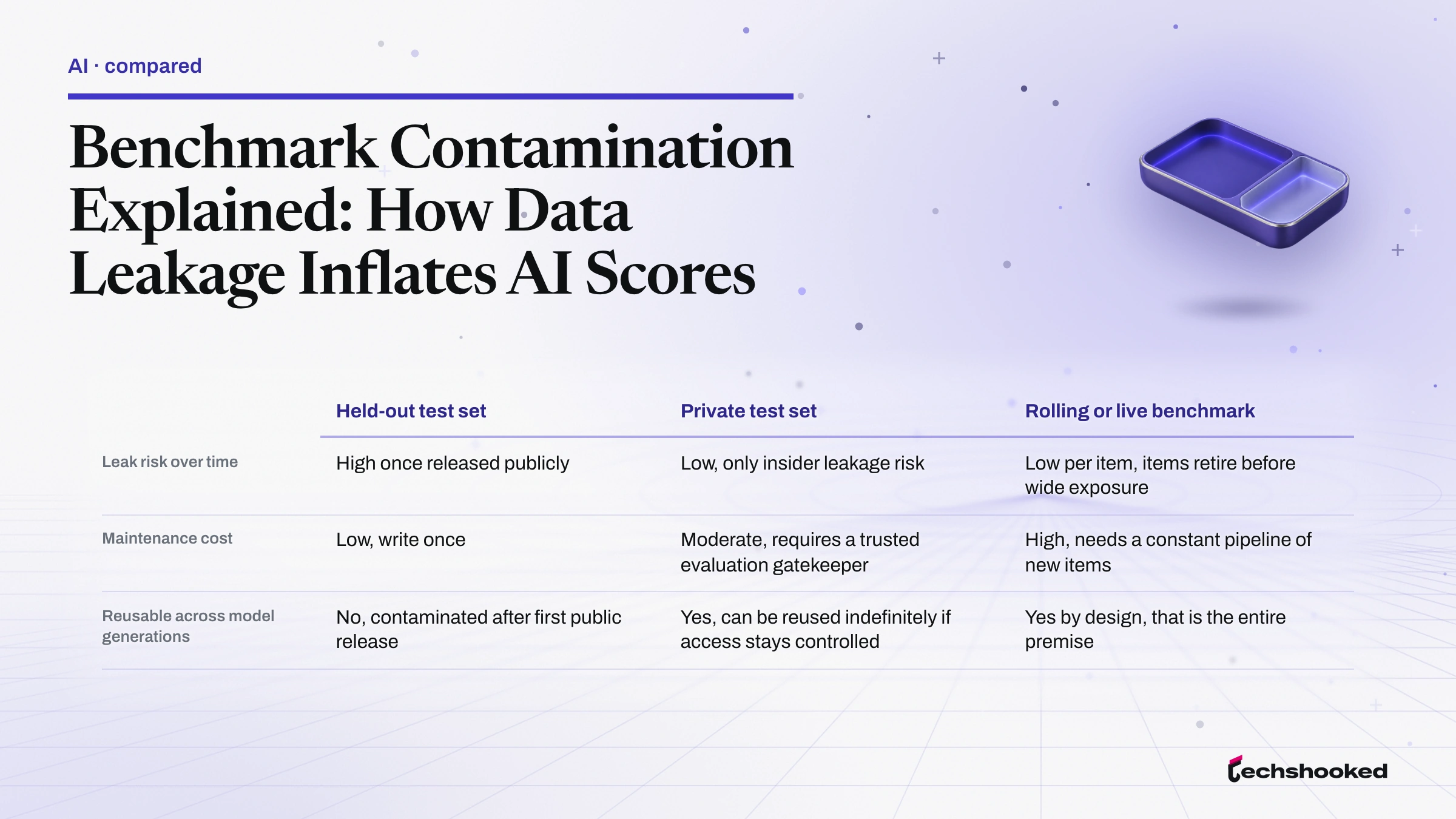
The three main approaches to keeping a test set clean trade off differently on leak risk, cost, and reusability across evaluation cycles.
| Approach | Leak risk over time | Maintenance cost | Reusable across model generations |
|---|---|---|---|
| Held-out test set (published after use) | High once released publicly | Low, write once | No, contaminated after first public release |
| Private test set (never published) | Low, only insider leakage risk | Moderate, requires a trusted evaluation gatekeeper | Yes, can be reused indefinitely if access stays controlled |
| Rolling or live benchmark (continuously refreshed) | Low per item, items retire before wide exposure | High, needs a constant pipeline of new items | Yes by design, that is the entire premise |
A held-out test set is the traditional academic model: questions are withheld from training, used once for evaluation, then published in a paper for transparency and reproducibility. That transparency is exactly what makes it vulnerable to future contamination, since the next model's pretraining corpus will likely have scraped the paper. A private test set solves that by never publishing the items at all, at the cost of asking the field to trust a gatekeeper's scoring rather than independently verifying it. A rolling or live benchmark, the approach behind systems like Chatbot Arena's ongoing human-preference comparisons, sidesteps both tradeoffs by treating freshness as the primary defense: no single test item stays in circulation long enough to be worth scraping.
Named benchmarks and the tooling built around evaluation benchmark integrity
The evaluation benchmark landscape most discussed in connection with benchmark contamination is the set of widely cited leaderboards that frontier language models report against: MMLU for broad knowledge, GSM8K for grade-school math reasoning, HumanEval for code generation, and SWE-bench for autonomous software engineering. Each is a rolling benchmark candidate in principle, since a maintainer could periodically retire old items and add fresh ones, but most were originally released as a single static held-out test set rather than as a continuously refreshed rolling benchmark. That static design is precisely the property that makes years-old items attractive scraping targets for a future pretraining corpus.
An evaluation harness standardizes how a benchmark is scored across different models, and a rolling benchmark like Chatbot Arena resists memorization by design, since human preference votes on fresh prompt pairs cannot be pre-scraped the way a fixed answer key can. Neither an evaluation harness nor a rolling benchmark performs data decontamination on its own. Data decontamination, the process of scrubbing known benchmark items out of a training corpus before a model is trained, remains a separate step that a lab has to run and disclose voluntarily; a harness only reports whatever score the model produces, contaminated or not.
OpenAI has published more than one benchmark built around this idea of sourcing tasks from an active external circuit rather than a static academic question bank, SWE-Lancer among them, on the reasoning that wholesale scraping and republishing is harder against a moving target than against a fixed evaluation benchmark. Even so, that design choice does not make data decontamination unnecessary. A lab that reports both a raw leaderboard score and a documented data decontamination pass, rather than the leaderboard score alone, is giving outside reviewers more to independently verify.
Who reports on evaluation benchmark integrity today
Public interest in benchmark contamination has grown alongside the industry practice of publishing a scorecard for every major model release. Vendor blog posts, independent Model Cards, and third-party leaderboards each carry a different incentive structure, which is one reason arXiv preprints remain a reference point: a peer-reviewable paper can document a Detection Technique or a Mitigation Strategy in enough methodological detail for another team to reproduce it, something a marketing page rarely attempts. Community leaderboard operators such as Hugging Face and LMSYS host public rankings precisely because a rolling benchmark hosted by a neutral third party is harder for any single vendor to game than a vendor's own internal test suite.
Coverage of benchmark contamination tends to reference a small set of well-known model families as shorthand for the broader industry, GPT-4, Claude, Gemini, and Llama among them, without necessarily claiming that any one of them has been proven contaminated. The 2024 arXiv survey follows this pattern: it frames Benchmark Data Contamination as a significant issue affecting large language models generally, citing the field's biggest names as context for why the problem matters at scale, rather than publishing a per-model contamination audit. A reader encountering a specific accusation against a specific vendor should treat the underlying evidence, not the model's name recognition, as the thing worth checking.
Independent researchers, university labs, and nonprofit evaluation groups increasingly publish their own Data Contamination audits alongside vendor self-reported numbers. A Github repository documenting an n-gram overlap analysis, a workshop paper proposing a new Canary String standard, or a blog post from a Machine Learning Engineering team walking through a Membership Inference test all serve the same underlying goal: giving the field a way to check a Leaderboard Score against something other than the vendor's own word. A short checklist of what an independent audit typically covers before it publishes contamination-adjusted leaderboard scores:
- Corpus access. Did the auditor obtain any portion of the Training Corpus, or is the analysis limited to Black Box Testing of model outputs?
- Benchmark coverage. Does the audit span a single Evaluation Benchmark such as MMLU, or a broader Benchmark Suite covering GSM8K, HumanEval, and SWE-bench together?
- Disclosure format. Is the finding published as a peer-reviewed Conference Paper, an arXiv Preprint, or an informal Blog Post with no external review?
- Vendor response. Did the Model Vendor acknowledge the finding, publish a Rebuttal, or run its own follow-up Data Decontamination pass?
Why contamination matters even when a score looks credible
A high benchmark score does not automatically mean a model is contaminated. Genuine capability improvements happen, and most published leaderboard results reflect real progress. Benchmark contamination is a risk factor that can inflate scores and undermine cross-model comparisons, not a certainty attached to every strong result. The arXiv survey is explicit that assessments based on traditional benchmarks "may not accurately represent the true capabilities" of a model when contamination is present, without claiming that any specific named model's published scores are contaminated.
The practical stakes are highest wherever a benchmark score gets used to make a decision: a buyer choosing between vendors, a research team selecting a base model to fine-tune, or a journalist reporting a leaderboard result as evidence of capability. OpenAI's own SWE-Lancer benchmark illustrates why evaluation design at scale matters here. SWE-Lancer packages more than 1,400 real freelance software engineering tasks sourced from Upwork, valued at 1 million dollars total in real-world payouts, precisely because tasks pulled from an active freelance marketplace are harder to have pre-memorized than static academic test sets that have circulated online for years. Building a benchmark around live, economically real tasks is itself a form of the curating-new-data mitigation strategy described above, applied at a scale that is difficult to fully scrape and republish before the benchmark itself evolves.
None of this means a reader should distrust every leaderboard. It means treating a single benchmark number as a starting point for questions rather than a final verdict: when was the benchmark published relative to the model's training cutoff, was the evaluation run against a public or private copy of the test set, and has the vendor disclosed any decontamination process at all. A model card or technical report that discloses its data decontamination methodology is giving a reader more to verify than one that reports only a raw score.
A short reference table maps each contamination-related term used in this article to its plain-language meaning, useful for a reader cross-checking a Model Card or a Technical Report against the vocabulary above.
| Term | Plain-language meaning |
|---|---|
| Benchmark Data Contamination | Evaluation items or their answers were present in a model's training data |
| Data Leakage | Informal synonym for contamination, used interchangeably in most coverage |
| Training Cutoff | The date after which a model's training corpus stopped collecting new data |
| Canary String | A unique marker embedded in a test set to trace unauthorized copies |
| Membership Inference | A statistical test estimating whether an example was seen during training |
| Data Decontamination | The process of removing known benchmark items from a training corpus |
A reader who wants to go beyond a single vendor's disclosure has several venue types to check. A Neural Information Processing Systems submission, an International Conference on Machine Learning workshop paper, or an Association for Computational Linguistics proceedings entry each carries independent peer review that a company blog post does not. A Github Issue Thread on a benchmark's own repository sometimes surfaces a Contamination Report well before it reaches a formal paper. None of these venues replaces the others; each catches a different stage of the same underlying problem, from an early Community Flag to a fully reviewed Academic Finding. A Research Scientist, a Data Engineer, and an Independent Auditor each tend to notice a different signal first, which is why cross-checking more than one Disclosure Channel remains standard advice from the Machine Learning Community. A Startup Founder evaluating vendors, an Enterprise Buyer comparing SKUs, and a Graduate Student choosing a thesis baseline all face the identical Verification Gap between a headline number and its evidentiary basis, whether the source is a Press Release or a Peer-Reviewed Paper.
Further reading
Related reading: AI model evaluation, MMLU and HumanEval benchmarks, and SWE-bench and GAIA agentic benchmarks.
Frequently Asked Questions
What is benchmark contamination?
Benchmark contamination is when an AI model has been exposed to evaluation questions or their answers during training, so it appears to perform well without actually generalizing. It is also called benchmark data contamination or data leakage.
How does benchmark data end up in training data?
Benchmark questions and answers get copied onto forums, code repositories, and paper mirrors, and a later web crawl scrapes those pages into a pretraining corpus. Popular sets like MMLU and GSM8K have circulated online for years, widening this exposure window.
How do researchers detect benchmark contamination?
Common detection methods include n-gram overlap between training data and test items, canary strings hidden in official test sets, and membership inference. Each compares model behavior on known items against genuinely unseen paraphrases.
Does a high benchmark score always mean a model is contaminated?
No. A strong score can reflect genuine capability. Contamination is a risk factor that can inflate scores and make comparisons unreliable, not a certainty; it typically requires overlap analysis or a held-out re-test to confirm.
What is the difference between a held-out test set and a private test set?
A held-out test set is data withheld from training but still released publicly after evaluation, which risks later contaminating future models once it circulates online. A private test set is never published at all, so it cannot leak into subsequent training runs, which is why rolling and live benchmarks increasingly favor this approach.