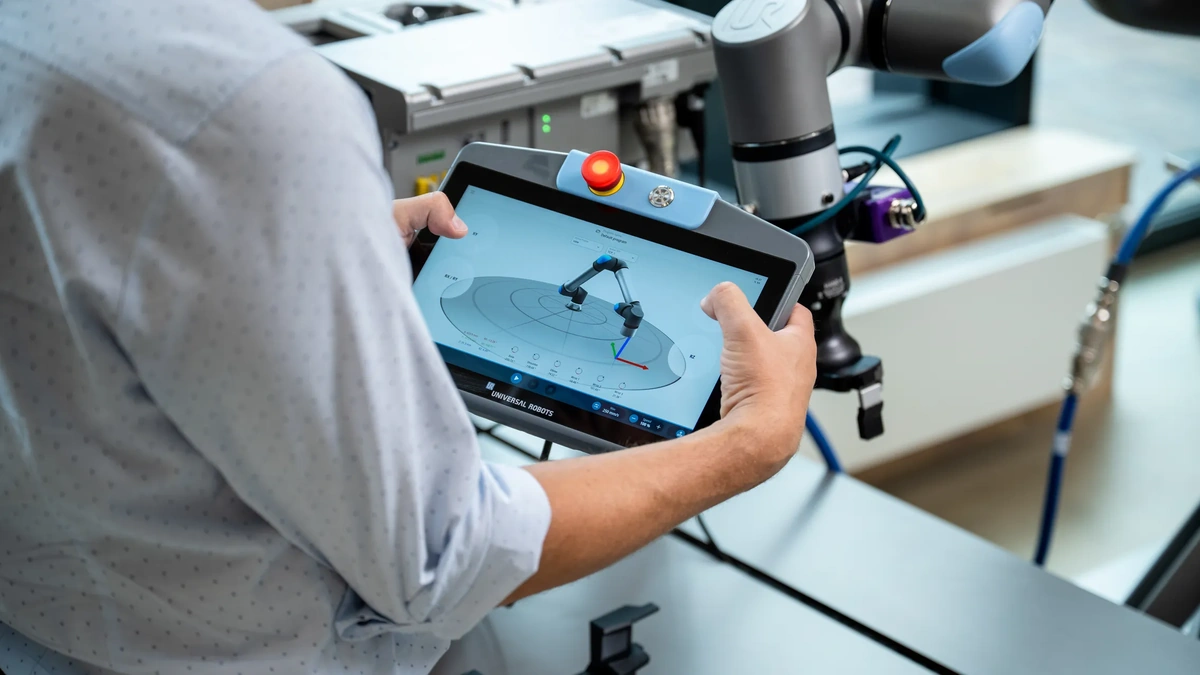
Universal Robots' seventh-generation cobot platform reworks nearly every part of the machine an integrator actually touches: the control box, the pendant operators carry, and the flange where tools attach at the robot's wrist. The Universal Robots Gen 7 platform is built so cameras, force sensors, and AI processing can plug directly into the arm instead of being wired on separately, removing a layer of custom cabling that has typically slowed automation projects down.
The platform adds three new g-Series arms, UR10g-1750, UR17g-1300, and UR18g-950, named for their payload and reach much like earlier Universal Robots generations. Universal Robots says the redesigned tool flange routes data, power, and safety signals to wherever a camera or gripper is mounted, and pairs the arms with a new CB7 controller the company describes as smaller and more powerful than its predecessor, plus a compact version meant to fit inside an existing automation cabinet. A new operating system, PolyScope X, adds ROS2 support and open APIs so integrators can run edge AI processing on the robot rather than a separate PC.
Universal Robots frames Gen 7 around what it calls physical AI: AI models acting in the physical world instead of staying on a screen. Universal Robots says the platform draws on more than 20 years of cobot development and over 100,000 industrial deployments, and that the new CB7 controller stays compatible with its existing e-Series and UR Series arms, so a factory already running Universal Robots hardware could adopt the new control stack without replacing every arm on the floor. The company also says the Universal Robots Gen 7 platform's g-Series arms carry a PLd, Category 3 safety architecture certified to ISO 13849-1, are TÜV-certified to ISO 10218-1 and UL 1740, and that Teradyne Robotics, UR's parent company, holds an IEC 62443-4-1 ML3 cybersecurity certification.
Those are vendor claims, not independent verification, but they matter for cobots, which are designed to share workspace with people rather than work fenced off behind a cage. Jean-Pierre Hathout, president of Teradyne Robotics Group, said the redesign is meant to reduce the integration work needed to run advanced AI applications in real-world production rather than only in demos.
At IMTS in Chicago, the company showed Universal Robots Gen 7 running alongside more than 20 partner integrations, including Cognex, Schunk, and Inbolt, presented as evidence that outside vision and gripping software can run directly on UR hardware without a separate PC. Whether operators already running Universal Robots' e-Series and UR Series arms actually adopt the new controller and software stack, rather than waiting for a full hardware refresh, will do more to prove the physical AI pitch than anything on a trade-show floor.