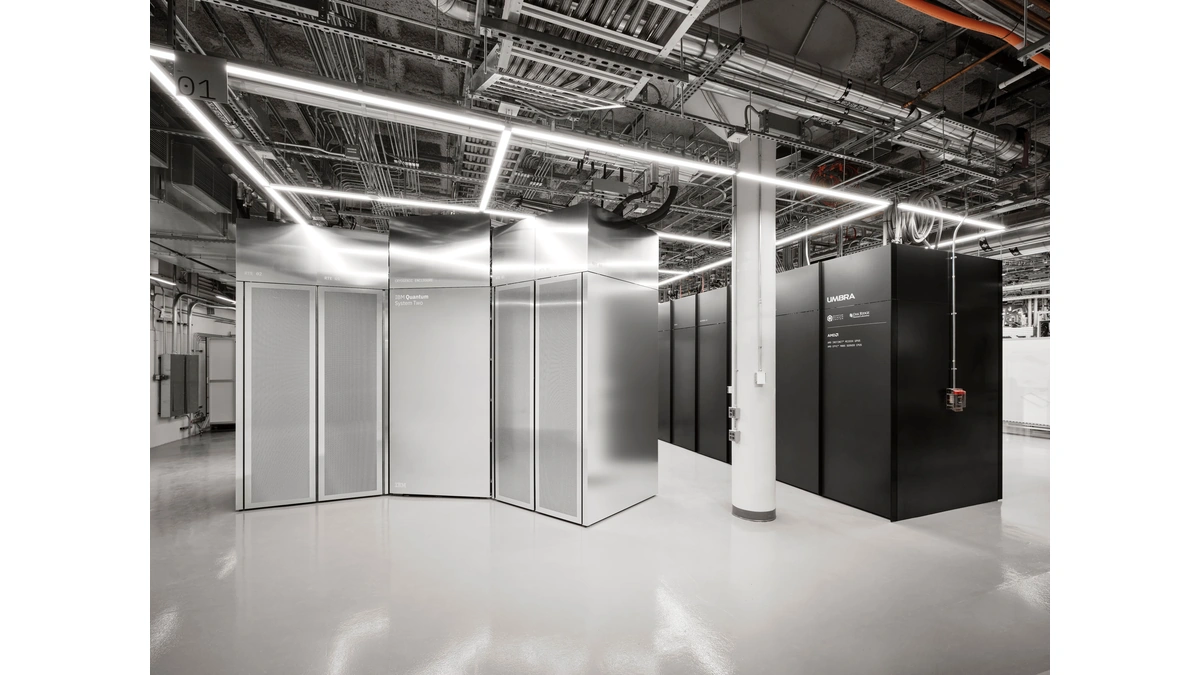
ORNL, IBM and AMD launched a co-design platform for quantum error correction that places IBM quantum computers beside Umbra, an Oak Ridge HPC system built on AMD chips. Per IBM, the systems include the 120-qubit IBM Quantum Nighthawk processor, which the first deployment pairs with Umbra's AMD Instinct MI355X GPUs and 5th Gen AMD EPYC CPUs.
The platform is a shared environment where ORNL, IBM and AMD test the architectures, software and workflows that hybrid quantum systems will need, AMD said. IBM supplies the quantum hardware, Oak Ridge National Laboratory contributes its research and computing environment through the Quantum Science Center, and AMD brings CPUs, GPUs and the open ROCm software stack. AMD also lists its Versal adaptive SoCs for low-latency control, readout and decoding near the quantum processor, but the first deployment as described runs on EPYC and Instinct.
The Department of Energy's Quantum Genesis Mission, through its Q Competition, targets 100 logical qubits running 100,000 hard operations by late 2028, according to IBM. IBM says its experiments so far have reached up to 70 logical qubits and 438 hard operations, a result active on the Quantum Advantage Tracker. IBM puts the remaining gap at a roughly 230-fold increase in hard operations. The research challenge now, IBM says, is learning to scale these advances using more classical computing.
Nighthawk's role is to let researchers try error correction methods and compare what each demands in qubits, time, samples and classical resources. IBM says its Quantum System API allows qubits to be measured mid-calculation with results acted on in real time, and lets researchers set the exact timing of the signals that protect qubits from noise. The workflows IBM names include concatenated codes, space-time codes, algorithm-aware decoders and hardware-aware circuit optimization and compilation. "The question is no longer if error correction will work on quantum hardware," said Jay Gambetta, IBM Fellow and director of IBM Research.
IBM says the platform builds on its separate collaborations with ORNL and AMD. IBM and AMD showed an algorithm last year that decodes quantum errors on AMD chips, and IBM already uses AMD GPUs to speed up the classical diagonalization step in sample-based quantum diagonalization. The experiments are meant to show where accelerators such as the AMD nodes in Umbra help the most.
Plans call for linking the platform to the Oak Ridge Leadership Computing Facility, which also houses Lux SI (Super Intelligence) + HPC, a new Oak Ridge supercomputer powered by AMD EPYC CPUs and Instinct GPUs. That connection would extend the experiments to a full-scale system.