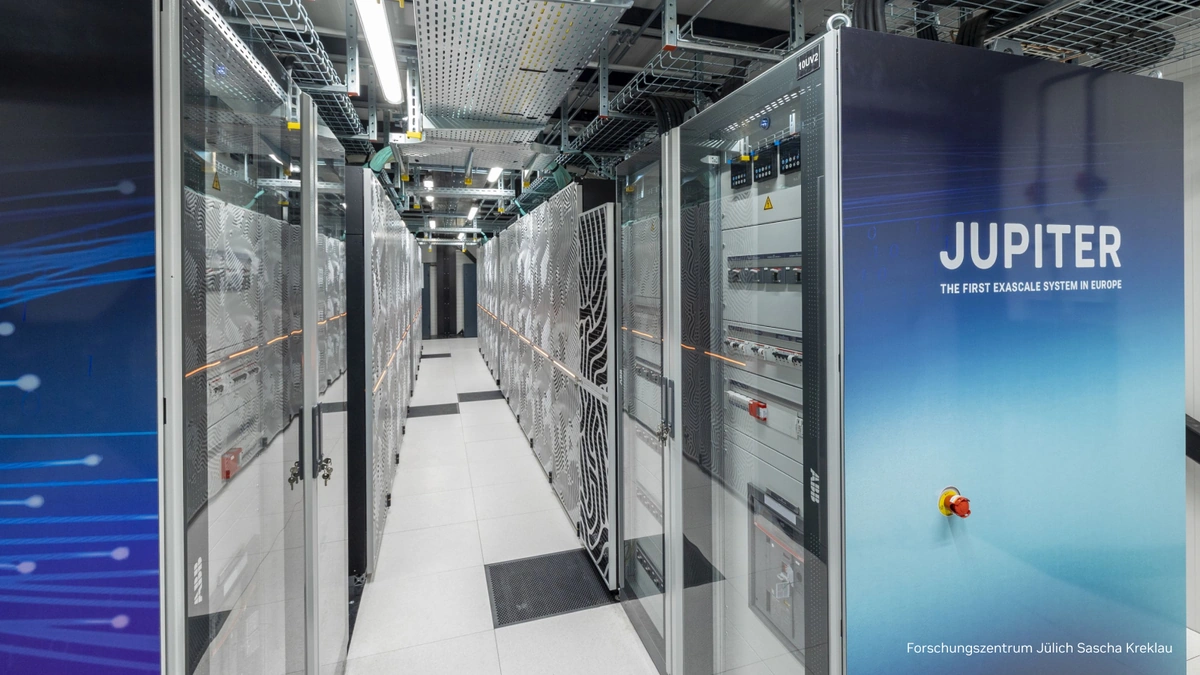
NVIDIA researchers have used JUPITER, Europe's first exascale supercomputer, to run a 104-qubit simulation of a fault-tolerant quantum processor that NVIDIA calls the largest comprehensive one to date.
NVIDIA contrasts it with Jülich's earlier 50-qubit simulation under ideal, noiseless conditions; this run adds realistic hardware noise. It used 8,192 NVIDIA GH200 GPUs at the Jülich Supercomputing Centre to model a key stage of magic-state cultivation, a way of producing the special qubit states that error-corrected quantum computers keep consuming. The company says cultivation needs 90% fewer qubits than previous methods, and the simulation tests the approach under realistic noise.
According to NVIDIA and Jülich researchers, the simulated protocol starts from a distance-3 color code, adds flag measurements to catch harmful faults, and grows into a distance-7 hybrid of color and surface codes. The noise model covers coherent phase errors, which can accumulate and interfere, and leakage, where a superconducting qubit slips out of its two computational levels. Modeling leakage means some sites carry a third energy level, which makes the state far larger.
The memory a direct state-vector simulation needs grows exponentially with the number of quantum degrees of freedom, so the team reused storage as qubits were measured and released and packed groups of three-level systems into binary storage: five of them have 243 basis states and fit in eight bits, which hold 256. In the largest configuration, a 45-bit register holds about 35.2 trillion complex amplitudes. In double precision that is 512 TiB spread over the GPUs, or 64 GiB each.
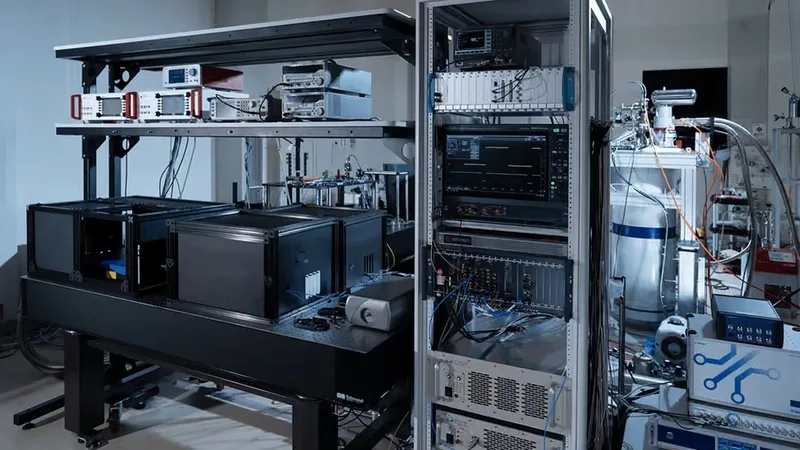
Development ran on a GB200 NVL72 system at NVIDIA's Accelerated Quantum Research Center, where researchers scaled tests from four GPUs to hundreds before the 8,192-GPU runs. NVIDIA says that cut a weekslong simulation effort to days. In small validation cases there, state-vector and tensor-network calculations agreed on measurement probabilities to roughly 10⁻¹³ once the tensor-network truncation threshold was tightened. The software stack is NVIDIA cuQuantum for the simulation and the CUDA-Q fault-tolerant logical layer for the magic-state circuit.
Smaller runs double as a budgeting tool: they estimate the GPU count and cost of a larger experiment, and GPU count multiplied by runtime gives the GPU-hour budget before substantial supercomputer time is reserved. NVIDIA says the approach can carry over to other leakage models, circuit schedules and error-correction protocols, with each new workload checked at manageable scale first.