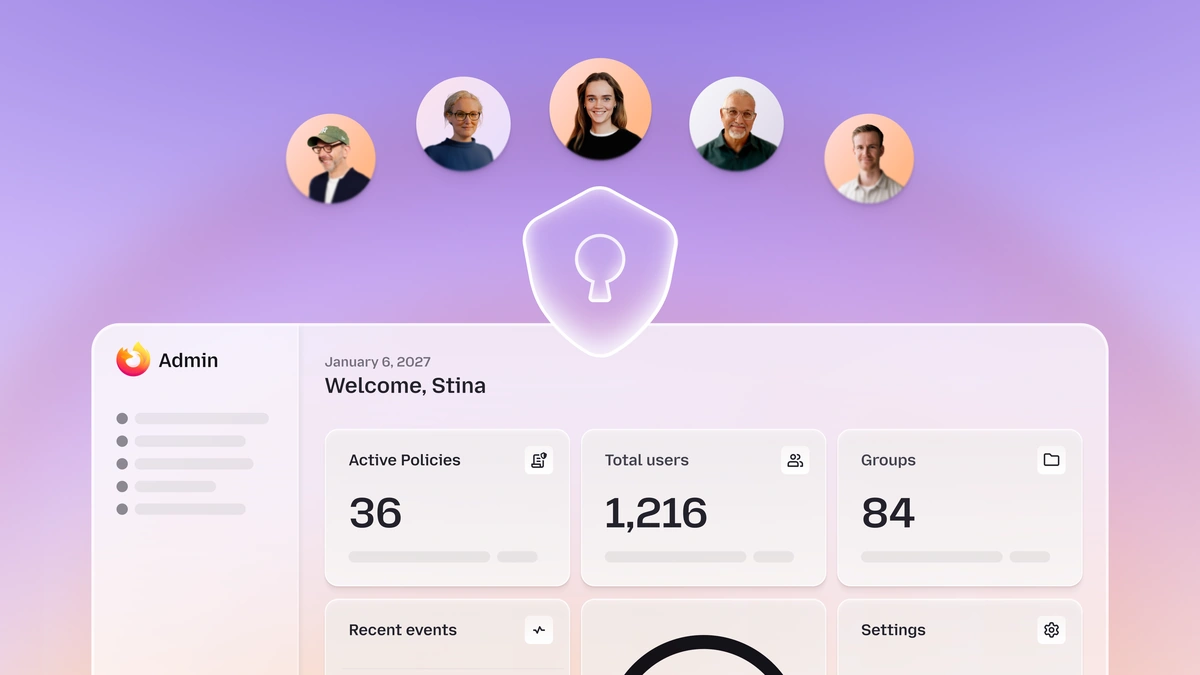
Mozilla released Firefox Enterprise, a managed edition of its browser that comes with an admin console organizations host on their own infrastructure. Version 158 is the first Firefox Enterprise release, built on Firefox 158 and the Gecko engine, and it targets institutions with strict security, governance and compliance requirements.
The pitch to IT teams is who runs the management layer. Firefox Enterprise administrators set browser policy and access rules, control how data moves through the browser and put limits on AI tool use from one console. Mozilla says the product sits beside existing identity providers, SIEM tools and MDM systems rather than replacing them. Anthony Enzor-DeMeo, Mozilla's CEO, framed it as a dependency question: "If all your options are built with the same technology underneath, 'choice' is a lie."
The release notes for version 158 list the working parts. Employees sign in through single sign-on over OpenID Connect, and devices report their posture (operating system, disk encryption, endpoint security status) so admins can refuse or end sessions on machines that fall short. Built-in data loss prevention can block pasting, uploads, downloads and printing on chosen sites, for example pasting into AI tools an organization has not approved, and the checks run on the device rather than sending content out for inspection. Other controls include on-screen watermarks, a Lockdown Mode that can disable JavaScript JIT compilation or isolate a site in a container, and encrypted profile data with a key provided by the admin console. More than 130 policies can be managed centrally.
Self-hosting is the main design choice. Per Mozilla, organizations run the console plus the supporting services for Remote Settings, Sync, telemetry, crash collection and browser updates, and security event logs go to the organization's own console instead of Mozilla. The trade-off is that Firefox Enterprise turns off connections to Mozilla and third-party services that are not needed in a managed deployment, and those cannot be switched back on. It also drops consumer features such as sponsored New Tab content, Firefox VPN and Relay email masks, and its profiles open only in Firefox Enterprise, not in regular Firefox.
Mozilla points to Gecko as the only major browser engine developed outside Google and Apple, which it presents as a way for institutions to avoid reliance on one architecture. It puts Firefox at roughly 200 million monthly users, with deployments across thousands of organizations. The sales push starts in Europe, with an initial focus on France, Germany, Austria and Switzerland, and a Thunderbird Enterprise product for email is in development. Access runs through an early-access request, and Mozilla has not published pricing. For a security team that wants the browser's management data to stay inside its own network, that request form is the next step.