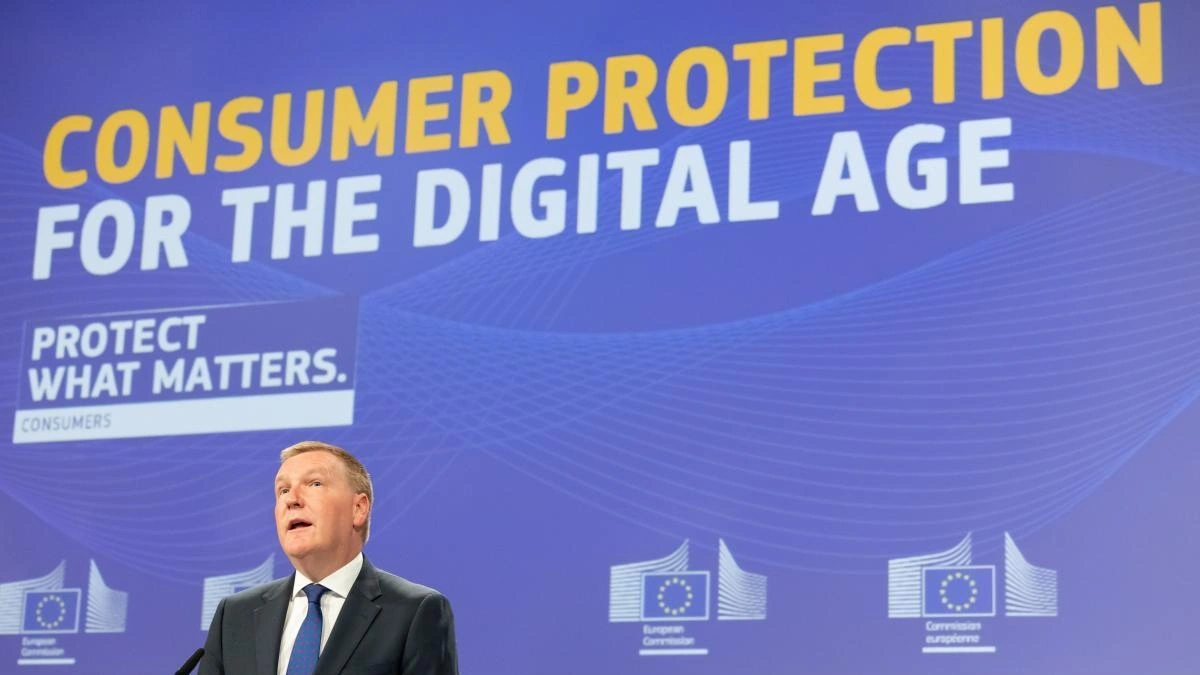
The European Commission has proposed the Digital Fairness Act, a regulation that would ban manipulative design on every website and app that sells to EU consumers, stop games aimed at under-18s from selling them loot boxes and pay-to-win items, and require a labeled cancel button wherever a contract can be signed online. A companion text would let the Commission itself investigate cross-border cases that reach most of the EU and fine companies up to 6% of worldwide annual turnover. On its Digital Fairness Act page, the Commission calls the package its most significant upgrade of EU consumer law in more than 20 years.
None of it is law. The Commission adopted the package on November 11, 2026, and the European Parliament and the Council both have to agree on a text. The regulation would apply 12 months after it enters into force and would repeal the EU's 2005 Unfair Commercial Practices Directive, the general law against misleading and aggressive selling. A shorter directive would amend the Consumer Rights Directive and the ePrivacy Directive. Under the enforcement text, companies outside the EU that target EU consumers would have to name a legal representative in a member state. The Commission says the package should save EU consumers up to EUR 13.7 billion a year.
Dark patterns would be banned on every website and app, not only on online platforms
The core of the proposal's text on dark patterns is Article 10: traders could not design or operate an online interface in a way likely to deceive or manipulate consumers, or otherwise to distort their economic behavior in a material way. Beside that test, the annex lists ten dark patterns treated as unfair in every case, among them false claims that a product is scarce or popular, defaults that sign a shopper up to pay for something extra, and making it far harder than necessary to refuse, withdraw or change a choice. The Commission could add to the list without a new law, unless Parliament or the Council objects within two months, a period either can extend by two more.
Two earlier findings frame the ban. The Commission's 2024 review of EU consumer law, the Fitness Check, cited a 2022 study that found 97% of the most popular websites and apps used by EU consumers ran at least one dark pattern. A sweep by national consumer authorities the same year found fake countdown timers, buttons styled to steer the choice, or hidden information in 148 of 399 web shops checked.
The EU already has a dark-pattern rule in the Digital Services Act, but it binds online platforms only; the DFA's ban would also reach web shops and app makers. The Commission's questions and answers add that companies would have to show the full price, fees and taxes included, from the start, which the Commission says would end drip pricing, the practice of adding fees step by step at checkout. The annex writes that duty into the blacklist: the first price shown must include every foreseeable fee, tax or charge a buyer cannot avoid.
Games aimed at under-18s could not sell them loot boxes or pay-to-win items
A minor is anyone under 18, and most restrictions apply where a product is directed at minors or where the trader knows with reasonable certainty that minors use it. The articles do not define "directed at minors." The recitals, a non-binding preamble that guides how the articles are read, point to objective indicators, for example an age rating such as PEGI, Europe's game age-rating system, showing the product is suitable for people under 18.
When those conditions are met, three rules would apply (Articles 14 to 16). Paid virtual currencies would be off by default for minors and could be switched on only with a parent's or guardian's approval. Traders could not offer minors paid variable reward systems, the proposal's term for loot boxes, wheels of fortune and paid card packs. Nor could they offer minors pay-to-progress or pay-to-win mechanics, purchases that are necessary, or presented as necessary, to progress or succeed in a game. Recital 65 gives examples: artificial difficulty walls, progression so slow that the unpaid path becomes illusory, and competition where spending effectively decides the outcome.
All players would get transparency rules, and for adults they take the place of bans. Sellers of paid virtual currency would have to show what an item costs in the real currency the player first used to buy virtual currency, or an estimate. Loot boxes would stay legal for adults, but the seller would have to list the item types on offer and the odds of getting each, and give every consumer an easy tool to switch them off. The Commission's Q&A lists loot boxes among the gambling-like features the DFA would ban; in the article text, that ban covers minors only. Social networks, video-sharing platforms, AI companions and chatbots covered by the EU KIDS Act, a separate Commission proposal on children's safety online, are partly exempt.
National consumer authorities are already acting under existing EU consumer law. Through the CPC Network, their joint body, they adopted principles on in-game virtual currencies in March 2025. On September 30, 2026, they launched actions against nine game companies, among them King, Mojang, Riot Games, Supercell and Ubisoft, over suspected breaches of EU consumer law involving in-game virtual currencies.
Europe's games industry says the rules would leave parents without a say
The trade bodies Video Games Europe and the European Games Developer Federation call the proposal "unworkable, unjustified and disproportionate." They argue it would ban virtually all in-game purchases for players under 18 and take the decision away from parents. They say the text treats games rated below PEGI 18 as directed at children, that the pay-to-win ban lacks clear definitions, and that it reinforces what they call the legal uncertainty started by the CPC Network's currency principles. They point to PEGI and Germany's USK, which they say expanded their criteria in 2026 to cover in-game purchases and paid random items.
The draft's wording bears on three of those points. On age ratings, recital 62 treats a rating marking a product as suitable for under-18s as a sign it is directed at minors; read that way, a PEGI 16 game would count, although recitals guide interpretation and do not bind. On parents, the answer differs by rule. Paid virtual currencies could be switched on with a parent's approval. Loot boxes and pay-to-win mechanics have no such switch, so for minors in a game directed at them or known to be played by them, a parent's consent would not bring those back. On how much of a game's store is covered, the test is whether a purchase is necessary, or presented as necessary, to progress or succeed, the definition the two trade bodies say lacks clarity.
Canceling a subscription would take one labeled button
The subscription and contract rules set steps and deadlines:
| Situation | What the trader would have to do | Article |
|---|---|---|
| Free trial ending | Send a reminder first; without it, or without the consumer's express agreement to pay, the consumer is not bound | 20 |
| Auto-renewing contracts of 6 months or more | Remind between one month and 14 days before renewal, or the consumer may terminate free of charge | 21 |
| Shorter contracts renewing repeatedly | Remind a week before the renewal that brings the total to 6 months or the tenth renewal, whichever comes first | 22 |
| Ending a contract online | A "terminate the contract here" button, a confirmation step and an acknowledgment within a week; a matching "withdraw from contract here" button for withdrawals | 23, 24 |
| Customer service | A human on request when other means are not effective | 25 |
| Purchases by an automated system | On first use, the consumer chooses to confirm every contract, some types, or none | 26 |
The termination button applies wherever a trader lets consumers sign up online, however the contract was concluded. The right to a human excludes investment services.
For AI shopping agents, which the text calls automated systems, the middle option lets a consumer pre-approve certain kinds of contract within a price cap and a time limit. A system paid to propose a contract, or with a conflict of interest, would have to disclose it and get confirmation regardless. Traders could not force consumers to use such systems, and financial services fall outside the article.
The simplification directive loosens some duties. For audio and video streaming subscriptions, the 14-day withdrawal right would give way to a right to cancel during the first month, with that month's fee due. Repeat in-app purchases of up to EUR 50 would need less pre-contract information. Unlike the two regulations, which would apply directly, this directive would have to be written into national law within 12 months of entering into force.
Autoplay and streaks would get an off switch, and paid influencer posts a fixed label
Under Article 17, where a product's design is intended, or can reasonably be foreseen, to encourage compulsive or excessive use, the trader would have to let consumers switch off four features, one by one or all at once: autoplay, notifications not triggered by the user's own activity, streak-style rewards for coming back, and prompts that simulate a relationship. The rule covers all consumers, but not traders already bound by the KIDS Act's addictive-design rules, for their practices toward minors. CCIA Europe, which represents communications and technology firms, notes that the KIDS Act also targets addictive design and calls that a duplication risk. The Commission's Q&A describes the DFA switches as complementing the KIDS Act's more specific rules for minors.
Influencers would have to label each commercial post "advertisement" or "commercial collaboration," and could not directly urge minors to buy a product or to talk their parents into it, an appeal the 2005 directive already blacklists in advertising. A brand that pays an influencer would have to ensure compliance.
Article 12 would stop traders from targeting ads through profiling, building a picture of a person from their data, when they know with reasonable certainty that the consumer is a minor, or when the profiling uses sensitive data under the GDPR, such as health. Traders would not have to collect extra data to work out a user's age. According to the Commission, online platforms already face these bans under the Digital Services Act (Articles 26 and 28), and the DFA would extend them to all websites and apps; the article leaves out platforms already bound by those DSA rules.
Article 13 would bar traders from personalizing a price through profiling in a way reasonably likely to harm the consumer, where the trader knows with reasonable certainty that the consumer is a minor, or is vulnerable because of age, credulity, disability or a specific misfortune or circumstance that impairs their judgment. The Q&A leaves out the harm condition, saying companies "will be banned from presenting higher personalised prices to minors or vulnerable consumers." CCIA Europe argues that a wider definition of vulnerable consumers could push services to monitor behavior and process sensitive data, against the GDPR's data-minimization principle. Article 13 states that traders would not have to process extra personal data to assess vulnerability.
Ticket sellers whose prices can rise through their own actions or algorithms would have to say how many tickets remain at the advertised price and the maximum a buyer might pay. In a virtual queue, the trader would show the current price in real time, whether it can change, and its ceiling.
The Commission could fine large companies up to 6% of global turnover itself
Enforcement changes sit in the revision of the Consumer Protection Cooperation (CPC) Regulation, the law under which the national authorities' network works. The Commission could open proceedings when it reasonably suspects a breach that harms consumers in at least two-thirds of member states holding at least two-thirds of the EU population. Small and medium-sized companies are excluded and stay with national authorities. For intentional or negligent breaches, the Commission could impose fines of up to 6% of worldwide annual turnover, and up to 1% for obstructing an investigation.
Under the DFA text, member states would decide penalties, but in coordinated cross-border actions the maximum fine would have to reach at least 4% of the trader's turnover in the countries concerned, or EUR 2 million where turnover figures are missing. Through the CPC rules that the DFA's 6% clause points to, the Commission's ceiling would apply only to companies larger than SMEs, in breaches harming consumers across two-thirds of the EU.
Consumer groups back the text, and tech and games lobbies want it narrowed
The Commission's impact assessment describes the EUR 13.7 billion savings figure as a modeled yearly cut in harm to consumers, with lost time counted as money. It puts recurring costs for business at EUR 1.2 billion a year, or EUR 678 million once overlaps are removed.
BEUC, the European consumer organization, backed the proposal the day before it was published. Its director general, Agustín Reyna, called the act "a much-needed tool" to give consumers back control of their time and money online. The group asked Parliament and the Council to stand firm behind the objective.
CCIA Europe grants that one EU regulation might reduce differences between member states but says the DFA overlaps with the DSA, the Consumer Rights Directive and the GDPR, adding parallel enforcement before existing rules are fully enforced. The Commission's Q&A calls the DFA a safety net that complements the EU digital rulebook and notes that the DSA applies only to online platforms. CCIA Europe's head of policy, Alexandre Roure, says the ban on repeatedly prompting users to reconsider a choice could catch reminders to turn on multi-factor authentication. The listed practice exempts prompts a trader needs to comply with legal requirements.
Anna Cavazzini, the Greens/EFA member who chairs Parliament's internal market and consumer protection committee, speaking as chair, welcomed cancellation as easy as signing up, the influencer rules and renewal notices. She said the proposal "leaves loopholes" on manipulation into unwanted purchases and on addictive designs built for endless scrolling, which MEPs could address in committee negotiations.
Until Parliament and the Council agree on a text and the 12 months pass, the 2005 directive stays in force. It belongs to the existing EU consumer law under which national authorities opened their actions against the nine game companies on September 30.