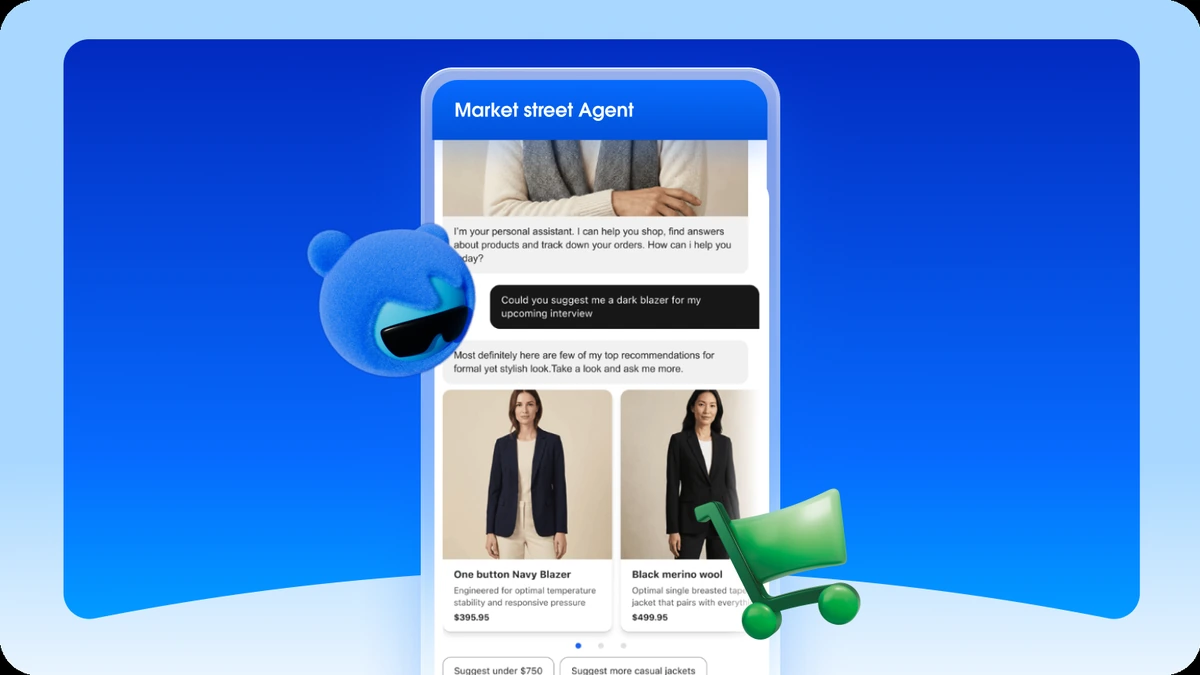
Agentforce Commerce, which reached general availability on June 24, 2026, is Salesforce's bet that the next storefront is a conversation, and that the agent running it should be one a brand owns rather than a marketplace's. Billed as the company's biggest commerce release in years, it is built around three agents grounded in a retailer's own data: Shopper Agent, Buyer Agent, and Merchant Agent. All three are live now, and Salesforce says native integration with ChatGPT arrives in July, with Google Search, including its AI Mode, and the Gemini app following over the summer.
The line Salesforce draws is between agents that talk and agents that act. Shopper Agent carries a customer from discovery through checkout and into service on a brand's own site, checking live inventory and confirming carrier cutoffs before it commits to a sale. Buyer Agent handles B2B procurement inside WhatsApp and SMS, so a buyer can reorder by text and get back current contract pricing and a finished order. Merchant Agent gives operations teams plain-language control over catalogs and sort rules, and Salesforce says early customers cut the time to complete a task by 88 percent.
The company wraps the launch in bullish market data, citing holiday-season figures that AI influenced 20 percent of global online sales, worth 262 billion dollars, and that retailers running their own shopper agents grew sales 59 percent faster than those without. Those numbers come from Salesforce and are the argument for buying its product, so they carry the weight of Salesforce's own reading rather than independent measurement. The 88 percent time-to-task figure is likewise a self-reported early-customer result.
Underneath the agents sits a set of infrastructure meant to shorten deployment, the part that decides whether the release is more than a demo. Storefront Next can stand up a production-ready storefront in under 30 minutes and ships in every B2C Commerce edition, per Salesforce. The release also folds in Agentic Commerce Search, built on technology from the recently acquired Cimulate and reaching general availability in July, and Agentic Order Management, which Salesforce says unifies inventory across 7,000 locations and 250 million records. A separate product sync feeds a retailer's catalog into external agents like ChatGPT so the same inventory shows up wherever a shopper starts.
The strategic tension is visible in that last piece. Salesforce is arming brands to run their own agents on their own sites while simultaneously helping them show up inside ChatGPT and Google, the very general-purpose assistants that could disintermediate the brand relationship entirely. That hedge is rational while nobody knows whether shoppers will start at a retailer's agent or at a chatbot that spans every store. What Salesforce is selling is a way to be present in both worlds without picking a winner yet. The open question is whether owning the shopper agent turns out to be a durable advantage, or whether the general assistants become the front door and a brand's own agent is reduced to fulfilling orders that started somewhere else.