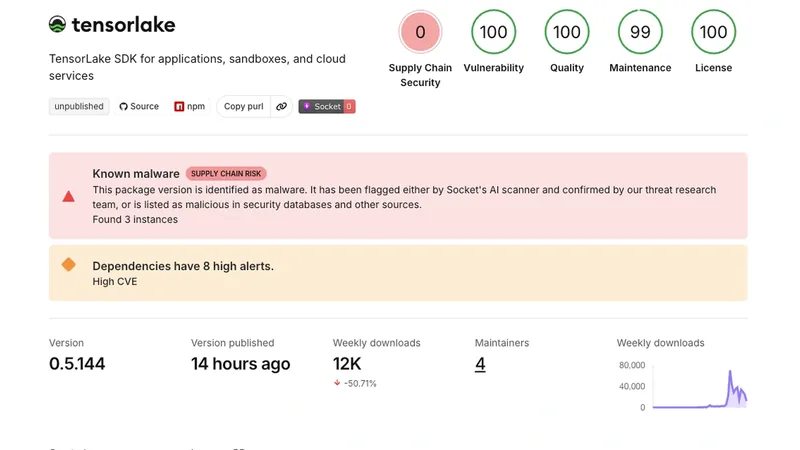
Cursor has traced October's malicious Claude Code extension back to an access key it had issued to its AI inference vendor Fireworks. An attacker used that key to copy data from a read-only storage bucket, found unredacted credentials inside it, and worked from there to Cursor's own marketplace cache, where two tampered builds sat for about 11 hours.
Cursor says the key was exposed by Fireworks. The read-only bucket held coding agent traces, mostly from 2025, from sessions not in Privacy Mode, which Cursor was permitted to use for model training. A small number of those traces contained credentials that had not been redacted, exposing API credentials for less than 0.01% of customers. Among users not in Privacy Mode, traces were exposed for fewer than 0.05%. With the credentials, the attacker reached select SaaS tools and accessed select archived non-production source repositories, limited support data and email conversations, usage metrics, contact details, summaries of some agent conversations and some credentials users had sent to support.
Cursor's earlier security notice names versions 2.1.312 and 2.1.313 of the extension for Windows and macOS. They were live on October 29 between about 2:27 a.m. and 1:35 p.m. Pacific. At most 5,000 users who requested specific cached versions could have received a malicious build. The attacker used a stolen credential to place the copies directly on the cache that serves the marketplace. Cursor says Anthropic did not publish them, the flaw was not in Anthropic's product, and the upstream source, Open VSX, never carried the malware.
The code collected the hostname, username, operating system, home directory, environment variable names and public IP, then tried to append an attacker key labeled svc-telemetry to the SSH authorized keys file, switch on the local SSH service and open a reverse tunnel. Persistence ran through a LaunchAgent on macOS or a scheduled task on Windows, with scripts retrying the tunnel roughly every 60 seconds. Turning on SSH needs administrator rights, which the extension lacked on most machines, so the tunnel step failed there. The key, the persistence scripts and the host report still landed, which is why Cursor says removing the extension may not be enough.
A quick check is to search the authorized keys file for svc-telemetry: ~/.ssh/authorized_keys on macOS, and that file plus C:\ProgramData\ssh\administrators_authorized_keys on Windows. Affected users should run the remediation scripts and rotate every credential reachable from the machine, working from a trusted system. The incident fits the pattern in software supply chain attacks, where a trusted distribution point carries the payload.
Cursor has moved all inference traffic off Fireworks, deactivated its key and rotated every credential used across its internal systems. It says the Cursor app and its updates, release signing keys and customer code repositories were not affected, and that the last attacker activity it has seen, on November 1, was blocked.