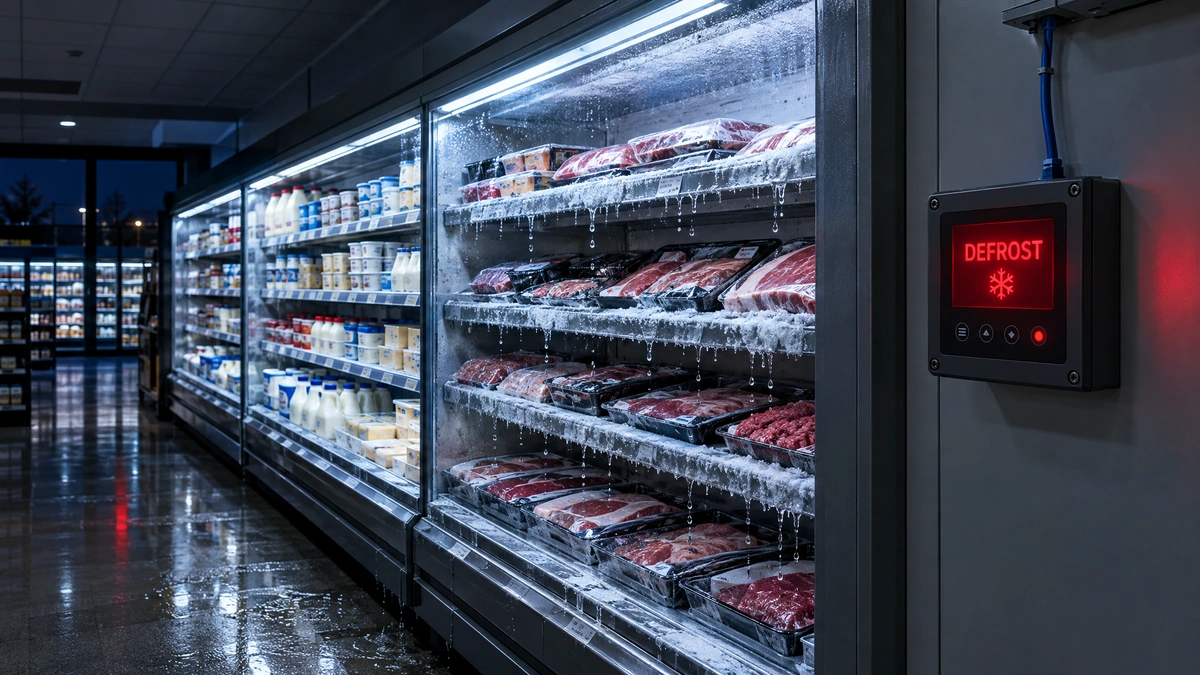
On the night of October 11 to 12, attackers reached the refrigeration controllers of French supermarkets over the internet and set them to defrost. Temperature settings went as high as 50 C (122 F), according to multiple sources cited by Unit 42, stores threw out chilled and frozen stock, and in some cases the activity ended in fires. On October 13, Finance Minister Roland Lescure told parliament that about 700 of France's 10,000 supermarkets were affected, AP reported. He saw no risk to food supplies but said the attack "touches the heart of our food security." Three weeks later it happened again: on the night of November 1 to 2, more than 100 stores in at least 10 other European countries were hit, by Unit 42's count. France's blood service, the EFS, said freezers at three of its sites were hit too.
France's CERT-FR knows of numerous compromises of Danfoss AK-SM and AK-SC controllers and of Copeland and Dixell xweb supervisors. Danfoss told Radio France that most of the affected devices were obsolete AK-SM800 and AK-SC355 systems that no longer receive software or security updates, and that the AK-SM800A units hit were running outdated firmware. Copeland Controls says an older XWEB EVO generation, in which it acknowledges a vulnerability, gets no patches either. After the second wave, Danfoss said the Dutch systems that were hit sat outside a secure network and still used default passwords. CERT-FR's own warning is blunt: an end-of-life unit left reachable from the internet faces a very high probability of compromise.
Two things remain open. Unit 42, which combines public reporting with its own scans, says the way in is unconfirmed and calls vulnerable software or default credentials "widespread speculation." And the pro-Russian groups NoName057(16) and Z-Pentest, which Unit 42 says claimed responsibility on Telegram, have not been shown to be behind it; Unit 42 calls their claims unverified.
Two overnight waves, three weeks apart
Thierry Cotillard, who heads Intermarché, said on BFMTV that the attackers set all of its cold units to defrost "and up to 50 degrees." Les Mousquetaires, Intermarché's parent group, told Reuters the fridges stayed that hot for six hours. The Paris prosecutor's office opened an investigation on its own initiative, run by its cybercrime section with the anti-cybercrime office OFAC, which is to identify victims and match them to the reported damage: lost food and equipment that caught fire.
The government's 700 is the figure Unit 42 repeats. Other counts run lower. Reuters later wrote of "more than 350 establishments," and French outlets, as BleepingComputer relayed, put it at 250 to 350, a gap that may come down to what each count treats as a site.
The second wave came overnight from November 1 to 2. Unit 42 puts it at more than 100 retail locations in at least 10 European countries beyond France, which it does not name. Between them, BleepingComputer, SecurityWeek and AFP named Belgium, Estonia, Finland, Germany, Ireland, Italy, Luxembourg, the Netherlands, Portugal, Romania, Sweden and the UK.
France was hit again the same night. The Établissement français du sang (EFS), the national blood service, said an attack on one of its refrigeration-equipment providers raised temperature and defrost settings at three of its facilities. It reported no health impact and no loss of blood products. Freezers normally held at minus 30 C were ordered to defrost, franceinfo reported; the attack was stopped at two sites, and plasma bags were moved at the third.
The Belgian federal prosecutor's office opened an investigation, according to SecurityWeek. Whether one actor ran both waves is not established: Censys says it is not confirmed, and SecurityWeek wrote that investigators had not linked them. EU agriculture commissioner Christophe Hansen called the repeated attacks a deliberate attempt to disrupt the food supply chain. The EU's NIS2 directive lists food businesses engaged in wholesale distribution and industrial production and processing among its critical sectors; retail is not named.
| Wave | Country | Retailer or operator | Stores affected, as reported | Who gave the figure |
|---|---|---|---|---|
| 1 | France | Intermarché and Netto (Les Mousquetaires) | At least 300; around 150 Intermarché stores in the group's October 12 figure | Les Mousquetaires, to AFP and AP; to Reuters on October 12 |
| 1 | France | Coopérative U | 80 of 2,000 | CEO Dominique Schelcher, to franceinfo |
| 1 | France | Carrefour | 80 of about 6,000 | Carrefour, to Reuters |
| 1 | France | Monoprix | About 30 | franceinfo |
| 1 | France | E.Leclerc | Several stores; says a refrigeration-equipment supplier was attacked | franceinfo; E.Leclerc, to AFP |
| 2 | France | EFS (blood service) | Three facilities | EFS, via BleepingComputer |
| 2 | Belgium | Delhaize | Several dozen | Ahold Delhaize, via BleepingComputer |
| 2 | Belgium | Carrefour Belgium | 15 of about 700 | Carrefour, to BleepingComputer and Al Jazeera |
| 2 | Belgium | Colruyt (franchised Spar shops) | Five | SecurityWeek |
| 2 | Luxembourg | Delhaize | Four | SecurityWeek |
| 2 | Ireland | SuperValu (Musgrave) | 13, chilled and frozen products pulled | Musgrave, via Al Jazeera; SecurityWeek |
| 2 | Sweden | Coop | 7 of more than 800 | Coop, to BleepingComputer |
| 2 | Sweden | ICA | A small number outside ICA's central network; one store manager said settings were changed to 50 C and could not be modified | ICA, to BleepingComputer; the manager, to TV4, via BleepingComputer (franceinfo: could not confirm a cyberattack) |
| 2 | Netherlands | Butchers and small grocers | At least 17 businesses | Danfoss, to Dutch media |
| 2 | Finland | Kesko | A few smaller stores | SecurityWeek |
| 2 | Portugal | Intermarché (Mosqueteiros group) | Seven | SecurityWeek |
| 2 | Italy | Coop-branded operator in Sicily | Four of 300 | Director Giuseppe Spadaro, via AFP, citing Corriere della Sera |
Schelcher said a very large majority of Coopérative U's 80 affected stores managed to counter the attack, and only a minority threw goods away. Intermarché said all affected products had to be discarded to respect the cold chain, and flagged insurance as a sticking point because policies do not cover this kind of incident.
The loss figures so far are the retailers' own. Cotillard estimated "tens of millions of euros" nationally. After the second wave, a Belgian butchery chain put its loss at about 15,000 euros of meat, according to Al Jazeera.
The controllers CERT-FR named, and what their makers say
CERT-FR gives no site count and names no CVE; Unit 42 names no vendor or model and points to the CERT-FR list. Vincent Strubel, director general of France's cybersecurity agency ANSSI, said it was urgent to disconnect the Danfoss controllers from the internet, or at a minimum to filter network access very tightly, AFP reported.
Danfoss’s Tech Insider bulletin of October 2025 noted that the AK SM 800 had been declared end of life in May 2021, said the AK SC 255 and 355 were phased out in 2016 and set out a hard end-of-service policy for legacy products. Danfoss told AP it had long advised customers to keep supported systems on current firmware and behind a firewall. After the second wave, a spokesperson told Dutch broadcaster NOS, as SecurityWeek reported, that Danfoss had told customers on October 13 to cut their systems' internet connections, and that "most stores took action at that time, but a small number did not."
Two days after the first wave, Copeland Controls acknowledged a vulnerability in a discontinued, end-of-life generation of its XWEB EVO controllers. It tells customers to pull every XWEB EVO unit off the public internet immediately, and adds that the supported XWEB PRO must not be exposed either. The bulletin names no CVE.
| Product family | Maker's status | Disclosed flaws and fixes |
|---|---|---|
| Danfoss AK-SM 800 | End of life since May 2021, per Danfoss | No updates; Danfoss names the AK-SM800 among the obsolete units that made up most of the affected devices |
| Danfoss AK-SM 8xxA | Current series; patched releases available. Danfoss says the AK-SM800A units hit ran outdated firmware | CVE-2025-41450, an authentication bypass, fixed in R4.2; CVE-2025-41451 and CVE-2025-41452 fixed in R4.3.1 |
| Danfoss AK-SC 255 and 355 | Phased out in 2016, per Danfoss | No updates; the AK-SC355 is named in the same Danfoss statement |
| Copeland/Dixell XWEB EVO (discontinued generation) | End of service, no security patches, per Copeland | Copeland acknowledges a vulnerability; no CVE named |
| Copeland/Dixell XWEB PRO | Supported platform, per Copeland | Copeland says it must not be exposed to the internet either |
Three accounts of how they got in
Officials have not publicly explained the way in, SecurityWeek wrote. CISA, the FBI, HHS, USDA and the Transportation Department say in a joint fact sheet that actors "may" exploit weaknesses in unpatched or internet-accessible controllers to force continuous heating and defrost cycles. They list authentication bypass, arbitrary code injection and weak configurations as vectors. Richard Horne, head of the UK's National Cyber Security Centre, told the BBC that a couple of instances involved "vulnerable technology" being exploited, AFP reported.
The most specific explanation so far came from outside experts. On October 13, ethical hacker Clément Domingo said on RMC, as franceinfo reported, that the attackers logged in with a very weak password, the day's date, every time. Marta Rybczynska, a cybersecurity specialist, told Sud Ouest the attackers used one of several documented flaws. That description fits a known bug. Danfoss disclosed CVE-2025-41450 in March 2025: in AK-SM 8xxA controllers before release R4.2, a password generated from the date and time could allow an authentication bypass, according to CISA's advisory. Claroty Team82 showed it can be chained with a second Danfoss flaw, a command injection that needs a login, to run code remotely, Censys notes. Jeppe Engell, a consultant at the Confederation of Danish Industry, told DR the Danfoss attack involves two vulnerabilities that, combined, let an attacker go straight at a company's cold-storage installation.
The fit is partial. CVE-2025-41450 covers 8xxA firmware older than R4.2, and Danfoss says the AK-SM800A units that were hit ran outdated firmware, so for those units the date-based login could apply; Danfoss has not said which versions they ran. The units Danfoss says made up most of the affected devices are the older AK-SM800 and AK-SC355, which fall outside that advisory and get no updates at all. Danfoss has not said, in the statements reported so far, whether those older units share the date-based login.
Danfoss blamed default passwords on unsecured networks for the Dutch cases. Security researcher Kevin Beaumont told SecurityWeek that people he spoke with had confirmed every freezer hit on November 2 had a management interface reachable from the internet. Lupovis, which runs decoy sensors, told SecurityWeek it saw login attempts against its Danfoss AK-SM decoys from October 20 to 30, mostly with factory-default credentials that Danfoss documents publicly, all rejected; that shows probing between the waves, not how either wave got in.
E.Leclerc said one of its refrigeration-equipment suppliers was attacked, and the EFS said its provider's system was. Coolworld, a refrigeration rental company that BleepingComputer links to the EFS case, blamed a vulnerability in a third-party component outside its control. On October 12, a source in the prime minister's office told Reuters that ANSSI had identified a vulnerability in software supplied by Danfoss; neither CERT-FR's alert nor Unit 42 confirms that. The groups claiming the attacks say they needed no malware and used only the systems' built-in functions.
An exposed web panel, an unpatchable old unit and a contractor's remote access could each be the route at different sites, which would explain why sources describe the way in so differently. It would also mean that no single patch would have closed it.
Exposure fell after the first wave; thousands of panels stayed online
Censys counts hosts in the two product families named in the advisories, Danfoss StoreView and Copeland/Dixell XWEB. Between October 9 and November 5, their combined exposure fell 53%, from 6,695 to 3,124 hosts. StoreView fell faster, from 3,004 to 708, than XWEB, which went from 3,708 to 2,420. In France, StoreView hosts dropped from 1,841 to 497 between October 13 and 15 and stood at 209 on November 5. Censys cautions that its data does not show why the controllers went offline.
Unit 42 counts differently, taking in every device from the makers CERT-FR lists, so its figures are not comparable with Censys's. Unit 42 found more than 5,000 such devices exposed on November 5 and 6, and stresses that exposure does not mean they run vulnerable software. Its count for France fell from 1,853 in the first half of October to 558 in the second half, then 316 in the first six days of November.
In an earlier Censys count on November 2, Belgium had 138 StoreView hosts exposed, 68% of them apparently on patched firmware. France had 220, of which 41% appeared patched, a reading Censys infers from HTTP headers. XWEB exposure is spread more widely, led by Italy with 366 hosts and Greece with 209. On Censys's figures, about 3,100 such panels were still reachable from the internet on November 5, after both waves.
Two pro-Russian groups claimed it; the claim is unverified
Unit 42 says NoName057(16) and Z-Pentest claimed responsibility in Telegram posts on November 3. DR, the Danish broadcaster, describes a channel claiming to be NoName057(16)'s official one posting a video titled "Operation Chronicle: Danfoss," in which the group says it was behind the attacks, allegedly with Z-Pentest. Il Sole 24 ORE says the claim surfaced on the morning of November 4, and that NoName's Telegram channel, at least the part visible to the public, carries no message attributing the fridge attacks to the group. Italian investigators analyzing the video hold that a signature is not proof, the paper says.
Danfoss told DR it had seen no sign of a successful attack on its internal IT or of a data breach, could not confirm the material the groups published and would not speculate on who was behind the attacks. Denmark's Agency for Societal Security said it was too early to say whether the two groups played a role, noting that pro-Russian groups regularly claim attacks to draw attention. Engell said information gathered by the security vendors he consulted does not point to the claiming groups, though it does not rule out pro-Russian or Russian actors. Kremlin spokesman Dmitry Peskov called accusations of Russian involvement "absurd," DR reports.
CISA, the FBI, the NSA and partner agencies assessed in December 2025 that NoName057(16), Z-Pentest and two other pro-Russia groups run less sophisticated attacks on critical infrastructure through minimally secured, internet-facing VNC connections to operational technology. The agencies say Z-Pentest, formed in September 2024 from members of CARR and NoName057(16), specializes in OT intrusions it then publicizes, and warn that these groups regularly make false or exaggerated claims. NoName057(16), running DDoS attacks since March 2022, was the target of the Europol-coordinated Operation Eastwood in July 2025. On July 13, 2026, the Council of the EU sanctioned Z-Pentest, citing its December 2024 attack on a Danish water utility.
Z-Pentest's specialty fits an attack on store controllers. But the agencies' own warning about exaggeration, and an advisory built around VNC rather than refrigeration web panels, would make a Telegram video weak evidence on its own. Neither the advisory nor the sanctions concern these controllers.
The same kind of equipment has been hit before
Danfoss’s October 2025 bulletin says 16 Russian supermarkets using the AK SM 800 were targeted at the start of the war in 2022. The same year, it says, 40 stores in Israel were hacked, all running the AK SM 800 and none with a proper firewall or VPN. In December 2025, federal prosecutors in Los Angeles accused a Ukrainian woman of belonging to a group that knocked out refrigeration at a meatpacking facility in 2024, ruining more than 2,000 pounds of meat, Reuters reported; that is an allegation, not a conviction.
The United States has an open case of its own. Four officials told Reuters the Pentagon is treating freezer malfunctions that spoiled food at US military bases in August as a suspected hack, with at least six commissaries affected according to Reuters' review of base posts. Reuters could not establish whether Danfoss or any other brand of controller was in use at the affected bases. The US Army Criminal Investigation Division said its Cyber Field Office was working with French law enforcement on the refrigeration outages in Europe.
What CERT-FR, CISA and the makers tell operators to do
CERT-FR, CISA, Copeland and Danfoss all tell operators to take controllers off the public internet and reach them only through a VPN, firewall or protected network; CERT-FR, CISA and Copeland add changing default passwords. Copeland spells it out: no port forwarding, no DMZ and no direct public IP address. Danfoss's AK-SM 800A page adds the latest software and Strict Mode. CISA goes further, recommending a dedicated network segment for operational technology, phishing-resistant multifactor authentication where feasible, IP allowlisting, offline backups and logging. It also calls for setpoint limits on the equipment downstream of controllers, with alerts when a unit drifts outside a safe range.
CERT-FR adds the practical detail a store operator would need. It tells operators to check the conditions of their insurance contract before cutting the data link to a refrigeration contractor, then to verify the whole configuration, defrost windows included. Filtering contractors' IP addresses at a firewall is acceptable as an emergency stopgap, it says, but not as a lasting fix. A compromised Danfoss unit should be restarted, or failing that reset to factory settings and reconfigured.
For the oldest units, that last step does not settle much. CERT-FR warns that the campaigns are probably still under way, that an end-of-life device without security fixes left exposed to the internet has a very high probability of compromise, and that a factory reset alone is not enough because the device stays vulnerable. Danfoss offers firmware updates where they exist, and for an AK-SM 800 that reached end of life in 2021, none is coming. For a store still running one, disconnecting or replacing it would be the only fix on offer, and the November exposure counts suggest not every store has done either.