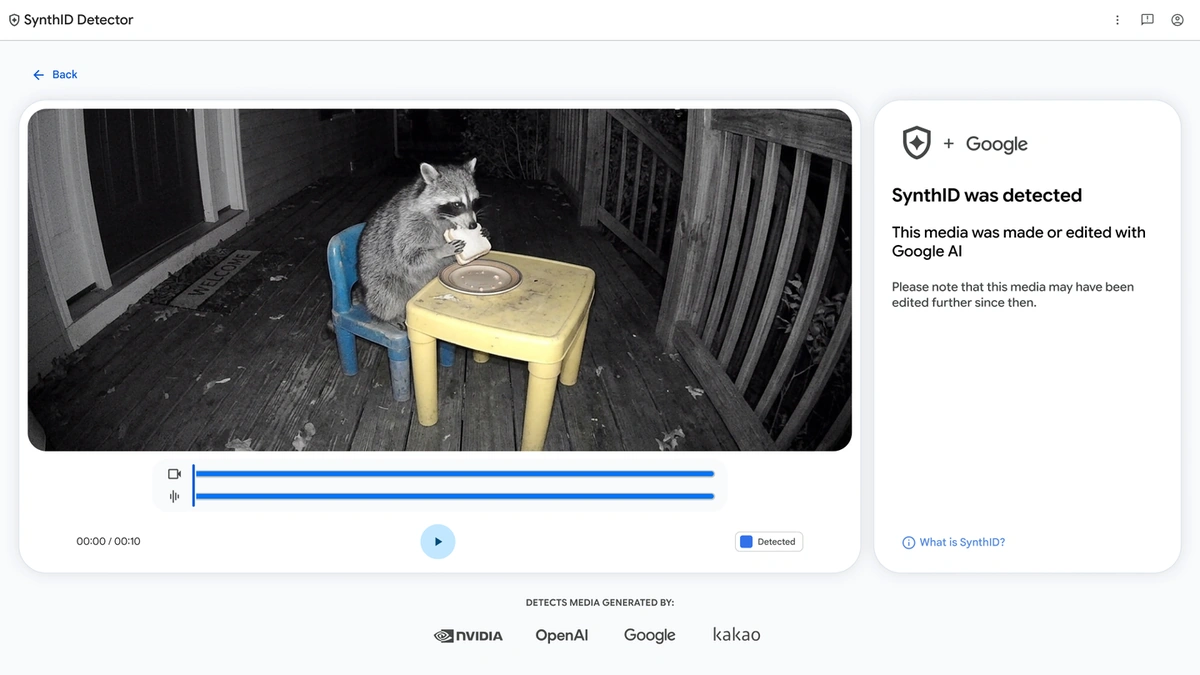
Google opened its SynthID Detector to the general public, making the watermark-checking tool available worldwide in English. The portal first launched in 2025 as a limited release, and Google says it was tested with journalists and media professionals before this wider rollout.
The SynthID Detector reads SynthID, the invisible watermark Google embeds in media made with its generative models. A user submits an image, video or audio file, and the tool reports whether that mark is present. Coverage extends past Google's own output: the SynthID Detector also checks files from partners that use the technology, including OpenAI, NVIDIA and Kakao, with Apple listed as coming next. Pushmeet Kohli, a vice president at Google DeepMind, wrote that SynthID has now marked more than 180 billion images and videos, plus 240,000 years of audio, since its 2023 debut.
How well the mark survives editing is Google's own claim. For images and video, the company says the watermark is added at creation and is built to withstand cropping, filters, changed frame rates and lossy compression. For audio from its Lyria music model and the podcast feature in NotebookLM, it says noise, MP3 compression and speed changes do not strip the mark. No independent test of those claims accompanies the announcement.
The new site is not the only place to run a check. Google says verification built into Search, the Gemini app and Chrome already handles over 1 million requests a day, so the standalone SynthID Detector adds a dedicated destination more than a new capability. Its scope is also narrower than the full SynthID family: Google describes the detector as covering images, video and audio, while its text watermark for Gemini output, which nudges word probabilities as a model writes, is described separately.
The SynthID Detector can only recognize marks that someone embedded, which shapes how to read its answers. A positive result is strong evidence that a participating generator produced or altered the file. A negative result says little, because a clip from a tool outside the partner list, or one with no watermark at all, looks the same as a human recording. That is why Apple's pending addition matters: its usefulness grows with every major image, video and audio generator that signs on, and many have not.