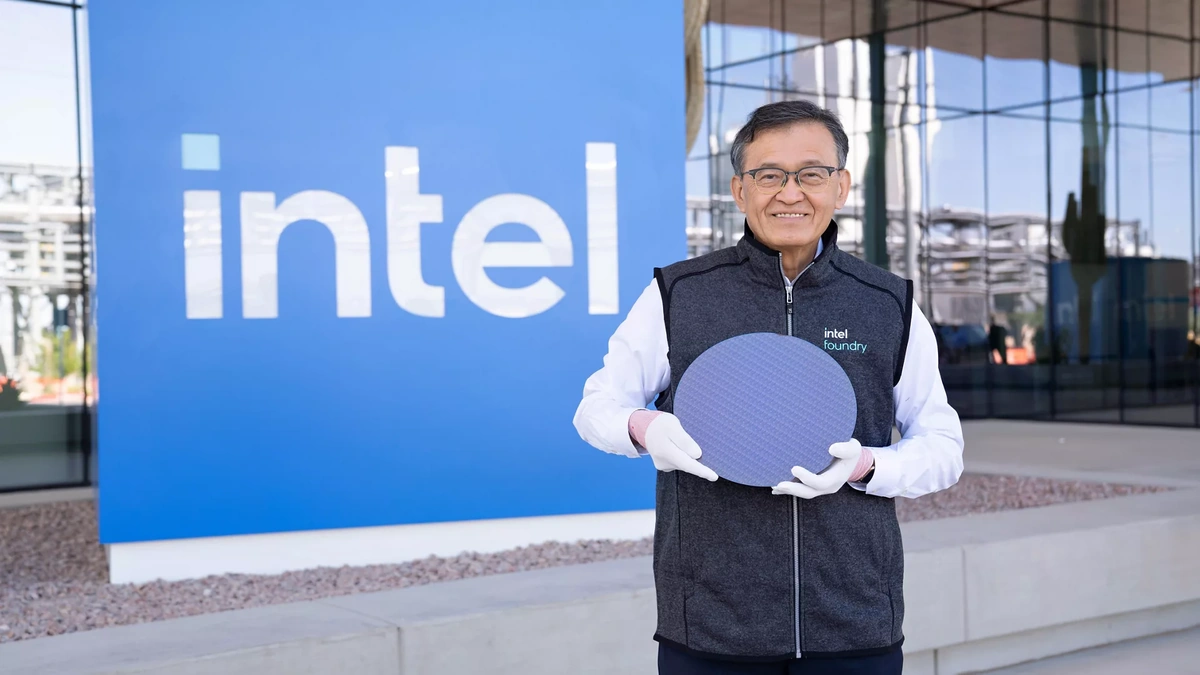
Intel plans to take some of its Oregon factory capacity off 18A, a manufacturing process it uses for Panther Lake PC chips and some server chips, and use it for Intel 3, the process behind its Granite Rapids server chips. On Intel's October 29 earnings call, Morgan Stanley's Joseph Moore asked, "does the PC weakness give you the opportunity to reallocate wafers and sort of address some of this and accelerate that transition?" CFO David Zinsner answered yes: "what we're taking offline to put Intel 3 into Oregon is 18A wafers," generally meant for Panther Lake, and some of that capacity could then make more data center wafers, the silicon discs chips are cut from. He did not say whether PC weakness changed the timing. CEO Lip-Bu Tan said Intel plans to have Intel 3 in production there in the second half of 2027.
Intel's third-quarter 10-Q filing and earnings release do not mention the Oregon move. The words come from the call, as transcribed by The Motley Fool and StockAnalysis. Neither executive gave a wafer count or a share of Oregon's 18A output. Zinsner's "some of that capacity" points to a partial move, and Tan separately said the 18A ramp continues in Oregon and Arizona and that Panther Lake has ramped.
A second effect came up when Bernstein's Stacy Rasgon asked about margins. On 18A, Zinsner said, "the loading isn't going to be where we want it," meaning those lines will run below the level Intel wants. "We're fixing a little bit of that with putting Intel 3 in Oregon," he added, while some underloading stays a headwind. In his prepared remarks, he said Intel is adjusting wafer starts for client, or PC, chips to current demand, which weighs on fourth-quarter margin. If those statements hold, the switch moves capacity Intel expects to underuse toward a process it calls "still constrained," which would make it two fixes at once. "A little bit" suggests it solves only a small part of the underloading, and Intel did not state the two together.
For a server buyer the question is how much more Intel can ship, and when. For a laptop buyer it is whether Panther Lake gets scarce and what a PC will cost. Intel's statements suggest a harder first half of 2027 for the first. For the second, they suggest no Panther Lake shortage from this move alone, an inference Intel did not state, while memory appears to be the larger part of the pressure on PC prices.
Server buyers: Intel says it will likely fall short in 2027
Zinsner would not forecast first-quarter data center revenue, but he told analysts that CPU demand stays strong all through 2027 and, of what customers need, "We will likely not fully meet what they require." He expects the first half of 2027 to be more challenging than the second.
A mid-October accident at Intel's factory in Kiryat Gat, Israel, adds to the near-term gap. Intel reports employee casualties and injuries, without giving numbers, and operations suspended for about two weeks, expected to resume by the end of October. Zinsner's early assessment is about $300 million of revenue impact in the fourth quarter, almost all of it on server chips made on Intel's older 10-nanometer process, and likely a similar hit in the first quarter of 2027. The company says it cannot yet reasonably estimate the financial impact and expects costs and results to suffer through the first half of 2027.
A buyer of the same chip probably did not pay 54% more. That is the rise in Intel's average server selling prices in the third quarter from a year earlier. Server units rose 10% in the quarter and server revenue rose $2.5 billion. Intel attributes most of the price rise to a richer mix of premium products and says demand-based pricing contributed less, in part to offset higher input costs. It gives no split between the two.
Wafers are not the only limit. In the same answer to Moore, Zinsner said "we're not only constrained on the wafer side, we're also constrained on the substrate side." Substrates are the base layers a processor is packaged on, and Tan described an industry-wide shortage of the advanced ones used in Intel's packaging. Intel is adding about 40% more substrate capacity, much of it arriving only in the second half of 2027, and the first half is "likely to be tighter in terms of wafers and substrates." After the third quarter, Intel signed two substrate supply agreements with estimated funding of $5.3 billion to $6.1 billion, about $3.3 billion of it payable by the end of 2027, with some terms not final. Substrates could still limit how many server chips Oregon's wafers become, though much of the new substrate capacity is due in the same period. Intel did not say how far substrates would limit Oregon's output.
Output also takes time: "it's going to take a while before that comes out of the fab and gets into products," Zinsner said, using the industry's word for a chip factory. If Oregon starts on plan, server buyers see chips from it later, how much later depending on whether Tan's "in the production" means first wafers or finished output. One rough guide comes from January 22, when Zinsner said a wafer mix shift toward servers begun in the third quarter of 2025 would not come out of fab until late in the first quarter of 2026, though that was a change in wafer mix rather than a conversion to another process.
PC buyers: the squeeze Intel describes starts with memory
None of the executives, PC makers or market firms quoted here ties Oregon to laptop prices or availability, so this step is inference from Intel's statements. If 18A stays underloaded as Zinsner expects, taking some of it offline should not by itself make Panther Lake scarce. That could change if PC demand recovers ahead of Intel's plan, or if Wildcat Lake, Intel's cost-optimized 18A chip that Zinsner says is sold out, draws on the same wafers, which Intel did not say. 18A's weight in the PC business has grown: its client chips went from under 5% of client CPU revenue in the first quarter to nearly a third.
Tan said customers began signaling a PC slowdown "based on the memory prices and availability," and that Intel expects the current environment "to persist until memory availability and prices begin to normalize." Zinsner does not expect memory to improve in 2027. His plan has industry PC units down about 12% in 2026, with the second half down more than 20%. For 2027 it has industry units down roughly 10%, with steeper declines in the first half and possible improvement in the second against a weak second half of 2026.
Revenue in Intel's client and physical AI segment, mostly PC chips, should fall more than 20% in the fourth quarter from the third as PC makers cut inventory. Most of that correction is likely to land in the fourth quarter and the first quarter of 2027, possibly running into the second.
Rasgon wrote that Intel "clearly did not see it coming," according to CNBC. Zinsner's April 23 plan already had weaker PC demand in the second half and full-year units down by a low double-digit percentage. On July 23, he said the client market was "unfolding as expected." On October 29, he called third-quarter revenue in the client segment "below our expectations," and said memory pressure "intensified during Q3, particularly late in the quarter." Tan said the pace of the correction had "accelerated over the last 2 months."
Preliminary third-quarter counts from IDC, Omdia and Gartner, published before Intel's call and measuring different scopes, put shipments down 20% to 22% from a year earlier. Gartner says DRAM costs rose fivefold year over year in the second quarter and PC vendors passed them on, and Omdia says DRAM and SSDs went from about 15% of a PC's cost to nearly 40%. IDC, which says vendors and sales channels stocked up ahead of price increases, and Omdia name first-half stocking. Gartner rejects excess inventory as the cause, blaming higher prices, vendors reprioritizing scarce components and a shift to pricier configurations.
Memory, more than the CPU, appears to be the larger part of a PC buyer's price pressure, though no one quoted here ranks the two. HP's units fell 16% in its quarter ended July 31 while its Personal Systems revenue rose 18%, which HP credited to richer mix as well as price increases, without a split. HP said in August that some customers deferred refreshes over this year's price increases and that memory and storage will keep growing as a share of its costs, though it reported meaningful improvements in memory supply and said it was confident of supply for its fiscal year ending October 31. Dell said in September that AI demand and limited capacity at memory makers have caused global constraints, and it expects component inflation to last through its fiscal year ending in January 2027. AMD planned on August 4 for a softer second-half PC market on higher memory and component costs. After Intel's call, UBS's Timothy Arcuri wrote that he sees "no relief in sight" for memory pricing or supply.
TrendForce said on October 12 that CPU supply for notebooks had improved significantly since the second quarter. Omdia said on October 9 that shortages of processors, among other chips, were complicating PC makers' supply and inventory planning.
CPU prices rose too. Intel's average selling prices for client chips were up 9% in the third quarter from a year earlier, primarily from price increases in part to offset higher input costs, plus a richer product mix, while volume fell 14% on lower demand and a competitive market. The same TrendForce report, citing Commercial Times, says Intel reportedly raised prices across its product lines from September 1, with high-end Panther Lake models up the most, at 15% to 20%. Those increases focus on models with high-end graphics tiles made by TSMC, not the whole Panther Lake lineup. Tom's Hardware reported in July that Intel's listed recommended prices for two desktop chips, the Core Ultra 270K Plus and 250K Plus, had risen by $30 to $50. Separately, and before those September increases, Mercury Research put AMD's share of x86 client CPUs, excluding IoT chips, at 30.3% in the second quarter, according to HotHardware.
Intel has been steering wafers toward servers since 2025
Granite Rapids, which Tan called Intel's biggest server revenue, is now the largest family in the server portfolio as output rises from Ireland, and Intel 3 volumes rose in the mid-teens percent from the second quarter. Data center and AI revenue reached $7.3 billion, up 78% from a year earlier. Even so, demand "continues to meaningfully exceed available supply," Zinsner said.
In January, Zinsner said that where possible Intel was prioritizing internal wafers for data center and using more outside wafers for client, and later on the same call that "we can't completely vacate the client market." He expected supply to improve from the second quarter and in each remaining quarter of 2026. By July the line was "while things will improve, we will not catch up. We will be behind in the fourth quarter." The forecast now has the industry supply-constrained through 2027 and into 2028, with server CPU units up more than 30% in both 2026 and 2027, and more if supply allowed. Tan describes, for the whole industry, "one of the most significant supply shortages" in history, driven by AI demand.
Those statements differ in scope, between Intel's own supply and the gap to demand, and Intel's supply did rise while its demand forecast rose too. They do suggest treating the second half of 2027 as a plan rather than a promise. Rasgon's view is harsher: Intel still has "too much PC capacity and not enough server, the latter a year into the current cycle."
Server share in 2027 depends on supply, Zinsner says
AMD's Lisa Su said on August 4 that server CPU supply was tight and should be better in 2027 than in 2026, and, citing improved supply, guided server revenue up more than 80% year over year in the second half of 2026 and more than 70% in 2027; AMD reports its third quarter on November 3. Mercury put AMD at 34.5% of x86 server CPUs, excluding IoT chips, in the second quarter, up on the year. Demand shows at server makers too: Dell's traditional server and networking revenue rose 122% to $10.5 billion in its quarter ended July 31. C.C. Wei, CEO of TSMC, which makes AMD's chips, said of its overall wafer capacity on October 15, after citing data center demand checks, that "the gap between demand and supply is still quite big," and would not say which way it goes in 2027. Zinsner said market share in 2027 will be "a function of supply," so AMD could pick up some buyers Intel cannot serve. On that August call, Su said AMD was working across its supply chain, from wafers to packaging and substrates, and felt very good about meeting growth of over 70%.
Spending is not the limit Intel names. Outlays on plants and equipment are on track for $20 billion in 2026 and expected to be up strongly in 2027, and firm equipment orders rose nearly 40% from the previous quarter. The wafer shift Zinsner described began in the third quarter of 2025, Intel's own supply has risen since, and if the Oregon plan holds, this line would start producing in the second half of 2027, about two years after that shift, though Intel did not connect the two.