Liquid AI's LFM2.5-VL-3B handles vision-language tasks on consumer hardware from smartphones to Apple Silicon Macs, designed to run on-device rather than offloading to cloud GPUs, while matching models up to twice its parameter count on standard benchmarks.
LFM2.5-VL-3B extends Liquid AI's earlier LFM2-VL series with four additions: substantially improved screen and UI element understanding across desktop, mobile, and web surfaces; object grounding via natural-language queries; multi-image reasoning; and function calling in both text-only and vision contexts. The model answers directly rather than reasoning through steps, keeping response latency low for real-time and on-device applications.
The model pairs a SigLIP2 400M NaFlex vision encoder with the same pre-trained backbone as Liquid AI's LFM2.5-2.6B text model. To support non-Latin scripts without retraining from scratch, the tokenizer vocabulary was extended in place to 128K tokens. Post-training ran supervised fine-tuning with knowledge distillation from a larger teacher model, then multi-reward reinforcement learning.
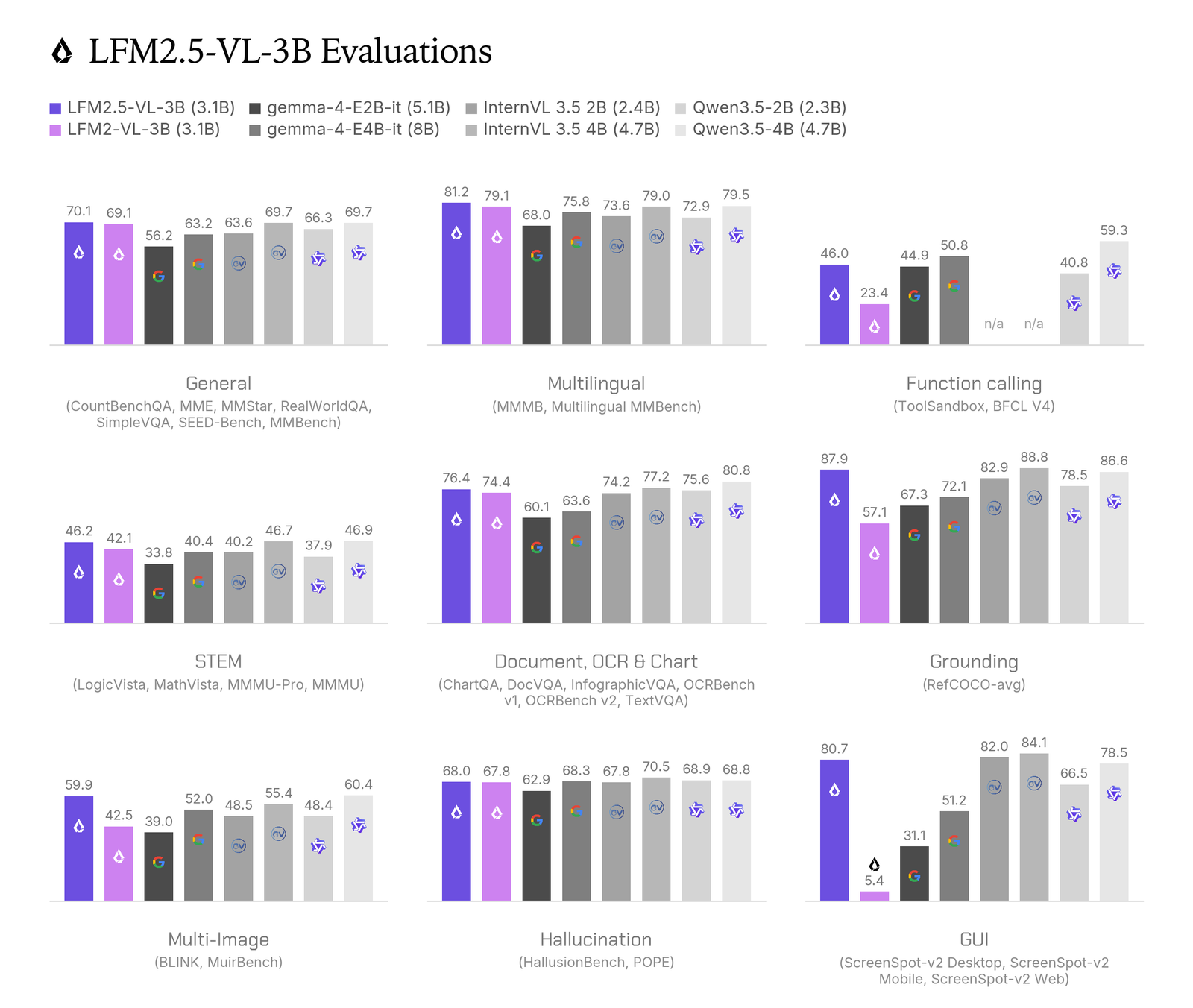
Per Liquid AI's release post, LFM2.5-VL-3B was pre-trained on roughly 34 trillion tokens with four times the vision data from the previous release. Screen-element grounding shows the largest benchmark gains: ScreenSpot-v2 Desktop rises from 6.0 on the prior LFM2-VL-3B to 78.7, and Mobile from 7.6 to 81.2. On object grounding, RefCOCO-avg reaches 87.9 against InternVL 3.5 2B's 82.9 at a similar parameter count, and MathVista (mini) climbs from 62.1 to 68.5. On-device, the model fits in roughly 3 GB of RAM, reaching 228 tokens per second on an M5 Max, 116 tokens per second on a Ryzen AI Max+ 395, and 20 tokens per second on a Galaxy S26 Ultra. On a single H100 at high concurrency it sustains roughly 11K output tokens per second, which Liquid AI says is about twice the throughput of competing 4B-class models.
Day-one inference support covers llama.cpp, MLX, vLLM, SGLang, and ONNX. A browser demo running via WebGPU is available with no local setup required, and the model weights are published on Hugging Face.
LFM2.5-VL-3B follows the LFM2.5-2.6B text model, which Liquid AI shipped for local agent workloads earlier this month. The practical ceiling of LFM2.5-VL-3B's screen grounding will become clearer as developers move it from the discrete element-click tasks that ScreenSpot-v2 measures toward open-ended interface navigation.