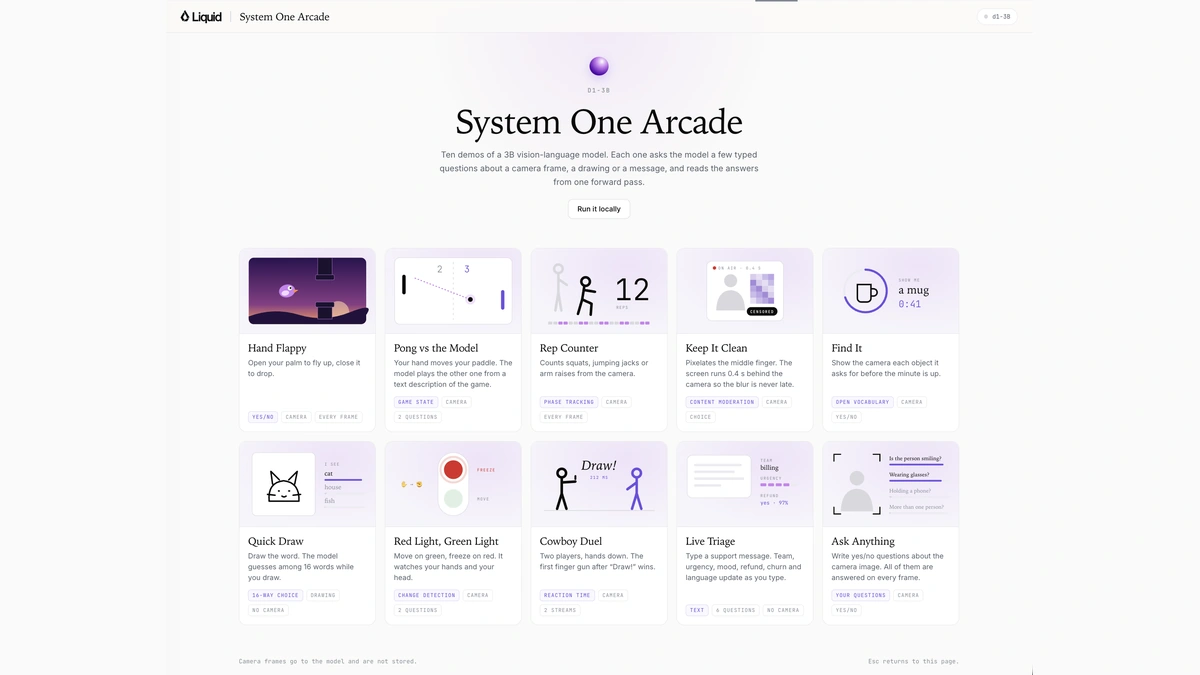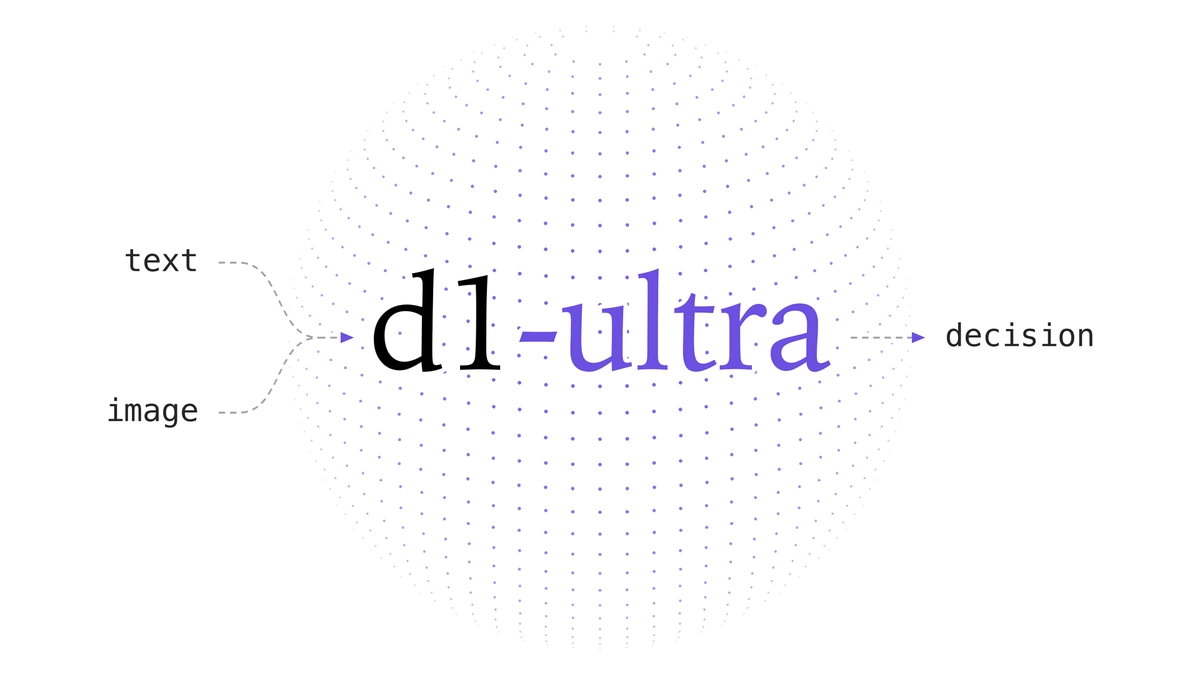
Liquid AI released d1-ultra, a multimodal model that reads text, images or both and returns a probability for each possible answer instead of writing a response. It costs $0.042 per million input tokens on the Liquid API, and output is free.
A decision model takes a situation plus one or more questions, reads them in one forward pass, and answers with numbers. Liquid AI names three question types: a yes/no question that returns a probability between 0 and 1, a pick-one-of-many question with a probability per label, and a score on an ordered scale. The examples Liquid gives for d1-ultra are a defect on a circuit board checked against its spec and a damage claim checked against the customer's photo.
d1-ultra is the top of a four-model lineup. Per Liquid AI, it costs just over double the earlier d1, at $0.042 against $0.02 per million input tokens, and the two smaller models, d1-3B (3.1B parameters) and d1-omni-600M (587M parameters, with audio input), are open-weight. Under the LFM Open License they are free to run in production for businesses with less than $10M in annual revenue, while larger companies must buy a commercial license from Liquid AI.
Images count as input at 1.5 tokens per 32x32-pixel patch, so a 1024x1024 image is 1,536 tokens. At d1-ultra's rate that is about $0.000065 per image, or roughly 6.5 cents per 1,000 images plus the text of each question. Each question is billed as its own prompt with all its images, so asking three questions about one photo is billed three times.
Liquid AI calls d1-ultra the world's best decision model and compares it with rivals including Jev 1.14, from TypeSafe AI, and Microsoft-Decision-1. Its yardstick is the Artificial Analysis Decision Index, which Artificial Analysis describes as four tests weighted 25% each: knowledge and hallucination, Humanity's Last Exam multiple choice, NVIDIA's When2Call tool-calling test and WildGuardTest safety classification.
On that index, d1-ultra scores 65.2, about 8 points ahead of Jev 1.14 at 57.1. Liquid says d1-ultra leads every other decision model there by at least 8 points, but Artificial Analysis scores the earlier Jev 1.13 at 57.5, 7.7 points behind. That earlier release is still TypeSafe's stable model, and Jev 1.14 is its preview build, per TypeSafe AI.
| Model (maker) | Artificial Analysis Decision Index | Liquid's own benchmark average | Inputs | Price per million input tokens |
|---|---|---|---|---|
| d1-ultra (Liquid AI) | 65.2 | 76.7 | Text, images | $0.042 |
| Jev 1.14 (TypeSafe AI) | 57.1 | 69.4 | Text (images in beta) | $0.042 |
| Microsoft-Decision-1 (Microsoft) | 53.8 | 66.6 | Text | $0.042 |
| d1 (Liquid AI) | 50.3 | Not shown | Text, images | $0.02 |
The table shows four of the models Artificial Analysis ranks, not its top four. Jev's image input is an opt-in beta that TypeSafe AI says is not yet ready for production, and Liquid did not score Microsoft-Decision-1 on images.
Liquid says it compared d1-ultra with d1 and Jev 1.14 across 112 evaluations. Liquid also says it trained d1-ultra to give better-calibrated probabilities because most decision models are overconfident. It reports a mean gap between confidence and accuracy of 1.5 points for d1-ultra, 2.7 for Jev 1.14 and 4.7 for Microsoft's model.
Microsoft ran its own comparison on October 9, before d1-ultra existed, across 36 public and private benchmarks. There, per Microsoft, Microsoft-Decision-1 averages 83.5 on accuracy against 82.3 for the stable Jev 1.13. Jev 1.13 scores higher on Microsoft's calibration scale, where 100 is perfect, at 93.7 to 92.2.
On its index runs, Artificial Analysis puts d1-ultra at about $32 per million tasks and a median of 93 milliseconds per task. Jev 1.14 is faster at 78 milliseconds but costs $42 per million tasks. Microsoft's model costs $31 per million tasks and takes 207 milliseconds.
All three models are on Vercel AI Gateway and OpenRouter as well as their makers' own platforms. Microsoft-Decision-1, built on Qwen3.5-9B, is also in Microsoft Foundry, and Microsoft plans to rebase future versions on OpenAI models and its own MAI models. Liquid AI plans regular updates to its decision models across a range of sizes.