A machine learning platform is a managed development environment that provides integrated tools for building, training, deploying, and monitoring ML models at production scale. Choosing the wrong one adds months of re-platforming work once traffic or data volume outgrows the original environment. The decision turns on five technical layers, a scored set of evaluation criteria, a realistic cost projection, and a constrained pilot before any production commitment.
What a Machine Learning Platform Does
A machine learning platform integrates five functional layers that would otherwise require separate tooling and manual glue code. Understanding each layer prevents teams from selecting a platform that excels at model training infrastructure while leaving the feature engineering pipeline and monitoring unaddressed.
- Data Ingestion
- Connectors and pipelines that pull raw datasets from object storage, data warehouses, or streaming brokers into the platform. SageMaker integrates with Amazon S3 and Glue; Vertex AI connects to BigQuery and Cloud Storage.
- Feature Engineering Pipeline
- Transformation and computation layer that converts raw inputs into model-ready feature vectors. The feature engineering pipeline stores and serves features consistently across training and inference so that production predictions use the same transformations as training runs.
- Model Training Infrastructure
- Distributed compute orchestration that schedules GPU and CPU resources for training jobs. Model training infrastructure determines job queue depth, spot-instance preemption handling, and multi-node parallelism support.
- Data Versioning
- Snapshot and lineage tracking for datasets and feature values. Data versioning links each model artifact to the exact training data slice used to produce it, making reproducibility and audit trails possible.
- Deployment and Monitoring
- Serving infrastructure for real-time and batch inference, plus observability hooks for model monitoring and drift detection that alert when live prediction distributions diverge from training baselines.
Step 1: Clarify Your Use Case and Skill Level
Every ML platform evaluation starts with a precise use-case definition. A platform optimized for natural language processing (NLP) workloads carries different infrastructure assumptions than one built for tabular classification or time-series forecasting. Mapping use case to practitioner profile before scoring any vendor avoids the common failure of choosing a platform on brand recognition alone. For algorithm selection background, see Machine Learning Explained: Supervised vs Unsupervised. Domain-specific deployments such as clinical risk models should also consult How to Implement AI in Healthcare for regulatory constraints that shape platform requirements.
- Classification and regression (tabular data). The dominant workload profile. Data scientists with scikit-learn or XGBoost experience can run these jobs on any major ML platform. Automated machine learning (AutoML) support matters most here: it compresses experiment cycles from weeks to hours by searching the model space automatically.
- NLP workloads. Teams fine-tuning large language models or training sequence classifiers need tight Hugging Face or JAX integration, large GPU memory per node, and fast tokenization pipelines. Vertex AI has the strongest native NLP toolchain among AWS, Google Cloud, and Microsoft Azure.
- Computer vision. Requires multi-GPU training runs with high network bandwidth between nodes. Evaluate whether the platform's model training infrastructure supports PyTorch Distributed and NCCL without custom configuration.
- Time-series forecasting. Often runs on CPU clusters rather than GPU. Evaluate feature engineering pipeline freshness guarantees: stale features fed to a forecasting model degrade accuracy silently.
- Research and experimentation. Teams with MLflow or Jupyter-native workflows may prefer open-source stacks (Kubeflow, MLflow) over managed platforms to retain environment control, at the cost of more operational overhead.
Step 2: Score Platforms Against Core Evaluation Criteria
Each ML platform scores differently across the evaluation criteria that matter for production deployments. The NIST AI Risk Management Framework (NIST AI RMF 1.0) Govern and Measure functions map directly to four of these criteria: bias and fairness evaluation, model explainability, hyperparameter tuning governance, and data versioning. Teams building natural language processing pipelines should weight AutoML NLP coverage and feature attribution depth more heavily than teams focused on tabular workloads. Score each candidate against every criterion before shortlisting. For the broader governance framing that shapes evaluation criteria in regulated industries, see AI Ethics Guidelines.
| Criterion | Amazon SageMaker | Google Vertex AI | Azure ML | MLflow + Kubeflow |
|---|---|---|---|---|
| AutoML support | SageMaker Autopilot (tabular, NLP, image) | AutoML Tables, Vision, NLP via unified API | Automated ML with explainability reports | No built-in AutoML; integrate third-party libs |
| Hyperparameter tuning | SageMaker HyperPod; Bayesian and random search | Vertex AI Vizier; Bayesian, grid, random | HyperDrive; integrates with Optuna | Katib (Kubeflow); pluggable algorithms |
| Bias and fairness evaluation | SageMaker Clarify; pre- and post-training bias reports | Vertex Explainable AI; model cards with fairness metrics | Responsible AI dashboard with bias analysis | Manual; integrate Fairlearn or AIF360 |
| Model explainability | SHAP values via Clarify; PDF and JSON reports | Feature attributions via Explainable AI API | InterpretML integration in Azure ML studio | Manual SHAP or LIME integration |
| GPU compute cost controls | On-demand and spot instances; Savings Plans available | On-demand, preemptible VMs, committed use discounts | Compute clusters with low-priority VMs | Cluster-dependent; requires own cost tooling |
| Data versioning | SageMaker Feature Store plus S3 versioning | Vertex Feature Store with time-travel queries | Azure ML Datasets with versioning API | MLflow Tracking plus DVC for dataset lineage |
| Vendor lock-in risk | High; tight AWS service dependencies | Medium-high; GCP-native APIs dominate | Medium; supports ONNX and MLflow open standards | Low; runs on any Kubernetes cluster |
Source documentation for SageMaker evaluation criteria rows: Amazon SageMaker Developer Guide. For Vertex AI: Google Vertex AI documentation.
Step 3: Assess Model Deployment Workflow Requirements
An ML platform's model deployment workflow that looks clean in a demo can create production bottlenecks when latency SLAs tighten or rollback windows shorten. Audit deployment requirements before signing a contract, not after a staging environment is already wired to a vendor's REST endpoint.
- Inference mode. Determine whether workloads require real-time inference via a persistent REST endpoint, batch transform jobs over large datasets, or asynchronous queued inference for variable-volume traffic. Each mode maps to different pricing and cold-start behavior across vendors.
- Latency SLA. For real-time model deployment workflows, measure p99 latency under realistic load before committing. SageMaker multi-model endpoints and Vertex AI dedicated endpoints differ significantly in warm-start time.
- CI/CD integration. Confirm that the model deployment workflow connects to your existing GitOps or Jenkins pipelines. Azure ML Pipelines and Vertex AI Pipelines both support Kubeflow Pipelines DSL, which reduces migration friction.
- Model monitoring and drift detection. Validate that the platform's model monitoring and drift detection hooks capture both data drift (input distribution shift) and concept drift (target distribution shift). SageMaker Model Monitor and Vertex Model Monitoring both support scheduled drift jobs; Azure ML Model Monitoring uses Application Insights as the backend.
- Rollback capability. Confirm that the platform supports versioned model endpoints and traffic-split rollbacks without full redeployment. This is non-negotiable for any deployment with a sub-1-hour recovery time objective.
Step 4: Evaluate GPU Compute Cost at Your Scale
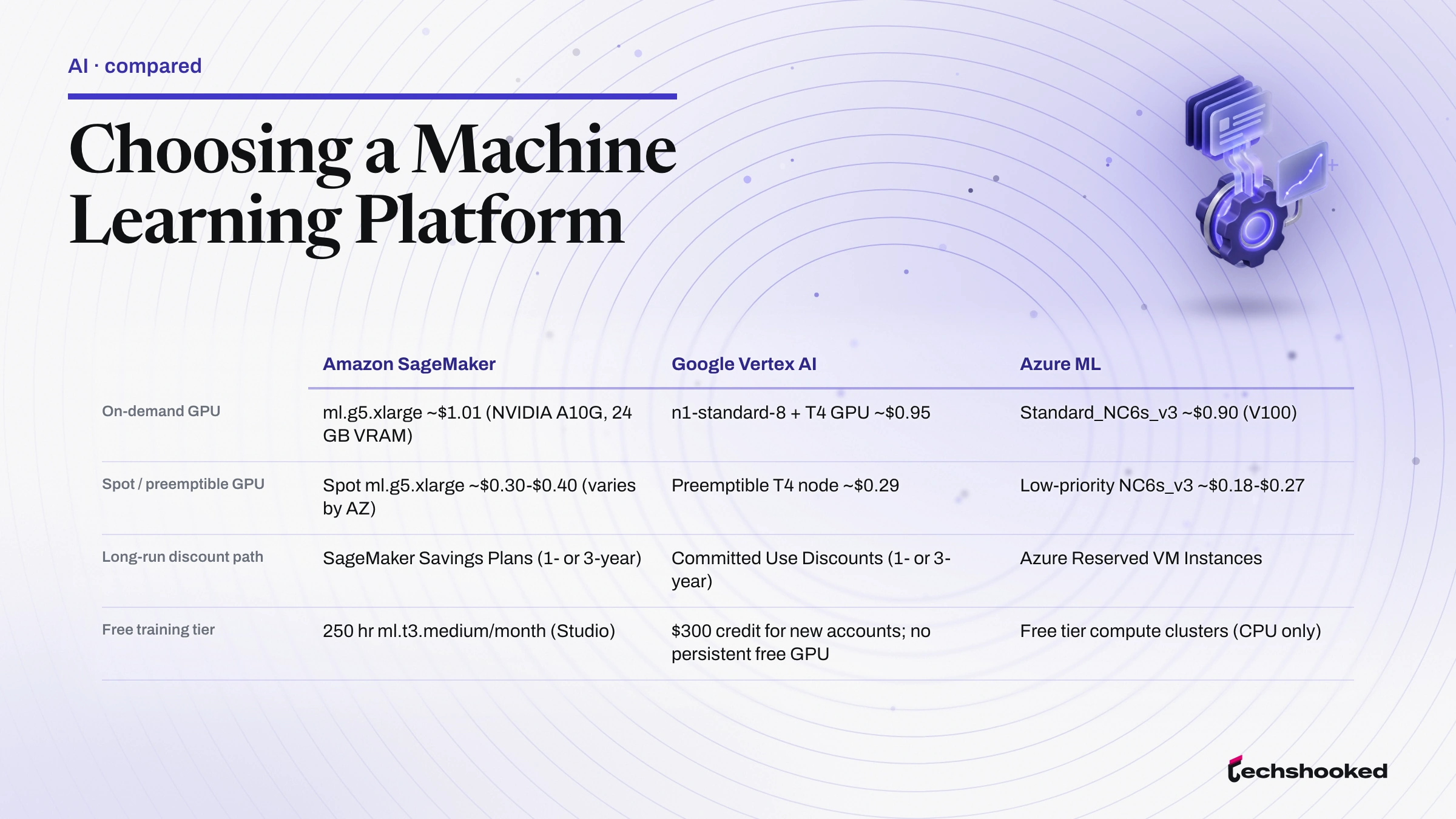
GPU compute cost is the dominant line item in most machine learning platform budgets once training jobs move beyond prototype scale.
| Instance type | Amazon SageMaker | Google Vertex AI | Azure ML |
|---|---|---|---|
| On-demand GPU (mid-tier, per hour) | ml.g5.xlarge ~$1.01 (NVIDIA A10G, 24 GB VRAM) | n1-standard-8 + T4 GPU ~$0.95 | Standard_NC6s_v3 ~$0.90 (V100) |
| Spot / preemptible GPU (mid-tier, per hour) | Spot ml.g5.xlarge ~$0.30-$0.40 (varies by AZ) | Preemptible T4 node ~$0.29 | Low-priority NC6s_v3 ~$0.18-$0.27 |
| Long-run discount path | SageMaker Savings Plans (1- or 3-year) | Committed Use Discounts (1- or 3-year) | Azure Reserved VM Instances |
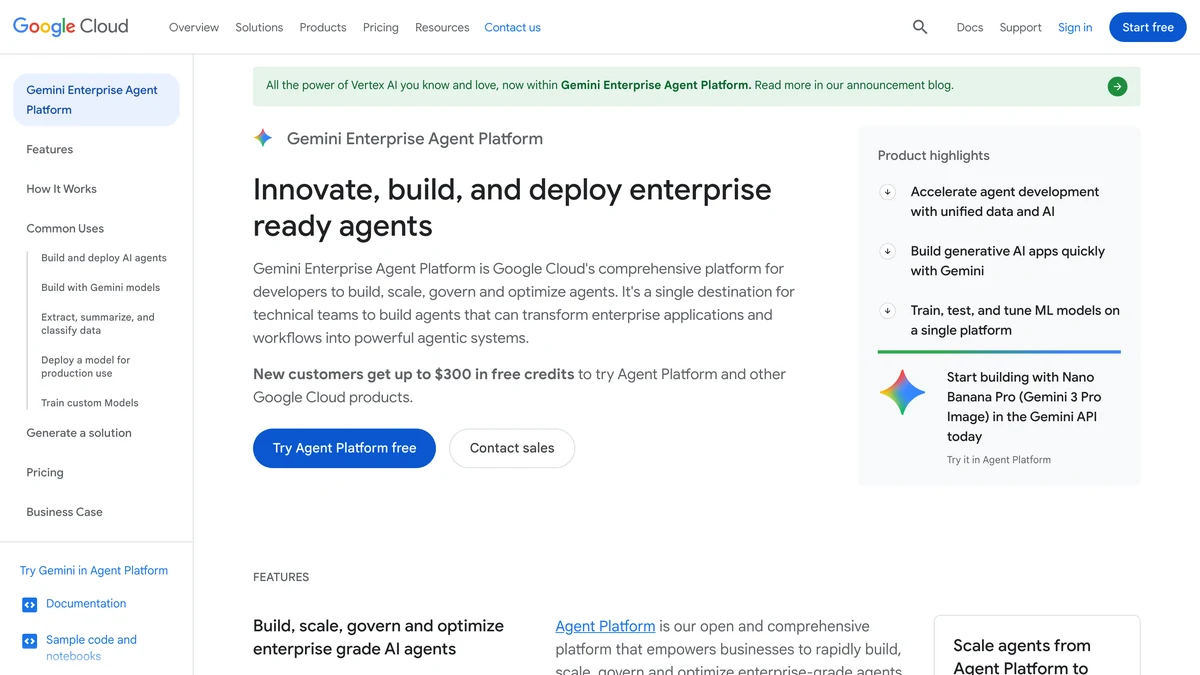
| Free training tier | 250 hr ml.t3.medium/month (Studio) | $300 credit for new accounts; no persistent free GPU | Free tier compute clusters (CPU only) |
Spot and preemptible instances cut GPU compute cost by 60-75% versus on-demand rates, but require checkpoint-based training jobs that can resume after preemption. Any training infrastructure that cannot tolerate mid-job interruption should budget for on-demand pricing or reserved capacity. Check current rates on the AWS EC2 On-Demand pricing page and in the Google Cloud and Azure pricing calculators before projecting monthly spend; cloud GPU rates shift with hardware generations and regional capacity.
Step 5: Run a Pilot and Validate Against KPIs
A structured pilot is the only reliable way to validate machine learning platform scoring criteria against real workloads. Constrain the pilot to four weeks and one realistic dataset to prevent scope creep. See also: AI in financial services.
- Training throughput. Measure GPU utilization and job completion time for your largest representative training job. Compare against the vendor's published compute infrastructure benchmarks for the same instance class.
- Feature pipeline latency. Time the full feature workflow from raw data ingestion to feature-ready tensors. A pipeline that runs in 4 hours during a pilot may bottleneck at 40 hours when dataset size doubles.
- Deployment reproducibility. Redeploy the same model artifact three times using the platform's deployment workflow. Verify that inference output is byte-identical across deployments to confirm environment pinning works correctly.
- Bias and fairness evaluation pass rate. Run the platform's bias and fairness evaluation tooling against your validation set. Record the percentage of protected-group subgroups that fall within your organization's fairness thresholds.
- Total spend on GPU compute. Tally actual costs for the pilot period, not vendor estimates. Include storage, networking egress, and managed-service overhead fees, which rarely appear in headline pricing.
- Model monitoring and drift detection sensitivity. Inject a known distribution shift into a shadow dataset and confirm that the platform's monitoring and drift detection alerts fire within your acceptable detection window.
Platform Recommendations by Workload Type
After running the scored evaluation and pilot, the ML platform shortlist typically collapses to a single primary recommendation per workload profile. For deeper head-to-head comparison across pricing tiers and SLA terms, see AWS SageMaker vs Google Vertex AI vs Azure ML.
- NLP-heavy workloads
- Google Vertex AI. Native automated machine learning support for NLP tasks, tight Hugging Face integration via Vertex AI Workbench, and deep tokenization pipeline controls make it the strongest fit for teams with transformer-based workloads. The Explainable AI API covers model explainability for text outputs with feature attribution at the token level.
- Enterprise Azure-native environments
- Azure Machine Learning. Teams already running Azure Active Directory, Azure DevOps, and Azure Databricks incur the least integration friction with Azure ML. The Responsible AI dashboard provides fairness evaluation and InterpretML-backed model explainability in a single interface that maps to enterprise governance workflows.
- AWS-native teams with end-to-end coverage requirements
- Amazon SageMaker. For organizations with data already in S3, compute in EC2, and IAM policies across the AWS estate, SageMaker provides the most complete training compute, feature store, and deployment pipeline without cross-cloud egress costs.
- Open-source preference or multi-cloud portability
- Kubeflow plus MLflow. This stack runs on any Kubernetes cluster across cloud or on-premises environments. MLflow experiment tracking and DVC for dataset lineage replicate most managed-platform capabilities at the cost of higher operational burden. Lowest vendor lock-in risk of any option in this comparison.
Further reading
- Machine Learning Explained: Supervised vs Unsupervised: algorithm selection background for each use-case category in Step 1
- AWS SageMaker vs Google Vertex AI vs Azure ML: full head-to-head comparison with pricing scenarios and migration cost analysis
- AI Ethics Guidelines: governance frameworks that inform bias evaluation requirements in regulated industries
- NIST AI RMF 1.0: the Govern and Measure functions that anchor scoring axes for responsible ML deployment
- Crypto Wallet Types Explained: Custodial, Non-Custodial, Hot, Cold, and AI-Agent Wallets