LLMOps is the discipline that operationalizes large language models in production environments. LLMOps, short for large language model operations, covers the deployment pipelines, prompt versioning, observability stack, and token cost controls that keep generative AI applications reliable once they leave a notebook and start serving real traffic. Microsoft characterizes LLMOps as the practices, techniques, and tools that facilitate the development, integration, testing, release, deployment, and monitoring of LLM-based applications (Microsoft AI Playbook, Generative AI technology guidance). LLMOps borrows the automation discipline of MLOps but reorganizes the lifecycle around prompts, retrieval indexes, and provider-hosted model endpoints rather than a single trained model artifact. For the broader context this sits inside, see how modern generative AI systems work.
What LLMOps Is and How It Differs from MLOps
LLMOps is the operational practice set that extends classical MLOps to address the unique production challenges of large language model applications. MLOps, as Google Cloud describes it, advocates for automation and monitoring at all steps of ML system construction, including integration, testing, releasing, deployment, and infrastructure management (Google Cloud, MLOps continuous delivery and automation pipelines). LLMOps inherits those habits but the versioned artifact changes shape: Microsoft notes that LLM pipelines often focus on prompt templates, agents, or chains rather than the model itself, and that LLM applications frequently consume a pretrained model selected from an internal or external model hub (Microsoft Azure Databricks, LLMOps). That single shift cascades through every downstream concern. The training data set is replaced or supplemented by a retrieval corpus and a vector index. The model binary is replaced by a hosted API endpoint plus a prompt template kept under version control. Evaluation moves from accuracy on a labeled test set to graded comparisons on a curated golden set, often with human feedback in the loop. For grounding in the supervised and unsupervised learning patterns LLMOps extends, see how supervised and unsupervised machine learning works.
- MLOps: the discipline of automating and monitoring machine learning workflows so models are systematically developed, deployed, retrained, and observed.
- LLMOps: the LLM-specific extension that adds prompt versioning, retrieval index management, token cost governance, and provider-update drift handling.
- Prompt template: the structured instruction sent to the model on every call, treated as code and stored in a Git-backed repository.
- Fine-tuning: further training of a base model on task-specific data to adapt its behavior, an option alongside prompt engineering and retrieval augmentation.
- GenAIOps: Microsoft's renamed framing of LLMOps, which it documents as the operational practices and strategies for managing LLMs in production.
The LLMOps Lifecycle: From Experiment to Production
LLMOps structures production delivery through five sequential phases: experimentation, evaluation, deployment, monitoring, and iterative improvement. Experimentation lives in notebooks where engineers iterate on prompt templates, retrieval strategies, and base model choices against representative inputs. Evaluation moves the winning candidate into a structured test harness with a fixed golden set, automated judges, and human raters. Deployment ships the prompt template, retrieval configuration, and any fine-tuned adapter through a CI/CD (continuous integration and continuous delivery) pipeline that mirrors the patterns used for production software, anchored in the same automation principles described in CI/CD pipeline fundamentals for production software. Monitoring then captures live traffic telemetry, while iterative improvement feeds those signals back into the next round of experiments. Google Cloud's LLMOps overview frames the same lifecycle as model deployment and maintenance, data management, model training and fine-tuning, monitoring and evaluation, and security and compliance (Google Cloud, What is LLMOps).
- Experimentation: compare prompts, retrieval configurations, and candidate models against representative inputs in a notebook or Prompt Flow workspace.
- Evaluation: grade the leading candidate on a fixed golden set with automated judges and human raters before any production rollout.
- Deployment: ship prompts, retrieval configs, and adapters through a CI/CD deployment pipeline with a model registry tracking each version.
- Monitoring: capture per-request latency, token cost, output quality scores, and error rates from live traffic.
- Iteration: feed live signals back into experimentation so prompt versioning, retrieval, and fine-tuning improvements ship continuously.
LLMOps Observability: Metrics, Logs, and Traces
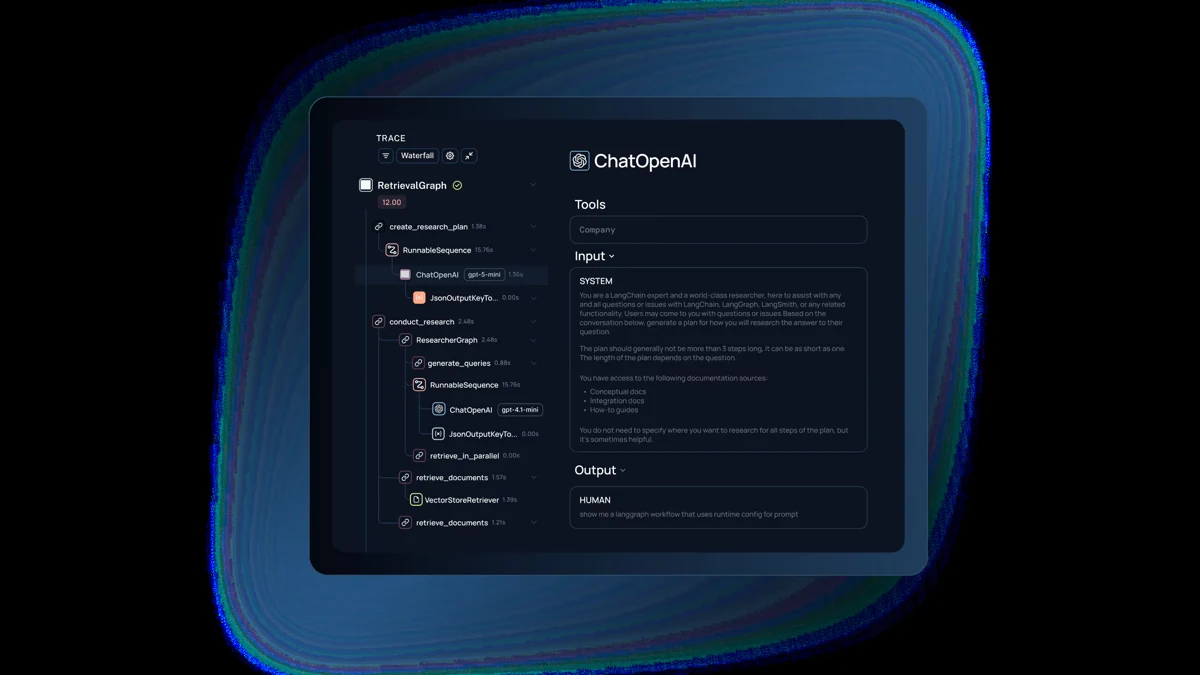
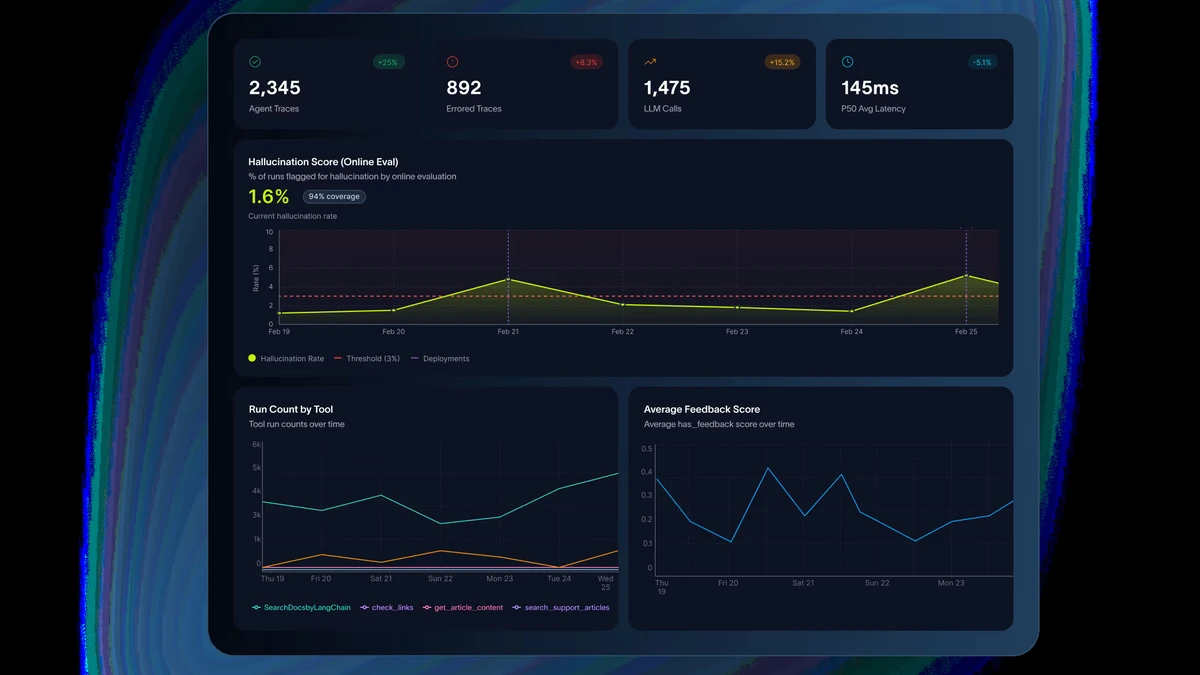
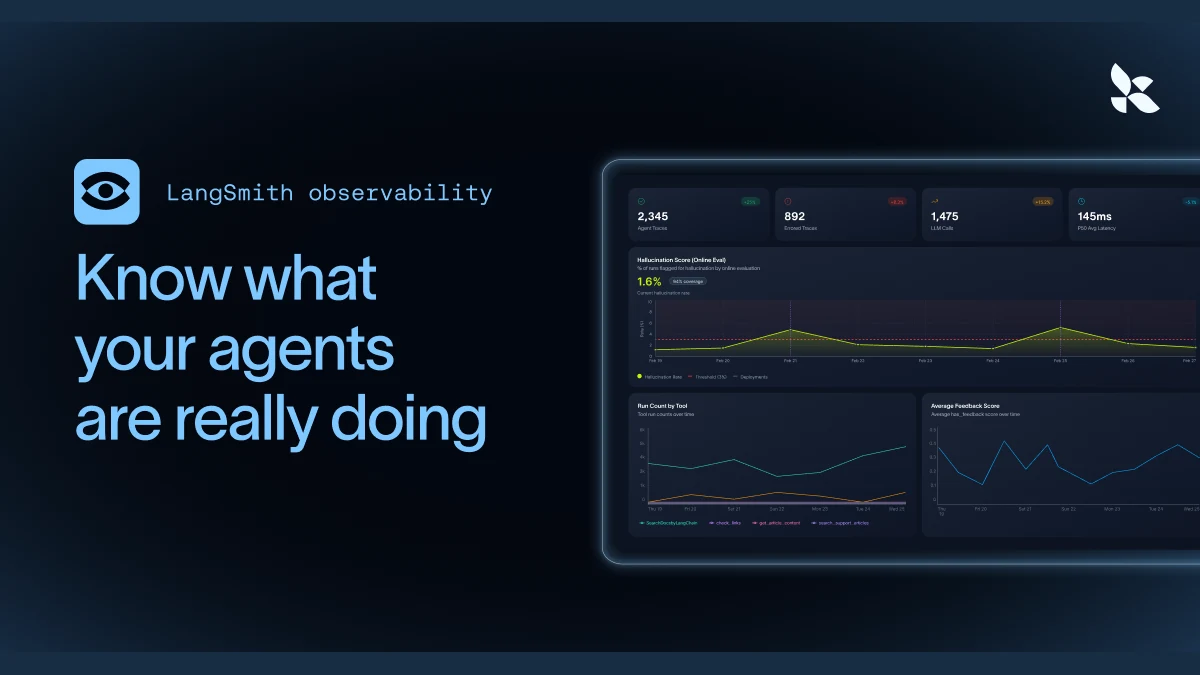
LLMOps observability means collecting metrics, logs, and traces across the full inference path to understand whether the system functions as intended, per Microsoft's generative AI playbook. Microsoft describes deployment monitoring and observability as including metrics, logs, and traces to gain visibility into a generative AI application's operations and to understand its state at any given moment (Microsoft AI Playbook, Generative AI technology guidance). The three signals serve different jobs. Metrics aggregate request rate, latency percentiles, token cost per call, and quality scores into time-series the operations team can chart and alert on. Logs preserve the exact prompt, completion, retrieved documents, and grading verdict for any single call, which matters when an incident demands a precise replay. Traces stitch the steps of an agent or chain into a parent-child span tree, exposing where latency or token spend actually accumulated across a retrieval call, a re-ranker, and the final model invocation. Microsoft's guidance reinforces that LLM monitoring should track model performance, data throughput, and response times to ensure the system is functioning as intended. Tooling has clustered around this triad: LangSmith, Weights and Biases Weave, MLflow, Arize Phoenix, and OpenTelemetry-based instrumentation each surface per-call breakdowns alongside aggregate dashboards, with most projects standing up a model monitoring stack that combines at least two of them.
| Tool | Primary signal | Strength | Typical role |
|---|---|---|---|
| LangSmith | Traces and per-call logs | Native LangChain integration, prompt regression tests | Trace-first observability for LangChain and LangGraph stacks |
| Weights and Biases Weave | Traces, evaluations, datasets | Experiment tracking carried into production | Unified eval and observability for teams already on Weights and Biases |
| MLflow | Runs, registry, traces | Open source, model registry, broad ML coverage | Versioning prompts and adapters alongside classical models |
| Arize Phoenix | Traces, evaluations, drift | Open source, OpenTelemetry compatible | Drift monitoring and span-level inspection in self-hosted stacks |
| OpenTelemetry | Traces and metrics | Vendor-neutral standard | Wire LLM spans into existing observability pipelines like Grafana or Datadog |
Prompt Versioning and Evaluation in LLMOps
LLMOps treats prompt templates as first-class versioned artifacts because most LLM application logic lives in the prompt rather than in the model weights. Microsoft makes the point directly: the ML logic developed for LLM pipelines often focuses on prompt templates, agents, or chains rather than the model itself, and human feedback is essential for evaluating and testing LLMs (Microsoft Azure Databricks, LLMOps). That observation reshapes the engineering workflow. Prompt versioning means each instruction string carries a semantic version, a commit hash, an owner, and a regression-eval verdict before it can be promoted from staging to production. Evaluation runs in two layers: an offline suite that scores the new prompt against a fixed golden set of inputs with expected outputs, and an online layer that compares production traffic between the previous and candidate prompt under a controlled rollout. Many LLM applications also use vector indexes for fast similarity searches to provide context or domain knowledge in queries, per Microsoft, so the prompt-evaluation harness must hold the retrieval configuration constant when isolating a prompt change. The retrieval mechanics underneath are covered in how retrieval-augmented generation works.
- Version the prompt: store each prompt template in Git with a semantic version, owner, and review history.
- Curate a golden set: assemble representative inputs with expected outputs or grading rubrics for repeatable offline evaluation.
- Run automated judges: use rule-based scorers and LLM-as-judge graders to flag quality regressions before a release.
- Layer human feedback: route a sampled stream of production calls to human raters for the qualities automated scorers miss.
- Promote with a canary: roll the new prompt to a fraction of live traffic, compare quality scores and token cost, then expand or roll back.
Deployment Patterns: Managed APIs, Self-Hosted Models, and Fine-Tuned Adapters
LLMOps deployment strategy depends on whether teams consume a managed API, self-host an open-weight model on GPU infrastructure, or fine-tune a base model with a task-specific adapter. Microsoft documents that LLMs are available as proprietary or open-source models accessed through paid APIs, off-the-shelf open source models, custom fine-tuned models, and custom pre-trained applications, and that LLMs can require GPUs for real-time model serving and fast storage for models that need to be loaded dynamically (Microsoft Azure Databricks, LLMOps). The managed API path consumes endpoints from OpenAI, Anthropic, Google, or Azure OpenAI and trades raw control for operational simplicity. The self-hosted path runs an open-weight model such as Llama or Mistral on Kubernetes with vLLM or NVIDIA Triton, often using Amazon EKS or Google Kubernetes Engine for GPU node pools. The fine-tuned adapter path keeps the base model frozen and trains a small parameter-efficient adapter, typically LoRA, that the deployment pipeline ships alongside the prompt template. AWS describes a pattern suitable for foundation model operations (FMOps) and large language model operations (LLMOps) in generative AI, covering fine-tuning, vector databases, and prompt management (AWS Prescriptive Guidance, MLOps workflow with Amazon SageMaker). The platform choices that sit underneath are compared in comparing AWS SageMaker, Google Vertex AI, and Azure ML for model deployment.
- Managed API: consume hosted endpoints from OpenAI, Anthropic, or Azure OpenAI; fastest path to production, but pricing and capability changes arrive on the provider's schedule.
- Self-hosted open weights: run Llama, Mistral, or Gemma on GPU nodes via vLLM or NVIDIA Triton; maximum control over privacy, latency, and unit cost at the price of operating the GPU fleet.
- Fine-tuned adapter: train a LoRA or QLoRA adapter on task-specific data, then load it on top of a frozen base served via Amazon SageMaker, Google Vertex AI, or Azure Machine Learning.
- Hybrid deployment pipeline: route low-stakes traffic to a cheaper tier and reserve a flagship model for the calls that need it, governed by the same CI/CD deployment pipeline.
Token Cost Governance and Latency Controls
LLMOps cost governance starts with per-request token tracing because input length, output length, model tier, and request volume are the four independent cost drivers. Tracing every call captures the prompt token count, the completion token count, the model identifier, and the latency, which makes a runaway feature or a regressed prompt visible the same day it ships rather than at the end-of-month invoice. Practical controls follow once the data is in hand. Trim the system prompt to the minimum that preserves quality. Cap output tokens at the smallest number the use case tolerates. Route lower-stakes requests to a cheaper model tier and reserve the flagship model for calls that demand it. Cache repeated prompt prefixes where the provider supports it, and cache full responses where the inputs are deterministic. Latency controls follow the same observability data: a P95 latency alert on the inference span tells the team when a provider is degraded, when a retrieval call is slow, or when a re-ranker has stalled. LangSmith, Weights and Biases, MLflow, and Arize Phoenix all surface per-call token breakdowns that make these levers actionable. The same observability pipeline drives model monitoring for quality drift, so cost governance and quality monitoring share a single instrumented path rather than running on parallel stacks.
- Trace every call: log prompt tokens, completion tokens, model tier, and latency at the span level for every production request.
- Cap output tokens: set the maximum completion length per route to the smallest value the use case tolerates.
- Tier the routing: send lower-stakes calls to a cheaper model and reserve a flagship model for high-value paths.
- Cache aggressively: enable prompt-prefix caching from the provider and add an application-layer response cache for deterministic inputs.
- Alert on cost burn: set budgets per route and page on anomalous token cost or latency before the monthly invoice surprises finance.
LLMOps Maturity Levels and Tooling
LLMOps maturity runs from ad-hoc manual deployments at level one through fully automated, proactive monitoring and structured deployment strategies at level three and above, per Microsoft's GenAIOps maturity model. Microsoft frames level three as managing advanced LLM workflows with proactive monitoring and structured deployment strategies, and level four as operational excellence in LLM application development, deployment, and monitoring (Microsoft Azure Machine Learning, GenAIOps maturity model). Microsoft also notes on the same page that Prompt Flow feature development ended on April 20, 2026 and full retirement is scheduled for April 20, 2027, with a recommendation to migrate Prompt Flow workloads to Microsoft Agent Framework before that retirement date. The maturity ladder is best read as a checklist of which gates exist, not as a vendor ranking. A level-one team writes prompts in a Google Doc and pushes changes to production by hand. A level-three team has prompt versioning in Git, CI/CD running automated evaluation on every change, deployment to canary traffic with automatic rollback, and an observability stack that pages on token cost and quality drift. Tooling typically clusters by maturity: MLflow for prompt and adapter versioning, LangSmith or Weights and Biases for evaluation and tracing, Argo or GitHub Actions for the CI/CD deployment pipeline, and a model monitoring layer wired into the same dashboards the rest of the platform already uses.
| Maturity level | Prompt management | Evaluation | Deployment pipeline | Observability |
|---|---|---|---|---|
| Level 1 (initial) | Untracked strings in code | Ad-hoc manual checks | Manual push to production | Console logs only |
| Level 2 (managed) | Stored in Git with version tags | Offline golden-set runs | Scripted deploy with manual approval | Basic metrics on latency and errors |
| Level 3 (defined) | Versioned in a registry, owner per prompt | Automated judges plus human review | CI/CD with canary and automatic rollback | Metrics, logs, traces, and drift alerts |
| Level 4 (optimized) | Federated registry across teams | Continuous online evaluation | Multi-region, multi-tier routing | Proactive quality and cost monitoring with SLOs |
References
- Microsoft AI Playbook, Generative AI technology guidance
- Microsoft Azure Machine Learning, GenAIOps maturity model
- Microsoft Azure Databricks, LLMOps
- Google Cloud, What is LLMOps
- Google Cloud, MLOps continuous delivery and automation pipelines
- AWS Prescriptive Guidance, MLOps workflow with Amazon SageMaker
Further reading
Frequently Asked Questions
How is LLMOps different from classical MLOps?
LLMOps differs from classical MLOps in that the versioned artifact is the prompt template, retrieval configuration, or fine-tuned adapter, not only the trained model binary. Classical MLOps pipelines version a model artifact and its training data; LLMOps must also track prompt templates as code, manage vector index versions, and account for the fact that the underlying model may be updated by the provider without a redeployment on your side. Microsoft describes this shift in its Azure Databricks LLMOps documentation.
How do you detect when an LLM application has drifted in production?
Production LLM outputs drift when the underlying model is updated by the provider, user behavior shifts, or the retrieval corpus changes, without any redeployment on your side. Detecting drift requires continuous evaluation: run a fixed golden-set of prompts on a schedule, compare outputs against expected results using automated judges or human raters, and alert when quality scores drop below threshold. Microsoft's generative AI playbook calls for collecting metrics, logs, and traces to gain visibility into the system's operations at any given moment.
What drives token cost in a deployed LLM application?
Token cost is determined by input length, output length, model tier, and request volume, so tracing per-request token counts is the essential first step. Practical controls include trimming system prompts, capping output tokens, routing lower-stakes requests to a cheaper model tier, and using caching for repeated prompt prefixes. LLMOps observability tooling such as LangSmith and Weights and Biases surfaces per-call token breakdowns to make these levers actionable.
How do you handle an AI agent making tool calls it should not?
An agent making unexpected tool calls signals a prompt injection, a changed tool schema, or a model update that altered instruction-following behavior. The remediation paths differ: prompt injection requires input sanitization and output parsing guards; a changed tool schema requires versioned schema validation in the deployment pipeline; a model-update regression requires a rollback or a prompt adjustment confirmed by a regression eval suite. LLMOps governance means each path has a defined owner and a playbook before the agent reaches production.