Fine-tuning is a technique that updates a pretrained model's weights on a task-specific dataset to produce consistent, specialized behavior that prompt engineering alone cannot reliably deliver. The same goal of shaping model behavior is pursued by two other methods that work very differently: retrieval-augmented generation (RAG), which leaves the weights frozen and injects relevant documents into the prompt at inference time, and prompt engineering, which steers a stock model purely through instructions and examples. OpenAI's accuracy-optimization guide presents these as additive, not mutually exclusive: teams start with prompt engineering, diagnose the failure type (in-context memory gaps versus learned behavior gaps), then layer retrieval or fine-tuning accordingly, with evaluation driving each step (OpenAI, Optimizing LLM Accuracy). Picking the wrong one wastes the largest budget item in an LLM project, which is engineering time, so the selection logic matters more than any single technique.
What Each Technique Actually Does
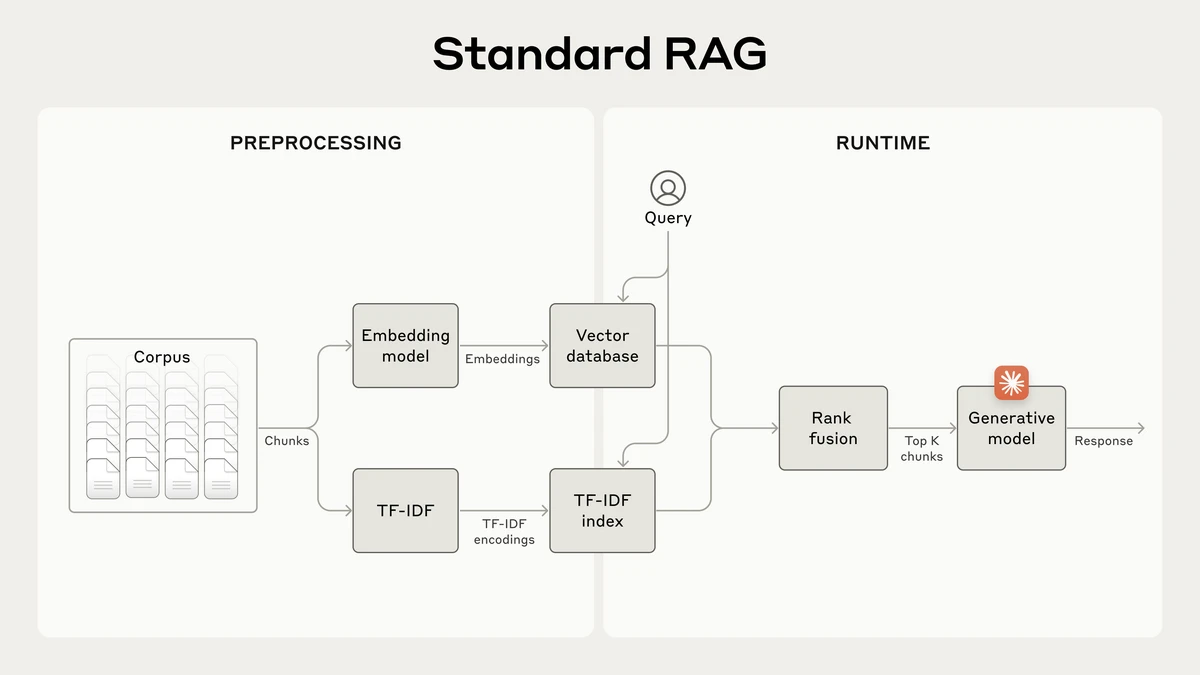
Fine-tuning, retrieval-augmented generation (RAG), and prompt engineering each intervene at a different point in the model pipeline, which is why they are not interchangeable. Fine-tuning runs an additional training pass that updates the model weights on a curated dataset, producing a new model that behaves differently on every subsequent inference call. RAG leaves the base model untouched and instead builds a retrieval system around it: documents are chunked, converted into embeddings, and stored in a vector index, then the most relevant chunks are pulled into the context window at query time. Prompt design changes nothing about the model or its environment; it shapes only the instructions, system messages, and few-shot examples sent at inference. The three techniques target different failure modes, and confusing the targets is how teams end up paying to fine-tune a model when a better prompt would have solved the problem. For a wider view of where these methods sit in the LLM stack, see how modern generative AI systems work, and for the mechanics of the retrieval layer specifically, see how retrieval-augmented generation works.
- Fine-tuning: additional supervised training that rewrites the model weights, changing how the model responds on every future call.
- Retrieval-augmented generation (RAG): a retrieval system pulls relevant text from an external index into the prompt at inference time, leaving the base model untouched.
- Prompt engineering: careful design of the instructions, system prompts, and few-shot examples sent to a stock model, with no training and no external index.
- Inference: the act of running the model on a single query, where prompt engineering and RAG operate and where fine-tuning's earlier training pays off.
When Fine-Tuning Is the Right Choice
Fine-tuning pays off when a task requires consistent output format, a specialized tone, or narrow domain knowledge that prompt engineering cannot stabilize across high-volume, repeated requests. OpenAI's model-optimization guide positions fine-tuning as a way to provide more example inputs and outputs than fit within the context window of a single request, lower per-request token usage by removing long instruction blocks, and reduce latency by avoiding huge prompts (OpenAI, Model Optimization Guide). Three patterns reliably justify a fine-tuning run: a classification task with a fixed label schema that must never drift, a structured-output task such as JSON extraction where the schema is rigid and the failure cost is high, and a tone or style task such as legal summarization where the desired register cannot be captured in a system prompt. In each, the model weights absorb the pattern once and reproduce it on every inference call, without re-spending tokens on instructions. LoRA (Low-Rank Adaptation) has made this practical at modest scale: the original paper introduced an adapter approach that trains a small set of low-rank weight matrices rather than rewriting the full model, sharply cutting memory and compute requirements while preserving downstream task quality (Hu et al., LoRA: Low-Rank Adaptation of Large Language Models). For background on the labeling step that underpins the training data itself, see how supervised machine learning trains on labeled examples.
- Fixed-schema classification: the model must emit labels from a closed set without invention, and the label space rarely changes.
- Strict structured output: JSON or function-call payloads that must conform to a schema across millions of calls, where prompt instructions drift under load.
- Specialized tone or register: legal, medical, or brand-specific voice that prompting captures inconsistently across writers and prompts.
- High call volume on a narrow task: per-call token savings from a shorter prompt compound enough to justify the training run and hosting cost.
When RAG Outperforms Fine-Tuning
Fine-tuning cannot keep a model current with documents that change daily, which is the core reason RAG exists as a separate architectural pattern. A fine-tuned model freezes its knowledge at training time; updating that knowledge means another training run, evaluation cycle, and redeploy. RAG sidesteps the problem by treating documents as live data: text is split into chunks, encoded into embeddings, written to a vector index, and pulled into the context window at query time based on similarity to the user's question. The original 2020 paper that introduced the pattern combines a parametric model with a non-parametric retrieval index (Lewis et al., Retrieval-Augmented Generation for Knowledge-Intensive NLP Tasks), and a later survey on arXiv tracks how the design has matured into a full sub-field with retrieval, ranking, and generation stages (arXiv, Retrieval-Augmented Generation for Large Language Models: A Survey). Anthropic's engineering team has documented contextual retrieval as a refinement that prepends short context summaries to each chunk before embedding, cutting retrieval-failure rates on real corpora (Anthropic, Contextual Retrieval). RAG also addresses an evaluation problem fine-tuning ignores: source attribution. A retrieval pipeline can cite the exact chunk it used, which a fine-tuned model cannot do because the source is dissolved into the weights. The cost and freshness advantages compound in the other direction too: refreshing a vector index over changed documents is far cheaper than retraining, and per-query retrieval costs scale with index lookup rather than retraining cycles. Google's Gemini long-context documentation positions a million-token window as an alternative to retrieval when the relevant corpus fits in context (Google AI for Developers, Gemini API long context), but retrieval remains the more economical pattern when the corpus is large, changes often, or requires explicit citations.
- Document freshness: the source corpus changes faster than a retraining cycle, so the model must read from a live index, not frozen weights.
- Source attribution: answers must cite the document chunk they came from, which a fine-tuned model cannot do because training merges sources.
- Large or proprietary corpora: the knowledge base is too large or too private to bake into model weights, but fits comfortably in a vector database.
- Long-tail factual queries: rare facts a fine-tuning run would never reinforce enough to recall reliably, but a retrieval system can surface on demand.
When Prompt Engineering Is Enough
Before investing in fine-tuning infrastructure or a retrieval pipeline, prompt engineering should be exhausted first because it requires no training data, no retraining cost, and zero latency overhead at model-serving time. OpenAI's prompt engineering guide covers the practical levers that close most gaps without training: clear role instructions, reusable prompt templates, markdown or XML formatting for structure, few-shot examples that demonstrate the target behavior, and inclusion of task-relevant context within the prompt itself (OpenAI, Prompt Engineering Guide). Anthropic's prompt design documentation reinforces the same general approach, treating clarity, examples, XML structuring, role prompting, and prompt chaining as the standard techniques to reach for before resorting to heavier interventions (Anthropic, Prompt Engineering Overview). The economic argument is direct: a well-crafted prompt costs hours of engineering, a fine-tuning run costs days plus ongoing hosting, and a RAG pipeline costs weeks plus an index to maintain. When the task fits inside a single context window and the desired behavior can be specified, prompting wins on both speed and cost.
- Task fits in the context window: all the information the model needs can be packed into a single prompt with room for the response.
- Few-shot examples close the gap: two to five worked examples in the prompt move accuracy into the acceptable range without training.
- Behavior is specifiable in instructions: the output rules can be stated clearly enough that a strong base model follows them reliably.
- Volume is moderate: the per-call token cost of a longer prompt is not yet large enough to justify the fixed cost of a fine-tuning run.
- Chain-of-thought helps: explicit reasoning steps in the prompt unlock harder tasks without any change to the underlying model.
Side-by-Side Comparison: Cost, Latency, and Maintenance
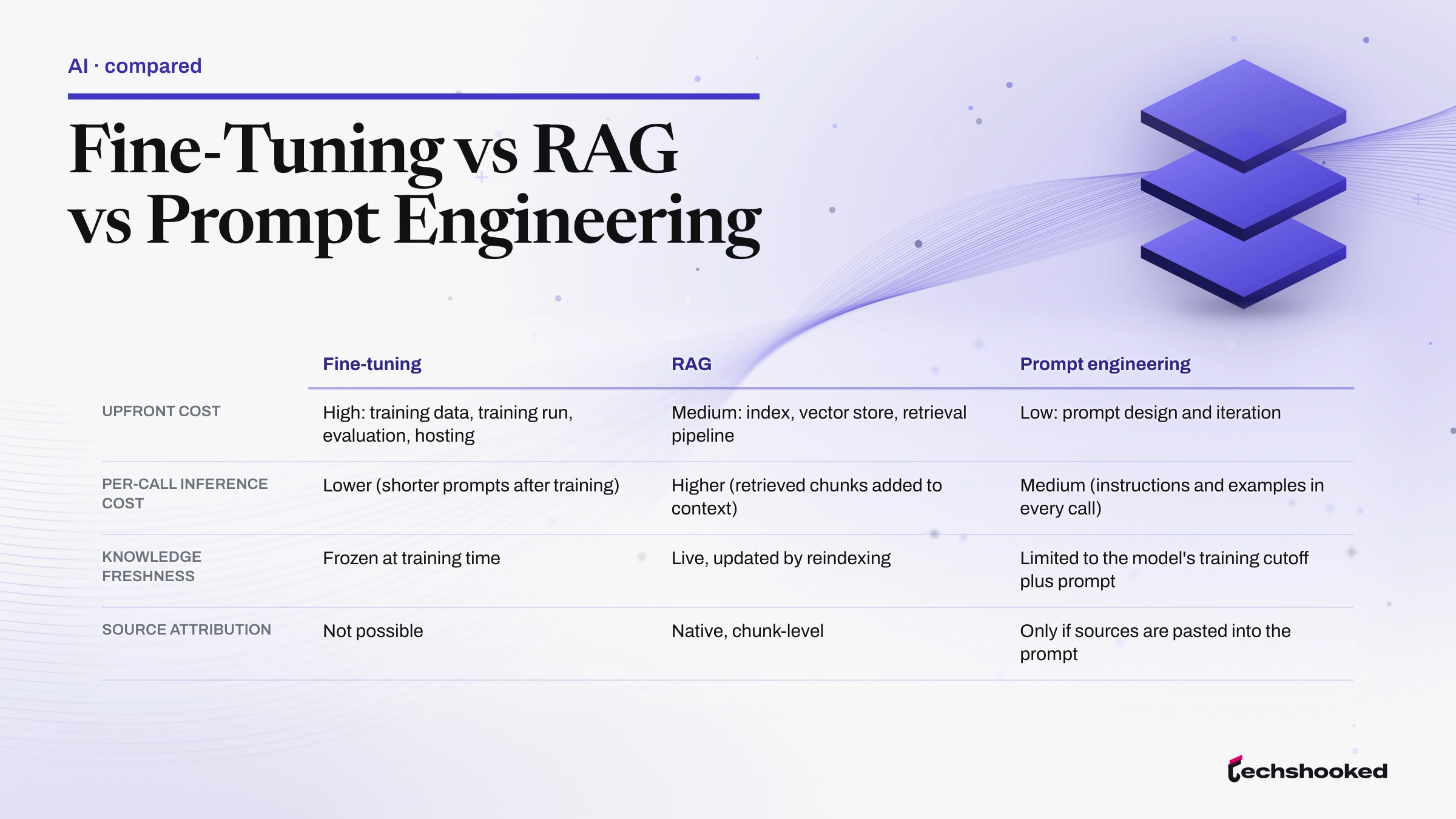
Fine-tuning carries the highest upfront investment of the three methods because it requires curated training data, a training run, evaluation, and a hosting strategy for the resulting model. RAG distributes its cost differently: low fixed cost to stand up, but ongoing infrastructure to maintain an embeddings index, a vector database, and a retrieval evaluation harness. Prompt engineering is the cheapest to start and the easiest to iterate on because every change is text. Latency and per-call economics diverge in a similar pattern, and the trade-offs only become visible when a project moves from prototype to production traffic. OpenAI's model-optimization guide notes that a fine-tuned model lets you use shorter prompts with fewer examples, which saves on token costs at scale and can lower latency, the compounding effect that flips fine-tuning's economics across millions of calls (OpenAI, Model Optimization Guide). The table below maps the three methods across the dimensions that most often decide which one ships.
| Dimension | Fine-tuning | RAG | Prompt engineering |
|---|---|---|---|
| Upfront cost | High: training data, training run, evaluation, hosting | Medium: index, vector store, retrieval pipeline | Low: prompt design and iteration |
| Per-call inference cost | Lower (shorter prompts after training) | Higher (retrieved chunks added to context) | Medium (instructions and examples in every call) |
| Knowledge freshness | Frozen at training time | Live, updated by reindexing | Limited to the model's training cutoff plus prompt |
| Source attribution | Not possible | Native, chunk-level | Only if sources are pasted into the prompt |
| Behavioral consistency | Highest | Medium | Variable across prompts |
| Iteration speed | Days per cycle | Hours per change | Minutes per change |
| Maintenance burden | Retraining and redeploys | Index refresh and retrieval quality monitoring | Prompt versioning and regression testing |
Combining the Three: Hybrid Production Patterns
Fine-tuning and RAG are not mutually exclusive; many production systems use both, applying fine-tuning for output style and routing logic while using RAG for factual grounding. A common architecture pairs a LoRA-adapted base model that has been fine-tuned to emit a strict JSON schema and a routing decision, with a retrieval layer that supplies the factual content the model will format and summarize. Prompt design still sits at the seam, governing how retrieved chunks are interleaved with instructions and how the routing decision is expressed at inference time. Anthropic's contextual retrieval work illustrates the same pattern from the retrieval side, where prepending short summaries to each chunk before embedding raises retrieval accuracy without changing the base model at all (Anthropic, Contextual Retrieval). Choosing which platform to run a hybrid stack on involves its own trade-offs, covered in comparing AWS SageMaker, Google Vertex AI, and Azure ML for model training. The risk of a hybrid system is mostly operational: every additional layer adds a place where domain knowledge can be encoded inconsistently, and the team needs a clear contract for which layer owns which decision.
- Fine-tune for shape, retrieve for substance: the fine-tuned model owns output schema and tone; the retrieval layer owns facts and citations.
- Fine-tune a router, retrieve the answer: a small fine-tuned model decides which corpus or tool to query, then a base model with retrieval composes the response.
- Fine-tune for guardrails, prompt for the rest: the fine-tuned weights bake in refusal and safety patterns while everyday behavior is steered by prompts.
- Retrieve for knowledge, prompt for reasoning: the retrieval layer supplies grounded chunks and chain-of-thought prompting drives the multi-step answer.
A Decision Framework for Choosing
Fine-tuning belongs at the end of the diagnostic checklist, not the beginning, because it is the most expensive option to build and the hardest to update once deployed. OpenAI's accuracy-optimization guidance treats prompting, retrieval, and fine-tuning as additive levers selected by evaluation results: prompting establishes the baseline, retrieval closes knowledge gaps, and fine-tuning addresses behavior gaps, with all three stacking when the failure analysis points that way (OpenAI, Optimizing LLM Accuracy). The checklist below applies that diagnostic logic to a concrete sequence a team can run before committing budget. For the platform-selection step that follows once the technique is chosen, see how to evaluate and select a machine learning platform. The honest answer for most projects is that prompt engineering plus retrieval covers more than 80 percent of cases, and fine-tuning is a targeted tool for the remaining tasks where consistency at high volume justifies the training run.
- Start with prompt engineering. Define the task in instructions, add two to five few-shot examples, and measure baseline accuracy against a held-out test set.
- Add retrieval if the gap is knowledge. If errors come from missing or stale facts, build a small embeddings index over the source documents and route relevant chunks into the prompt.
- Add fine-tuning if the gap is behavior. If errors come from inconsistent format, tone, or schema at high volume, curate a training dataset and run a LoRA adapter on a base model.
- Combine only when single methods plateau. Hybrid stacks are powerful but operationally heavier; reach for them once a single-method baseline is well understood.
- Re-evaluate at every model upgrade. A new base model often closes gaps that previously justified fine-tuning, so the decision is not permanent.
References
- OpenAI, Optimizing LLM Accuracy
- OpenAI, Model Optimization Guide
- OpenAI, Prompt Engineering Guide
- Google AI for Developers, Gemini API long context
- Hu et al., LoRA: Low-Rank Adaptation of Large Language Models
- Lewis et al., Retrieval-Augmented Generation for Knowledge-Intensive NLP Tasks
- Anthropic, Prompt Engineering Overview
- Anthropic, Contextual Retrieval
- arXiv, Retrieval-Augmented Generation for Large Language Models: A Survey
Further reading
Frequently Asked Questions
When should I use fine-tuning instead of RAG?
Fine-tuning is the better choice when your task requires a consistent output format, tone, or classification schema that cannot be reliably enforced through prompting alone. RAG is better when the core problem is factual freshness or source attribution, because updating a retrieval index costs far less than retraining a model. If your need is behavioral consistency at high call volume, fine-tuning often pays for itself; if your need is up-to-date knowledge, RAG does not require retraining at all.
Can fine-tuning and RAG be used together?
Fine-tuning and RAG address different parts of the problem and work well in combination. A fine-tuned model can be specialized for output structure and routing while a retrieval layer grounds it in current documents. Many production systems pair a fine-tuned adapter for style and a vector index for facts, with prompt engineering handling the connective logic at inference time.
Does fine-tuning replace the need for prompt engineering?
Fine-tuning reduces but does not eliminate the role of prompt engineering. OpenAI recommends exhausting prompt optimization before committing to a fine-tuning run because well-crafted prompts often close the gap without training cost. After fine-tuning, prompt engineering still governs how instructions and context are structured at inference time.
What is LoRA and why does it matter for fine-tuning?
LoRA (Low-Rank Adaptation) is a parameter-efficient fine-tuning method that trains a small set of low-rank adapter weights rather than updating the full model. It reduces memory and compute requirements compared to full fine-tuning while preserving downstream quality, which makes it the standard practical choice for adapting large base models. The original LoRA paper by Hu et al. describes the method and its trade-offs in detail.
How much training data does fine-tuning require?
Fine-tuning for a narrow task typically requires hundreds to a few thousand high-quality labeled examples rather than millions. The widely accepted best practice is to start with a small, carefully curated dataset, evaluate against a held-out test set, and expand only if results plateau, because data quality usually matters more than raw volume for specialized tasks.