
An AI app framework is a toolkit that wraps model calls, memory, and tools into one library so developers ship production AI applications without rebuilding orchestration from scratch. LangChain, LlamaIndex, and the direct API path through the OpenAI SDK or Anthropic SDK are the three live answers to that need, and each one solves a different half of the same problem. LangChain centers on agent orchestration and a wide catalog of third-party integrations, per LangChain documentation. LlamaIndex centers on context augmentation and retrieval over private data, per LlamaIndex documentation. The direct API path keeps every model call under explicit Python or TypeScript control, which is the sensible choice when the abstraction overhead of a framework would cost more than it saves. The decision matters because switching cost rises with every committed line of code in a half-finished AI app framework integration.
What an AI App Framework Actually Does
An AI app framework is a software layer that sits between your application code and the underlying model API, giving developers pre-built abstractions for the agent loop, memory, tool calling, and middleware so they do not write that plumbing from scratch. The category exists because a production AI feature is rarely a single prompt-response call. A useful agent loops over model output, runs tools, checks results, and decides whether to call another model, and stitching that flow by hand against a raw HTTP endpoint is tedious. LangChain describes itself as an agent framework that provides abstractions like structured content blocks, the agent loop, and middleware (LangChain Documentation, Products and Concepts). LlamaIndex describes itself as the leading framework for building LLM-powered agents over your data with LLMs and workflows (LlamaIndex Documentation, Chat Engine Context). Both vendor descriptions land on the same idea: the framework owns the orchestration so application code can express intent at a higher level. For the wider family this category sits inside, see how modern generative AI systems work.
- Agent loop: the runtime cycle that prompts a model, parses output, runs tools, and feeds results back until the task ends.
- Abstraction layer: the framework's high-level objects (chains, agents, indices) that hide raw HTTP calls and prompt assembly.
- Middleware: intercepted hooks for logging, retries, guardrails, and tracing wrapped around every model call.
- Tool calling: the framework-managed bridge between model output and external functions, APIs, or databases.
- Memory: persistent state, short-term conversation history, or long-term vector recall handled by the library, not the developer.
LangChain: Agent Orchestration and Integration Breadth
LangChain positions itself as an AI app framework for quickly building agents and autonomous applications, providing abstractions like structured content blocks, the agent loop, and middleware on top of a large ecosystem of third-party integrations. The framework helps developers chain together interoperable components and third-party integrations to simplify AI application development, and the project ships a standard interface for models, embeddings, and vector stores (LangChain GitHub Repository, langchain-ai/langchain). The practical consequence is that swapping OpenAI for Anthropic, or Pinecone for Weaviate, is a configuration change rather than a rewrite. The library itself is built on top of LangGraph, which serves as the lower-level agent runtime, yet LangChain documentation explicitly notes that you do not need to know LangGraph to use the higher-level framework (LangChain Documentation, Products and Concepts). The split matters at the integration boundary: LangChain is the developer-facing abstraction; LangGraph is what runs underneath when fine-grained, low-level control over agent orchestration is required. LangChain 1.0 is designated as an LTS release, which gives teams a stable target for production rollouts that semantic versioning would otherwise churn. For the agent side of the story, see how autonomous AI agents work and how AI agents use tools and APIs in agentic workflows.
- Standard interface: uniform Python and TypeScript objects for models, embeddings, and vector stores, so providers swap without touching application logic.
- Third-party integration catalog: dozens of connectors for OpenAI, Anthropic, Pinecone, Weaviate, Chroma, and other vendors.
- Agent loop and middleware: built-in orchestration primitives for multi-step reasoning, tool calls, and observability hooks.
- LangGraph runtime: the lower-level engine for stateful, fine-grained agent control when the framework's higher-level abstractions are not enough.
- LTS commitment: LangChain 1.0 long-term-support designation lets teams pin to a stable major release while minor releases follow semantic versioning.
LlamaIndex: Retrieval and Context Augmentation First
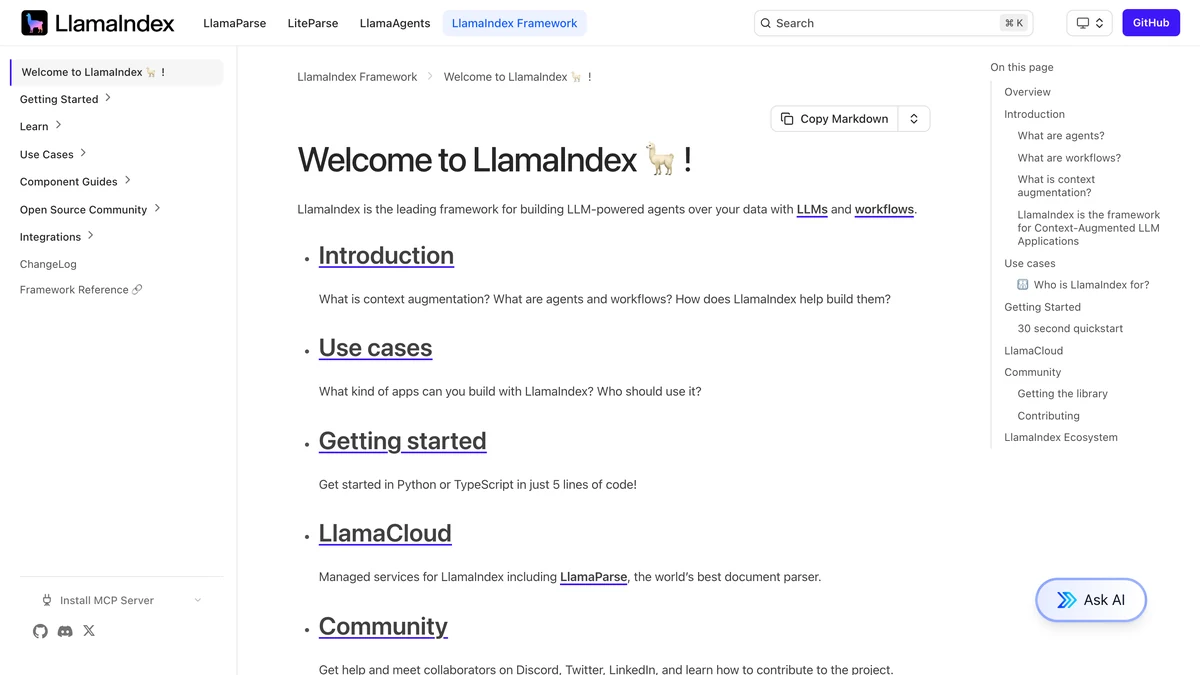
LlamaIndex is an AI app framework built around context augmentation: it specializes in ingesting, parsing, indexing, and retrieving data so the model always has the right information available when answering a query. The vendor frames context augmentation directly as making your data available to the LLM to solve the problem at hand, and the library ships tools to ingest, parse, index, and process data and quickly implement complex query workflows combining data access with LLM prompting (LlamaIndex Documentation, Chat Engine Context). That focus is the structural difference from LangChain. Where LangChain leads with the agent loop and bolts retrieval on as one integration among many, LlamaIndex leads with the retrieval pipeline and treats the agent as one tool that can sit on top. The two layers are not exclusive: LangChain documentation explicitly lists LlamaIndex among agent framework options, which is the vendor-level acknowledgment that LlamaIndex can supply the data layer inside a LangChain-orchestrated application. LlamaIndex also offers a high-level API that lets beginner users ingest and query their data in 5 lines of code, plus lower-level APIs that customize data connectors, indices, retrievers, query engines, and reranking modules for production-grade systems. For the retrieval theory underneath, see how retrieval-augmented generation works, often shortened to RAG.
- Data connector: ingestion modules for PDFs, Notion, Slack, Google Drive, SQL, and other source systems.
- Index: the structured representation of parsed documents, optimized for retrieval by vector, keyword, or graph.
- Query engine: the abstraction that turns a natural-language question into the right retrieval calls and prompt assembly.
- Reranking module: a second-pass scorer that reorders retrieved chunks before the model sees them.
- LlamaCloud: the end-to-end managed service for document parsing, extraction, indexing, and retrieval, per LlamaIndex documentation.
Direct API: When No AI App Framework Is the Right Call
Skipping an AI app framework entirely and calling the model provider directly through the OpenAI SDK, Anthropic SDK, or equivalent is a valid architecture for projects where the abstraction overhead outweighs the convenience. The direct API path keeps the surface area small: a Python script makes an HTTPS call, parses the JSON, and acts on it. There is no chain object to debug, no version bump to track across a multi-package ecosystem, and no leaky abstraction obscuring what was actually sent to the model. For single-turn classification, structured-output extraction, content moderation, or a backend that simply needs a model to summarize an event payload, an AI app framework adds layers that the use case never exercises. The trade-off is honest: every tool call, retry, memory store, and prompt template the team would have inherited from LangChain or LlamaIndex becomes code the team writes and maintains. Teams that go this route often pair the direct API with the Model Context Protocol when tool connectivity becomes the bottleneck, covered in how AI agents connect to tools via the Model Context Protocol. The direct API also gives full control over token accounting, latency budgets, and provider-specific features that a framework's lowest-common-denominator interface may hide. For a single-prompt feature with no orchestration, the OpenAI SDK in a few dozen lines of Python is faster to ship and easier to read than the equivalent framework pipeline.
- Install the SDK: add the OpenAI SDK or Anthropic SDK to the project; both ship official Python and TypeScript packages.
- Authenticate: set an API key as an environment variable; the SDK reads it on client construction.
- Compose the request: assemble messages, system prompt, and any tool schemas in plain dictionaries.
- Call the endpoint: invoke the chat-completions or messages endpoint; parse the structured response.
- Handle the loop yourself: if tool calls or multi-turn reasoning are needed, the application writes that loop directly.
Side-by-Side Comparison: LangChain vs LlamaIndex vs Direct API

The three AI app framework paths diverge most visibly across orchestration model, data-handling depth, vendor-lock risk, and the learning curve a new developer faces on day one. LangChain leads with agent orchestration breadth, LlamaIndex leads with retrieval depth, and the direct API leads with control and minimalism. Vendor positioning reinforces the split: LangChain documentation describes the project as an agent framework with abstractions for structured content blocks, the agent loop, and middleware (LangChain Documentation, Products and Concepts), while LlamaIndex documentation describes itself as the leading framework for building LLM-powered agents over your data with LLMs and workflows (LlamaIndex Documentation, Chat Engine Context). Neither vendor publishes an apples-to-apples comparison against the direct API path, so any side-by-side framing of all three is editorial rather than vendor-sanctioned. The table below captures the practical contrast from documented capabilities. Note that LangChain itself lists LlamaIndex among compatible agent framework options, meaning the choice is not always strictly either-or: many production stacks use LlamaIndex for the retrieval layer inside a LangChain-orchestrated agent. Teams running on a Python or TypeScript stack get both libraries with first-class support.
| Dimension | LangChain | LlamaIndex | Direct API (OpenAI SDK / Anthropic SDK) |
|---|---|---|---|
| Primary focus | Agent orchestration, integrations | Retrieval, context augmentation | Raw model calls, full control |
| Core abstraction | Agent loop, chains, middleware | Index, query engine, data connector | HTTP request, JSON response |
| Runtime underneath | LangGraph (lower-level engine) | Native query and workflow engine | None; application code is the runtime |
| Languages | Python, TypeScript | Python, TypeScript | Python, TypeScript, anything with HTTPS |
| Managed service | LangSmith for tracing and evaluation | LlamaCloud for parsing and indexing | Vendor platform only |
| Best fit | Multi-step agents, broad integrations | Document-heavy RAG, knowledge assistants | Single-call features, latency-sensitive paths |
Use Cases: Which AI App Framework Fits Which Project
Choosing an AI app framework is a project-architecture decision, not a permanent commitment, but the cost of switching mid-build is high enough that picking the right tool for the job at the start matters. A customer-support agent that calls a CRM API, queries a knowledge base, and writes a ticket is a multi-tool agent loop with light retrieval, which is LangChain territory. A legal-document assistant that ingests thousands of contracts, indexes clauses, and answers queries grounded in the corpus is a retrieval-first workload, which is LlamaIndex territory. A backend microservice that classifies inbound emails into ten categories with a single model call is a direct API job; wrapping it in a framework just adds dependencies. Hybrid stacks are common and supported: LangChain documentation lists LlamaIndex among compatible agent framework options, so an orchestrating agent that delegates to a LlamaIndex index for retrieval is a documented pattern rather than an integration hack. Haystack from deepset is another AI app framework worth knowing about for retrieval-heavy enterprise pipelines, though it sits outside the scope of this comparison.
- Multi-step agent with tools: reach for LangChain; the agent loop, middleware, and integration catalog cover the common ground.
- Document-heavy RAG over private data: reach for LlamaIndex; the ingest, parse, index, retrieve, rerank pipeline is the core product.
- Single prompt-response feature: reach for the direct API through the OpenAI SDK or Anthropic SDK; a framework adds overhead with no payoff.
- Retrieval-heavy agent: compose LangChain for orchestration with LlamaIndex inside it for the retrieval layer.
- Production agent requiring stateful low-level control: drop down to LangGraph, the runtime the higher-level framework is built on.
How to Make the Final Decision
The fastest way to pick an AI app framework is to map three project dimensions: how retrieval-heavy the data pipeline is, how much multi-step agent orchestration the task requires, and how much fine-grained control the team needs over every model call. Score each dimension high or low and the answer falls out. High retrieval, low orchestration leans LlamaIndex. Low retrieval, high orchestration leans LangChain. Low on both leans the direct API. High on both is a hybrid stack with LlamaIndex inside LangChain. Vendor maturity supports that mental model: LangChain 1.0 is designated as an LTS release with semantic versioning for minor releases (LangChain Documentation, Products and Concepts), and LlamaIndex documents both a high-level five-line API for beginners and lower-level APIs for production customization. Build a one-week prototype on the chosen path before committing, and pair the agent layer with reliability practices covered in how to build reliable AI agents with guardrails and evaluation. The wrong framework slows a team for months; a short prototype catches that risk early.
References
- LangChain Documentation, Products and Concepts (Python)
- LangChain GitHub Repository, langchain-ai/langchain
- LlamaIndex Documentation, Chat Engine Context
- LangChain Blog, How to Think About Agent Frameworks
Further reading
Frequently Asked Questions
When should I use LangChain instead of calling the API directly?
Use LangChain when your app needs multiple agents, tool calls, or a complex orchestration loop that would require significant custom code to manage manually. The framework's abstractions handle the agent loop, memory, and middleware so you can prototype quickly; if your task is a single prompt-response call with no chaining, the direct API is simpler and has less overhead.
What is context augmentation in LlamaIndex?
Context augmentation makes your data available to the LLM to solve the problem at hand, per LlamaIndex documentation. In practice it means ingesting, parsing, indexing, and retrieving documents so the model receives relevant content as part of every query rather than relying on training-time knowledge alone.
Is LangGraph the same as LangChain?
LangGraph is not the same as LangChain. LangChain is the higher-level AI app framework with easy-to-use abstractions, while LangGraph is the lower-level agent runtime underneath it that provides fine-grained, stateful control over agent orchestration. LangChain's own documentation says you do not need to know LangGraph to use LangChain.
Can LlamaIndex and LangChain be used together?
Yes, LangChain explicitly lists LlamaIndex among compatible agent framework options in its documentation, meaning you can use LlamaIndex as the retrieval and indexing layer inside a LangChain-orchestrated application. The two libraries are complementary rather than mutually exclusive for retrieval-heavy agent workflows.
What languages do LangChain and LlamaIndex support?
Both frameworks support Python and TypeScript. LlamaIndex documentation states availability in Python and TypeScript; LangChain ships separate packages for each language under its ecosystem and follows semantic versioning for both after the 1.0 LTS release.