Liquid AI d1, the company's family of decision models, now has open weights, with d1-3B and d1-omni-600M published on Hugging Face. Neither model writes text: each returns its answer in a single forward pass.
Both belong to a class Liquid AI calls decision models: instead of writing tokens, they read a situation plus one or more questions and output the answer directly. In Liquid AI d1's lineup the larger d1-3B reaches 48.57 on the Decision Index v0.2.1 public split, a benchmark run by Liquid AI itself, which the company says puts it ahead of every model under 10 billion parameters and level with Decider 35B-A3B, a decision model 12 times larger. The smaller d1-omni-600M takes text plus either an image or audio, and scores 15.95 on that index, according to Liquid AI.
Speed is the selling point of Liquid AI d1, and the published figures are for d1-3B answering one question. It takes 8 ms on an NVIDIA RTX 4090, 9 ms on an AMD MI325X and 30 ms on an Apple M5 Pro. On NVIDIA's Jetson boards the times are 16 ms on the AGX Thor, 26 ms on the AGX Orin and 50 ms on the Orin Nano. Asking three questions about the same input costs roughly 1.3 times as much as asking one. Long inputs change the picture: a prompt of several thousand tokens takes 640 ms on the M5 Pro and 1,640 ms on the Orin Nano, so the quoted latencies describe short prompts.
The two checkpoints come from different foundations. d1-3B is trained from LFM2.5-VL-3B, a decoder-only vision-language model, and Liquid AI says it merged weights from several fine-tuning runs, finding that longer training inputs, shuffled answer options and cleaned-up data shortcuts mattered more than fancier methods. d1-omni-600M starts from LFM2.5-Encoder-350M, a bidirectional encoder, with audio and vision encoders added in stages.
On seven public text benchmarks, Liquid AI d1 averages 82.9 at the 3B size, ahead of Decider 4B at 81.1, and d1-omni-600M averages 78.4 against 77.1 for Decider 2B. The table is not a clean sweep, though: Decider 4B still beats d1-3B on BoolQ (89.0 against 86.7) and XNLI (88.6 against 85.0). Liquid AI reports no vision numbers, keeping its private vision split out of this release, and says audio decision benchmarks barely exist yet, so the omni model's multimodal ability rests on demos rather than scores.
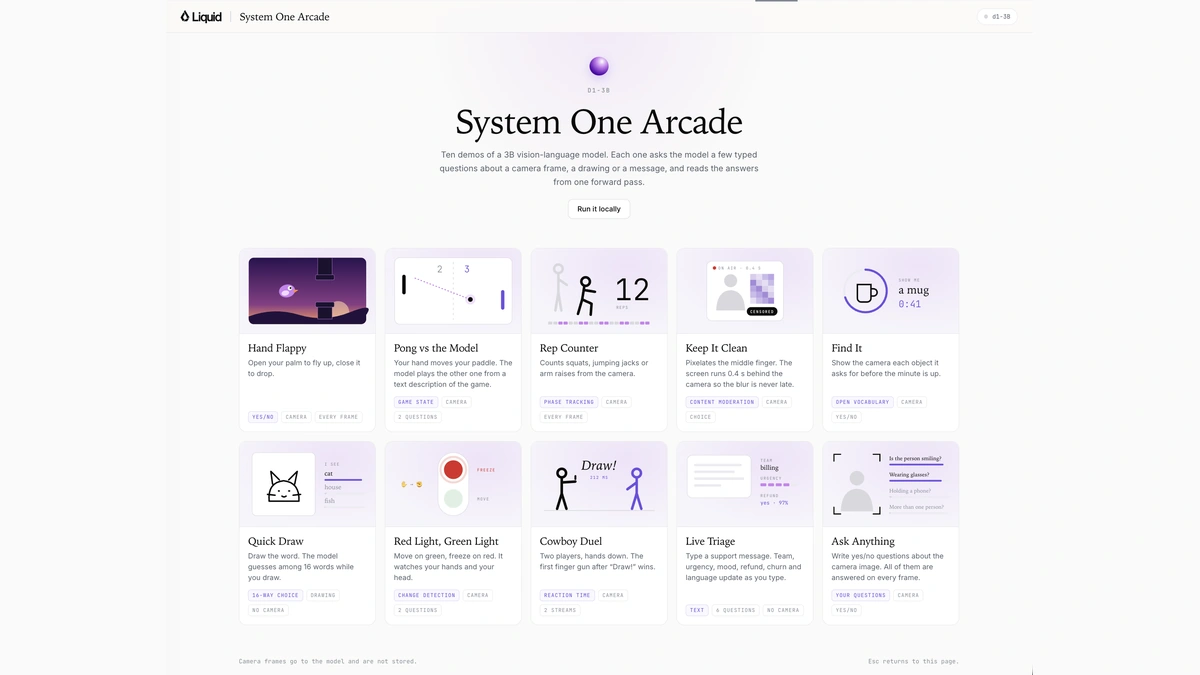
The open weights follow the hosted version of Liquid AI d1, which Liquid AI added image input to on October 5 and bills at $0.04 per million input tokens with no output tokens. For teams that use a large language model mainly to sort tickets, moderate content or pick the next action in a loop, a model that runs on a Jetson or a laptop without a data-center call is the practical draw. Liquid AI points to ten live-camera demos and an Isaac Sim navigation test on a Jetson as examples of what fits.