
Explainable AI is a set of methods that make a model's decisions understandable to humans. The discipline, often abbreviated XAI, has become the operational answer to a basic problem: deep neural networks deliver useful predictions but offer no native account of how those predictions were reached. SHAP, LIME, Grad-CAM, integrated gradients, attention analysis, and mechanistic interpretability each address a different slice of that opacity, and each comes with documented limits. Anthropic, OpenAI, and Google ship interpretability research alongside their models, while NIST has folded explainability into the AI Risk Management Framework as one of seven characteristics of trustworthy AI. The method repertoire matters because regulators, auditors, and engineers all need a working answer when a model rejects a loan, flags a tumor, or refuses a query. The sections below cover what explainable AI methods actually compute, where they work, and where they break.
What Explainable AI Is and Why It Matters
Explainable AI's most ambitious direction is mechanistic interpretability, which treats a neural network as a circuit and reverse-engineers which neurons and attention heads encode specific concepts. Anthropic has anchored a large share of this research agenda, publishing work that traces the internal computation a language model performs when answering a prompt and mapping how concepts are represented across the network (Anthropic, Tracing the thoughts of a language model). The work makes two empirical observations that shape the rest of the agenda. First, neural networks pack many concepts into single neurons, a phenomenon Anthropic studies under the name superposition, where a model represents more features than it has dimensions. Second, character traits and behavioral tendencies appear to live in activation patterns: Anthropic reports extracting persona vectors for traits such as sycophancy and hallucination, and using those vectors to monitor personality shifts and mitigate undesirable behaviors (Anthropic, Interpretability research team). The same page reports evidence for a limited but functional ability for Claude to introspect on its own internal states, which is a far stronger claim than attention visualization can support but a far weaker one than full transparency. Mechanistic interpretability remains research-grade and is not yet a production audit tool, but it is the path most likely to make explainable AI more than a surface readout. For the governance layer that sits on top of these technical methods, see how algorithmic accountability frameworks govern AI decision systems.
- Circuit-level analysis: identifying small subgraphs of neurons and attention heads that jointly implement a recognizable function.
- Superposition: the finding that a single neuron can carry signal for many unrelated features, complicating one-to-one interpretation.
- Persona vectors: activation patterns associated with traits such as sycophancy or hallucination, usable as monitoring signals.
- Introspection probes: tests of whether a model can report on its own internal states; Anthropic finds the ability is limited but functional.
- Ablation studies: targeted intervention on candidate circuits to confirm causal rather than correlational involvement.
NIST, Regulation, and the Governance Case for Explainability
Explainable AI is not only a technical practice but a governance requirement: NIST's AI Risk Management Framework lists explainability and interpretability among the seven characteristics every trustworthy AI system must balance. The framework states that trustworthy AI requires balancing each of these characteristics based on the system's context of use, and that the appropriate treatment of trustworthiness characteristics depends on the AI actor's particular role within the AI lifecycle (NIST AI RMF, Trustworthy AI characteristics). The companion Playbook for the Govern function is more operational. It instructs organizations to detail model testing and validation processes, to establish the frequency and detail of monitoring, auditing, and review, and to address documentation and disclosure where legal requirements such as nondiscrimination, data privacy, and security controls mandate transparency (NIST AI RMF Playbook, Govern function). Explainability rarely lives alone in a compliance program; it sits next to bias auditing, red-teaming, and model documentation. AI safety and alignment work covers the techniques that keep model behavior within policy once deployment is live, and the broader hub on how modern generative AI systems work explains where these governance hooks attach inside the model lifecycle. The regulatory case for these obligations is laid out further in AI safety standards and certification requirements and how the EU AI Act and US AI regulation compare on transparency obligations.
- Trustworthy characteristics: NIST lists explainable and interpretable as two of seven, alongside valid and reliable, safe, secure and resilient, accountable and transparent, privacy-enhanced, and fair with harmful bias managed.
- Context of use: NIST stresses that the right balance among these characteristics depends on the system's deployment context and the AI actor's lifecycle role.
- Testing and validation: the Govern Playbook requires policies that detail model testing, validation, and the frequency of monitoring, auditing, and review.
- Disclosure where law requires it: NIST highlights nondiscrimination, data privacy, and security obligations as common legal triggers for documentation and transparency.
Tradeoffs and Limits of Explainable AI Methods
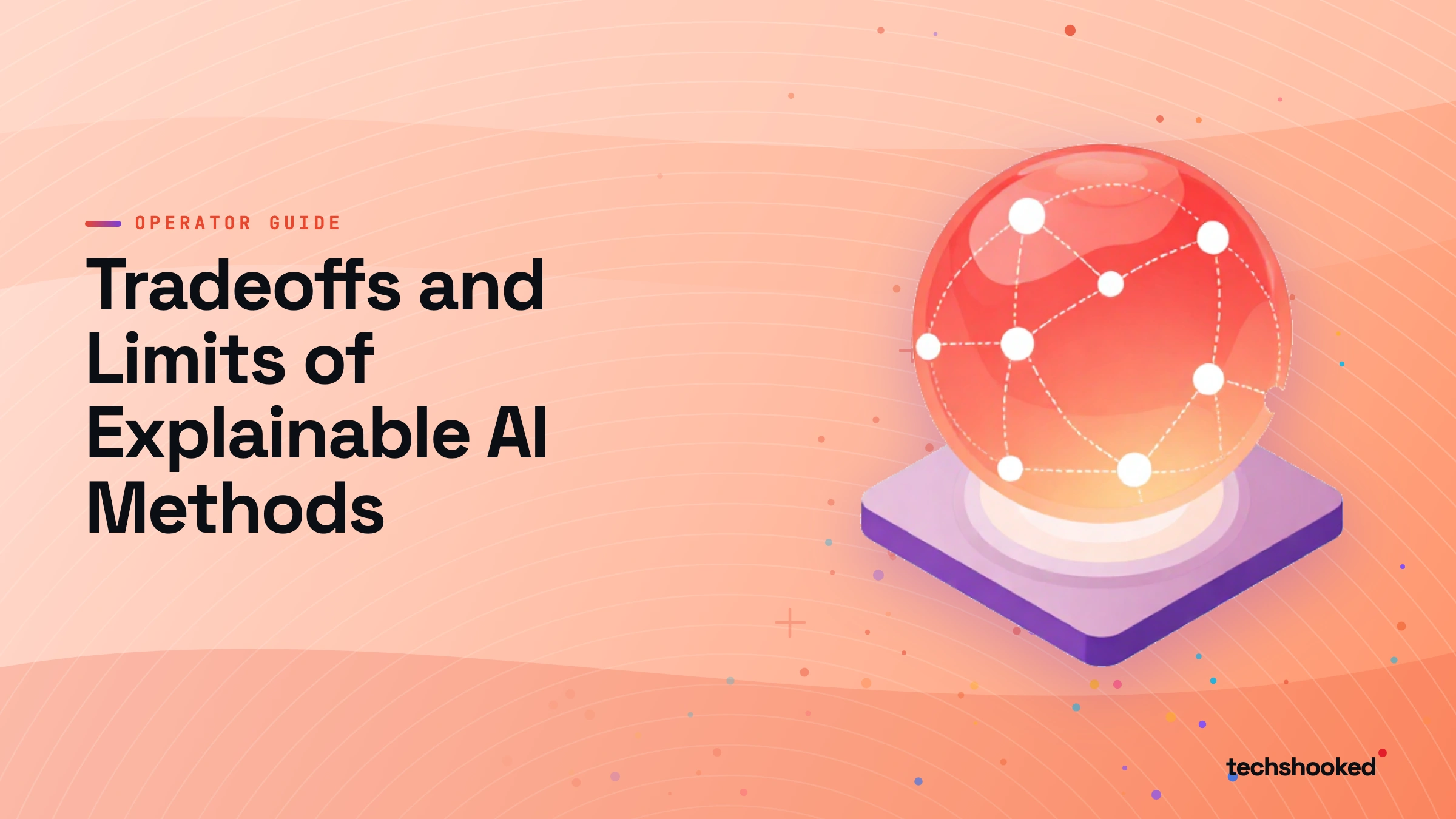
Explainable AI methods carry real tradeoffs: NIST explicitly notes tensions between interpretability and privacy, and between interpretability and predictive accuracy. The Trustworthy AI characteristics document states that in certain scenarios tradeoffs may emerge between optimizing for interpretability and achieving privacy, and that organizations might face a tradeoff between predictive accuracy and interpretability (NIST AI RMF, Trustworthy AI characteristics). The practical consequence is that inherently interpretable models, such as decision trees or linear classifiers, often sacrifice raw accuracy against the deep network they replace. Post-hoc methods preserve the original model's accuracy but produce approximations that may not fully reflect the model's true internal computation. A survey of explainability for safety and fairness reinforces the framing, arguing that XAI methods can uncover bias and reveal safety failures before or after deployment, while emphasizing that explanations are tools, not guarantees (ArXiv, XAI, Safety, and Fairness in Machine Learning). For a worked example of where these tradeoffs show up in production, see how bias auditing methods apply to algorithmic hiring systems.
| Tradeoff | What is gained | What is given up |
|---|---|---|
| Intrinsic interpretability | Direct human readability of the model | Predictive accuracy on complex data |
| Post-hoc explanation | Preserves the original black box accuracy | Approximate; may not match true computation |
| Detailed attribution | Fine-grained per-feature attribution scores | Higher compute cost and slower inference |
| Public transparency | External auditability of decisions | Possible exposure of private training data |
References
- NIST AI RMF, Trustworthy AI characteristics
- NIST AI RMF Playbook, Govern function
- Anthropic, Interpretability research team
- Anthropic, Tracing the thoughts of a language model
- ArXiv, A Survey of Explainable AI Methods for Large Language Models
- ArXiv, Interpretability and Explainability in Multimodal LLMs
- ArXiv, XAI, Safety, and Fairness in Machine Learning
Further reading
Frequently Asked Questions
What is explainable AI?
Explainable AI is a collection of methods that make a model's decision-making process understandable to engineers, regulators, and end users. Without these techniques, a neural network returns a prediction but gives no account of which inputs drove it or why. XAI methods range from local post-hoc explainers like SHAP and LIME to intrinsic interpretable architectures and mechanistic analysis of internal circuits.
What is the difference between SHAP and LIME?
SHAP assigns each input feature a numeric contribution score that shows how much it pushed the model's output up or down. LIME approximates the model locally around a specific input using a simpler interpretable surrogate. Both are post-hoc and model-agnostic, but SHAP values have stronger theoretical grounding in cooperative game theory, while LIME is faster for unstructured data such as images and text.
Does explainable AI work on large language models?
Explainable AI techniques apply to large language models but face added difficulty because transformer attention spans thousands of tokens. Anthropic's interpretability research finds evidence for a limited but functional ability for Claude to introspect, and identifies persona vectors that can flag sycophancy and hallucination tendencies. Attention visualization and probing classifiers are the most common approaches; mechanistic interpretability methods target individual circuits inside the model.
What tradeoffs does explainability introduce?
NIST's AI Risk Management Framework explicitly notes that tradeoffs can emerge between interpretability and privacy, and between predictive accuracy and interpretability. Models that are inherently interpretable, such as decision trees or linear classifiers, sacrifice some accuracy compared with deep neural networks. Post-hoc methods preserve model performance but produce approximate explanations that may not fully reflect the model's true internal computation.