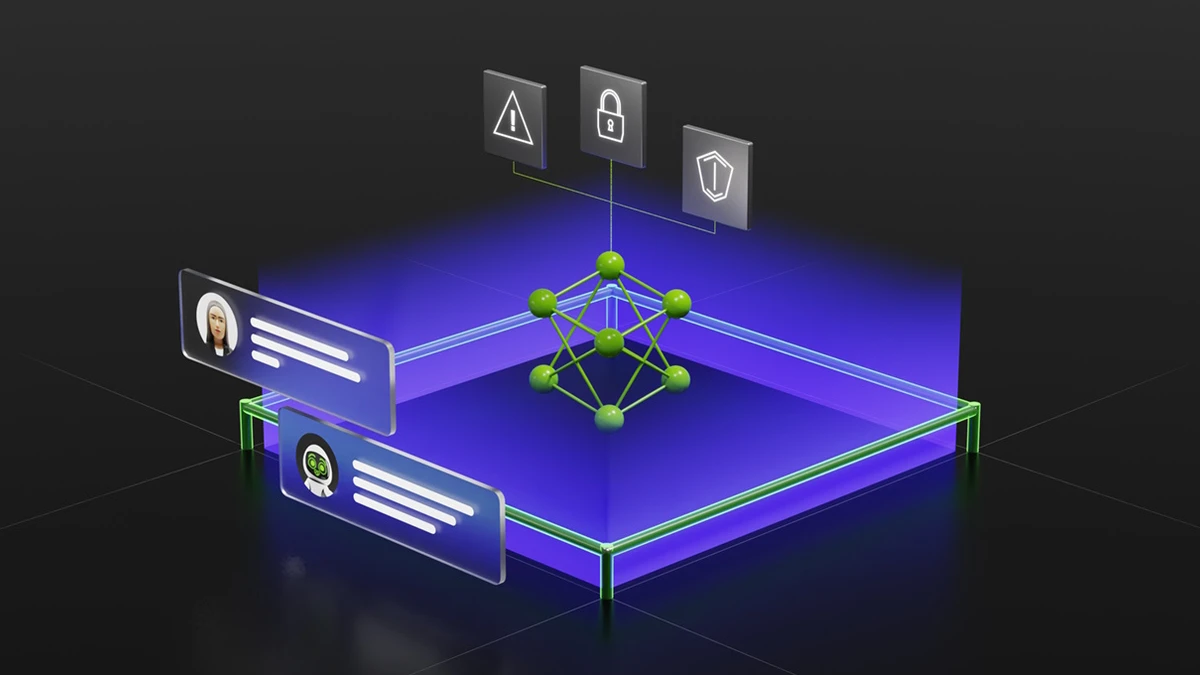
An AI guardrail is a control that constrains what a model can accept as input or produce as output, sitting between the application and the model to enforce safety, policy, and product requirements at runtime. AI guardrails are not a single product or formal standard; the term covers a layered set of runtime checks, including input validation, output filtering, content moderation, PII redaction, and jailbreak detection, that developers compose around a base model. Major platform vendors, including Amazon Web Services, Microsoft, OpenAI, NVIDIA, and Meta, all ship distinct guardrail offerings with different content categories, severity tiers, and policy enforcement granularity. AI guardrails differ from model alignment, which is baked in during pretraining and reinforcement learning from human feedback; alignment shapes the weights, while guardrails wrap the model at the application layer. Treating them as the same control surface is the most common architectural mistake teams make when shipping LLM features to production users.
What an AI Guardrail Is
An AI guardrail is a runtime control inserted between the application and the model to constrain inputs, outputs, or both, distinct from model alignment, which is baked in during training. The AWS Bedrock guardrail reference describes a guardrail as a named resource with topic policies, content filters, sensitive-information policies, and grounding controls that the application invokes around each model call (AWS, create-guardrail CLI reference). Microsoft's Azure AI Foundry documentation frames the same idea as platform-level policy enforcement layered on top of the model deployment (Microsoft Learn, Azure AI Foundry Guardrails overview). The practical consequence is that an AI guardrail can be added, tuned, or removed without retraining the base model, which makes it fast to iterate but also bypassable in ways that an aligned weight is not. For the broader category, see how AI safety and alignment keep models on track, and for the wider system context see how modern generative AI systems work.
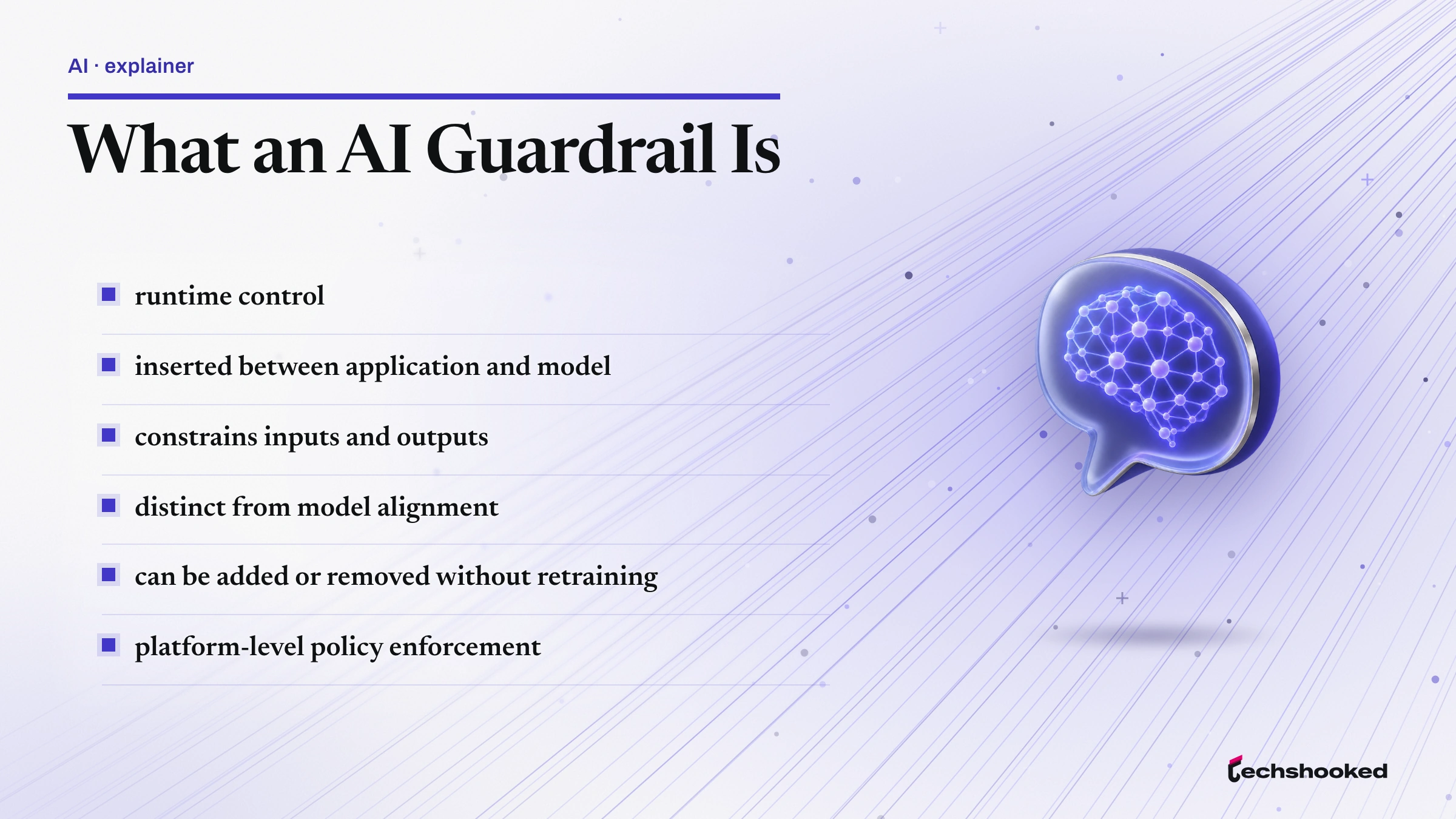
- AI guardrail: a runtime control between the application and the model that enforces input, output, or policy rules.
- Runtime control: logic that runs per request rather than being trained into the model weights.
- Application layer: the code path that handles the user request, builds the prompt, and post-processes the response.
- Model alignment: training-time shaping of model behavior, including reinforcement learning from human feedback (RLHF).
The Guardrail Stack: Where Controls Sit in a Request Pipeline
AI guardrails slot into four positions in a production request pipeline: pre-input sanitization, prompt construction gating, post-generation filtering, and asynchronous audit logging. OpenAI's developer cookbook recommends a layered design in which input validation runs before any model call, output filtering wraps the response, and a separate moderation API call gates content categories outside the main generation path (OpenAI Developer Cookbook, How to use guardrails). AWS describes the same layering in Amazon Bedrock Guardrails, where a single guardrail resource can apply both pre-processing checks on the user input and post-processing checks on the model output before the response is returned (AWS, create-guardrail CLI reference). Microsoft's Azure AI Foundry guardrail workflow is built around the same four-stage pipeline, with content filters and grounding checks attached to the deployment rather than the application code (Microsoft Learn, How to create guardrails). The pre-input stage handles raw user text, the prompt-construction stage handles assembled system prompts and retrieved context, and the post-generation stage handles the model's response token stream. For prompt-side techniques that interact with these layers, see prompt engineering techniques that improve model output.
- Pre-input sanitization: reject or rewrite raw user text containing prompt injection patterns, banned topics, or PII before prompt assembly.
- Prompt construction gating: validate the assembled system prompt, retrieved context, and tool definitions against policy before the model call.
- Post-generation filtering: scan the model's response for harmful content, PII leakage, off-topic drift, or grounding failures and block or redact before return.
- Asynchronous audit logging: log every input and output to a moderation API or evaluation pipeline for offline review and incident response.
Input Validation and Prompt Injection Defense
AI guardrails at the input layer block prompt injection attacks and jailbreak attempts before the model ever processes the text, addressing prompt injection, which the OWASP list of top LLM security risks places at the top of its rankings as entry LLM01 (OWASP, Top 10 for LLM Applications). Prompt injection happens when a malicious user, or untrusted retrieved content, smuggles instructions into the input that override the application's system prompt and steer the model toward unintended behavior. OpenAI's cookbook treats input validation as a first line of defense and demonstrates LLM-based input and output guardrails run asynchronously to limit the latency they add (OpenAI Developer Cookbook, How to use guardrails). Amazon Bedrock Guardrails ship a denied-topics policy and a prompt-attack content filter that scores inputs across severity tiers and rejects them above a configurable threshold (AWS, create-guardrail CLI reference). Microsoft's Azure AI Content Safety includes a dedicated Prompt Shield that flags direct and indirect prompt injection in user input and tool output (Microsoft Learn, Azure AI Foundry Guardrails overview). No single input validation layer is sufficient; AWS, Microsoft, and OpenAI all emphasize that input validation must be paired with output filtering and audit logging because a determined attacker will eventually craft input that slips past the classifier.
- Prompt injection: input that smuggles instructions overriding the system prompt, the top entry on the OWASP list of LLM security risks.
- Jailbreak: adversarial phrasing or role-play that pushes the model past its safety training and configured policies.
- Indirect injection: malicious instructions hidden inside retrieved documents, web content, or tool output rather than the user's own message.
- Encoding tricks: base64, Unicode homoglyphs, or token-splitting that hides forbidden text from a naive input validation filter.
- Multi-turn manipulation: a slow escalation across several messages that no single-turn input validation check catches in isolation.
Output Filtering: Content Moderation, PII Redaction, and Topic Blocks
AI guardrails on the output side intercept the model's response before it reaches the user, scanning for harmful content, personally identifiable information (PII), and off-topic material that violates product policy. Output filtering matters because even a perfectly validated input can produce a problematic response: the model may surface PII from its training data, repeat a banned phrasing, or veer into a denied topic. Amazon Bedrock Guardrails apply content filters across hate, insults, sexual content, violence, misconduct, and prompt-attack categories, each with low, medium, and high severity tiers, plus a sensitive-information policy that masks or rejects PII patterns in the output stream (AWS, create-guardrail CLI reference). Azure AI Content Safety exposes a similar set of content categories alongside groundedness checks that flag responses unsupported by the retrieved context (Microsoft Learn, Azure AI Foundry Guardrails overview). The OpenAI Moderation API plays the same role for OpenAI-hosted deployments: a separate endpoint the application calls explicitly on input or output, returning category flags across multiple harm categories (OpenAI, Moderation guide). Output filtering also interacts with monitoring; for the operational side of running these checks across a fleet, see deploying and monitoring AI in production with LLMOps.
| Output check | Purpose | Typical action | Trade-off |
|---|---|---|---|
| Content filter | Score harmful categories (hate, violence, sexual, self-harm) | Block, rewrite, or redact | False positive on legitimate dual-use queries |
| PII redaction | Detect names, emails, phone numbers, account numbers | Mask tokens or reject response | Over-redacts product names and code identifiers |
| Topic block | Reject denied topics defined per product policy | Refuse with policy message | Drift between policy text and classifier behavior |
| Groundedness check | Verify claims trace to retrieved context | Flag or refuse ungrounded sentences | Latency cost and limited cross-document reasoning |
Vendor Implementations: Amazon Bedrock, Azure AI Content Safety, and OpenAI Moderation
AI guardrail implementations differ substantially across cloud vendors: Amazon Bedrock Guardrails, Azure AI Content Safety, and the OpenAI Moderation API each expose different content categories, severity tiers, and policy enforcement granularity. Amazon Bedrock Guardrails are configured as a single named resource that bundles topic policies, content filters, sensitive-information handling, contextual grounding, and word filters, applied to any model invocation through the AWS CLI or SDK (AWS, create-guardrail CLI reference). Azure AI Content Safety sits at the platform layer, attached to a model deployment in Azure AI Foundry, with content categories, Prompt Shields, groundedness detection, and protected-material checks managed centrally rather than per-request (Microsoft Learn, How to create guardrails). The OpenAI Moderation API is a separate endpoint the application calls before or after a chat completion, returning category scores that the application combines with its own policy rules (OpenAI, Moderation guide). The architectural shape matters: Amazon and Microsoft bake policy enforcement into the invocation path, while OpenAI keeps it as a composable check the application orchestrates. None of these vendors position their content filter as a replacement for input validation, human oversight, or red-teaming.
| Vendor | Product | Where it runs | Configuration unit | Severity model |
|---|---|---|---|---|
| Amazon Web Services | Amazon Bedrock Guardrails | Bound to model invocation | Named guardrail resource | Low, medium, high per category |
| Microsoft Azure | Azure AI Content Safety | Attached to model deployment | Policy on Azure AI Foundry deployment | Severity levels per category |
| OpenAI | OpenAI Moderation API | Separate endpoint the application calls | Per-request API call | Probability score per category |
Open-Source and Framework-Level Guardrails: NeMo, Llama Guard, and Guardrails AI
AI guardrails can also be implemented outside the cloud vendor stack using open-source frameworks: NVIDIA NeMo Guardrails enforces dialog rails via a domain-specific language, Meta's Llama Guard runs as a safety classifier at the model layer, and Guardrails AI provides a declarative validator schema for structured outputs. NeMo Guardrails uses Colang, a dialog-flow language, to define which user intents are allowed, which topics are off-limits, and how the model should respond when a rail triggers, making it suited to chatbots where conversation shape matters. Llama Guard is a fine-tuned classifier from Meta that scores both user input and model output against a configurable taxonomy of harm categories, and because it ships as model weights, teams can run it on-premises next to the primary LLM. Guardrails AI focuses on structured-output validation: the developer declares a schema with type, regex, and semantic constraints, and the framework re-asks or repairs the model when the response violates the contract. None of the three replaces a vendor moderation API; teams typically combine an open-source dialog rail with a vendor content moderation filter so a bypass at one layer is caught at the next, the same defense-in-depth pattern AWS and Microsoft recommend (AWS, create-guardrail CLI reference; Microsoft Learn, Azure AI Foundry Guardrails overview).

- NVIDIA NeMo Guardrails: open-source toolkit that uses the Colang dialog language to define dialog rails, topical rails, and tool-use rails around an LLM.
- Llama Guard: Meta's fine-tuned safety classifier that scores input and output against a configurable harm taxonomy and ships as open model weights.
- Guardrails AI: Python framework for declarative output validators, structured-output schemas, and automatic repair when the model violates the contract.
- Defense in depth: the architectural pattern of layering an open-source dialog rail, a vendor content filter, and an audit logging path so no single bypass reaches the user.
Operational Costs and Trade-offs: Latency, False Positives, and Maintenance
Every AI guardrail adds latency, and misconfigured content filters introduce false positives that degrade user experience without improving safety. A synchronous moderation API call on every input and output typically adds tens to hundreds of milliseconds per turn, depending on classifier size, network topology, and whether the check runs in the same region as the model deployment. AWS, Microsoft, and OpenAI all document that guardrails do not replace human oversight, evaluation, or application-level safety design, which means the operational cost is not just runtime latency but also ongoing tuning, regression testing, and incident response (AWS, create-guardrail CLI reference; Microsoft Learn, Azure AI Foundry Guardrails overview; OpenAI Developer Cookbook, How to use guardrails). False positive rates are highest in dual-use domains: security research, medical information, legal advice, and code that handles credentials or PII can all read as policy violations to a content filter trained on generic harm taxonomies. The calibration trade-off is real, and teams that ship without measuring it typically discover the problem through support tickets rather than monitoring. Red-teaming is the standard way to surface bypasses before users find them; for that side of the loop, see how AI red-teaming stress-tests models for failures.
- Measure baseline latency: record p50 and p99 model-call latency without guardrails, then add each layer one at a time to attribute cost accurately.
- Track false positive rate by domain: sample blocked requests weekly and label them as true policy violations or false positives, broken down by topic.
- Run async where the use case allows: asynchronous audit logging imposes near-zero latency but cannot block a harmful response, so reserve it for low-risk surfaces.
- Version the guardrail config: treat content filter thresholds and denied-topic lists as code, with change review and rollback paths.
- Re-test after every model upgrade: a new base model can shift output distribution enough that the existing content filter calibration becomes wrong overnight.
References
- AWS, create-guardrail CLI reference (Amazon Bedrock)
- Microsoft Learn, Azure AI Foundry Guardrails overview
- Microsoft Learn, How to create guardrails (Azure AI Foundry)
- OpenAI Developer Cookbook, How to use guardrails
Further reading
Frequently Asked Questions
What is the difference between an AI guardrail and model alignment?
An AI guardrail is a runtime control applied at the application layer after training, while alignment is built into the model during training or fine-tuning. Guardrails can be added, tuned, or removed without touching the base model, which makes them faster to iterate but also bypassable; alignment changes require retraining and are harder to override.
Can an AI guardrail be bypassed or jailbroken?
AI guardrails can be bypassed through adversarial prompt injection, encoding tricks, or multi-turn manipulation that causes the model to ignore safety instructions. No single guardrail layer is sufficient; vendors including AWS and Microsoft recommend layering input validation, output filtering, and asynchronous audit logging so that a bypass of one layer is caught by another.
What are the main false positive risks with AI content filters?
Content filters that are tuned too aggressively block legitimate requests, which reduces user trust and increases support load. False positives are highest in dual-use domains such as security research, medical information, and legal advice, where the same phrasing can be benign or harmful depending on context, a calibration trade-off every deployment must tune.
Does adding an AI guardrail increase latency?
Every synchronous AI guardrail adds latency, typically tens to hundreds of milliseconds per call depending on classifier size and deployment topology. Asynchronous logging and offline audit guardrails impose near-zero latency cost but cannot block a harmful response before it reaches the user.