Marvell Technology agreed on November 1 to buy Lumentum Holdings, the maker of indium phosphide lasers for data-center optics, in an all-stock deal, Marvell said in a merger filing. Each Lumentum share would convert into 4.5 Marvell shares. The companies put the implied enterprise value at $115 billion, or about $1,132 per Lumentum share. That is a premium of about 23.9% to both stocks' closes on October 28, the last trading day before speculation about a deal began. The companies expect to close in the first half of calendar 2028, once stockholders of both companies and regulators approve.
Marvell holders would own about 67% of the combined company and Lumentum holders about 33%, on a fully diluted basis. On the morning of November 3, Lumentum stock traded about 11% below the value of the Marvell shares each Lumentum share would convert into, a gap Benzinga puts down to doubt over China's approval.
Bloomberg reported after the close on October 28 that the two were in advanced talks. Marvell's stock then lost 31.9% over three sessions, October 29, October 30 and November 2, its worst three-day stretch since October 2000, according to Benzinga. That slide erased about $66 billion of market value. Because the exchange ratio is fixed, each drop in Marvell's price also lowers what a Lumentum holder would receive.
Why Marvell wants the lasers Lumentum makes
Marvell and Lumentum say rising bandwidth needs and the physical limits of copper wiring are speeding the move to optical links, and that the industry is shifting from discrete parts toward integrated optics that require electrical and optical design to be done together. That is their reading of the market, and the deal rests on it. On the November 2 call with analysts, Lumentum CEO Michael Hurlston described what he called the copper wall. Links inside a rack, inside a server tray and inside a chip package still run on copper, he said, and copper's reach degrades fast as next-generation XPUs power larger clusters. Getting past it, he said, means moving optics ever closer to the compute chip.
Each move, by Hurlston's account, brings a tenfold jump in bandwidth. Scale-out links already carry 10 times the bandwidth of traditional scale-across links between data centers. Scale-up optics would carry another tenfold increase, he said, and scale-in optics, which Lumentum is developing with customers, another tenfold beyond that. Pluggable modules work for scale-across and scale-out, in his view, while scale-up and scale-in need tightly integrated co-packaged optics. Those last two steps are expectations, not shipping products.
Marvell CEO Matt Murphy tied the timing to that next step: "This is why we are acting now as scale-up begins to ramp next year." Asked by Barclays analyst Tom O'Malley about tight supply of indium phosphide, the material Lumentum's lasers are built on, Murphy said "the tight supply is not the reason we're wanting to enter this transaction now," calling it a byproduct of demand.
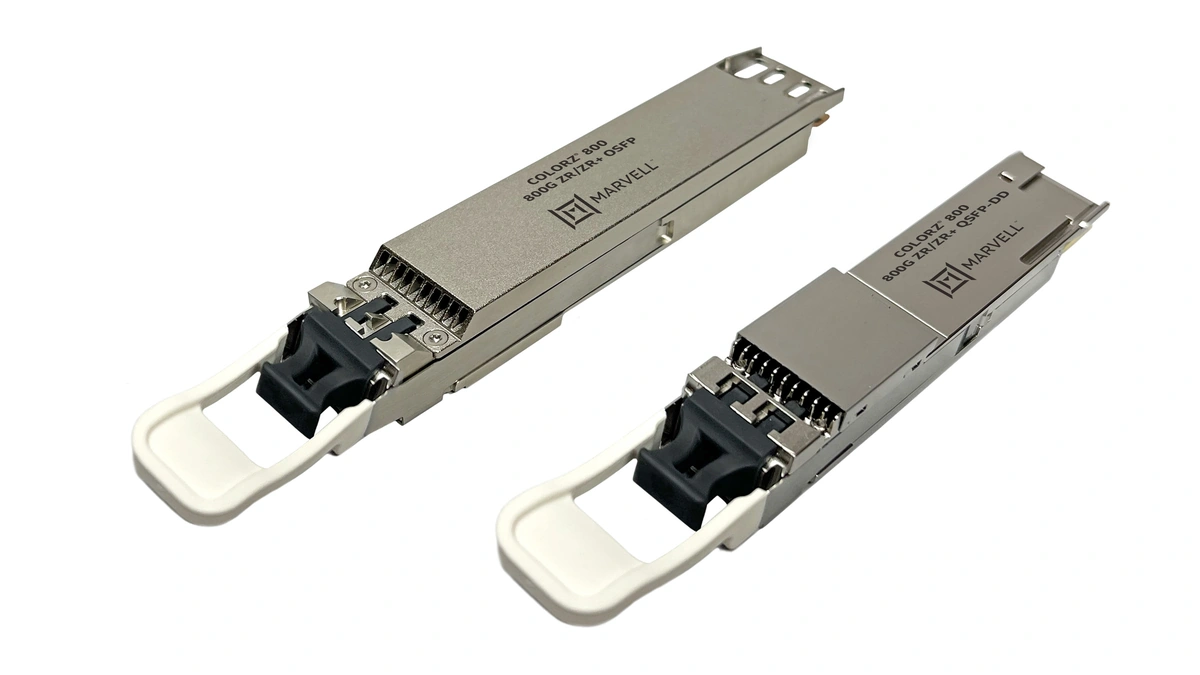
Marvell already sells many of the parts of an optical link. In its annual report for the year ended January 31, 2026, it lists PAM, coherent and coherent-lite DSPs, the chips that process signals in optical links, plus laser drivers, transimpedance amplifiers, silicon photonics, co-packaged optics and linear pluggable optics chipsets. Lasers themselves are not on that list. Research firm TrendForce called Lumentum's indium phosphide laser technology "a critical capability currently missing from its portfolio." Hurlston said Lumentum owns the world's largest indium phosphide manufacturing footprint and called its lasers key enablers of near-package and co-packaged optics, known as NPO and CPO.
The deal extends a year of interconnect buying at Marvell. It completed its $3.5 billion acquisition of Celestial AI, whose Photonic Fabric platform targets scale-up interconnect, on February 2, 2026, and closed the purchase of XConn Technologies on February 10. NVIDIA put $2.0 billion into each company in March. It bought Lumentum Series A convertible preferred stock at $695.31 a share on March 2, according to Lumentum's annual report, and Marvell convertible preferred stock on March 31. Murphy compared the deal with Marvell's 2021 purchase of Inphi, saying Lumentum alone is about 10 times the size Inphi was then, in a market almost an order of magnitude bigger.
What the combined company would sell, and to whom
Lumentum reports two product groups. Components, meaning laser chips, laser sub-assemblies and related parts that customers build into their own products, brought in $754.2 million in the quarter ended September 26. Systems, which covers optical transceiver modules, optical circuit switches and industrial lasers, brought in $508.4 million, up 228.8% from a year earlier. Hurlston said pump lasers and optical circuit switches led the quarter's growth. The MEMS-based switches contributed more than $90 million of revenue in fiscal 2026, their initial shipment phase, and Hurlston expects optical switching to become a multi-billion-dollar annual revenue stream, without saying when. Murphy said he expects the switches to coexist with Marvell's Ethernet switches in AI data centers.
Lumentum reported those results on November 2, the same day as the deal. Revenue for the quarter was $1,262.6 million, up 136.5% from $533.8 million a year earlier. Its non-GAAP gross margin was 53.2% and its non-GAAP operating margin 42.3%. For its fiscal second quarter, Lumentum forecast revenue of $1.575 billion to $1.625 billion. Hurlston also said Lumentum secured its second major NPO/CPO win in the quarter, "backed by purchase commitments exceeding $5 billion." Lumentum did not name the customer, and purchase commitments are not yet revenue.
Marvell's revenue was $2.74 billion in its quarter ended August 1, up 37% from a year earlier. Data center products were 79% of it. Marvell had guided the quarter ended October 31 to $3.150 billion, plus or minus 5%, and on November 2 said preliminary revenue was consistent with that guidance, narrowing the range to plus or minus 2%. The two companies used those numbers for a combined illustration: $12.6 billion of annualized revenue for Marvell and $5.1 billion for Lumentum, or $17.7 billion together, excluding synergies. Both figures are one quarter times four, Marvell's taken from its August 27 guidance midpoint and Lumentum's from its September quarter. On that basis the pair would run at a 57% non-GAAP gross margin and a 39% non-GAAP operating margin.
Both companies depend on a few large buyers, and neither names them. Marvell's ten largest customers accounted for 82% of revenue in its fiscal year ended January 31, 2026. In the August quarter, one distributor accounted for 44% of the chipmaker's revenue and one direct customer for 16%. At Lumentum, two end customers made up 26.6% and 15.0% of revenue in the fiscal year ended June 27, 2026. By shipping destination, China took 42% of Marvell's August-quarter revenue, and the company says a substantial majority of those shipments go to companies based outside China that have factories or contract manufacturers there. Lumentum shipped 17.2% of its fiscal 2026 revenue to Hong Kong and 9.4% to China, by the same ship-to measure.
Module makers buy DSPs from one and lasers from the other
The deal would put Marvell's signal chips and Lumentum's lasers under one owner while many of their customers build modules that compete with both. On the call, J.P. Morgan analyst Harlan Sur said he estimates Marvell holds "70% plus" of the DSP market and supplies most of the world's optical module makers, and asked whether Marvell would now compete with "existing module manufacturers who use your DSPs." Murphy said Marvell already runs both models: its own modules for data center interconnect, and a merchant business selling coherent DSPs to other module makers. Its first priority, leading in DSPs and related chips, "is not going to change," he said.
Hurlston said Lumentum supplies lasers "to almost all of our competitors" and that module makers Murphy called that day had all expressed support; neither executive named them. Lumentum already owns one module maker, Cloud Light, which it bought in 2023. Explaining why Lumentum's board chose a sale, Hurlston said the alternative was building a chip business by buying companies ranked second to fourth in their markets, "a string of pearls," rather than combining with a market leader. "Although obviously we're ceding control, we really believe that Matt and Dan can take this forward," he said, referring to Murphy and Marvell CFO Dan Durn.
Cignal AI, a research firm, said Innolight led datacom optical revenue and high-speed module shipments "by a wide margin" in the first quarter of 2026, when shipments of 400G-and-faster datacom modules rose 145% and almost 20 million modules shipped. TrendForce said Chinese module makers rely heavily on Marvell DSPs and on lasers from suppliers such as Lumentum. They "could face a substantial competitive disadvantage," TrendForce said, if the merged company restricted rivals' access to lasers, bundled DSPs with lasers or gave its own subsidiaries priority on shipments.
TrendForce estimates Marvell and Lumentum rank fourth and eighth this year in what it calls the semiconductor wired communications market, and that together they would hold nearly 7%, behind only NVIDIA and Broadcom. Murphy's own description is "the pure-play leader in the optical connectivity industry." The companies put their combined addressable market at $550 billion in 2030, an estimate built from each company's earlier investor briefing. About $60 billion of that, Murphy says, comes from the combination itself, mostly in scale-up and later scale-in interconnect. Writing before the terms were known, TIKR's David Hanson said that with Lumentum inside Marvell, Coherent "would be the big laser maker not tied to a chip designer."
Two shareholder votes, HSR and approvals the companies have not named
Lumentum needs a majority of the voting power of its outstanding common stock and Series A preferred stock, voting as one class, which includes the preferred shares NVIDIA bought in March. Marvell's stockholders vote too, because Marvell is issuing new shares and must raise its authorized share count. The share issuance needs a majority of the voting power present at Marvell's meeting, and the charter amendment a majority of votes cast. Both meetings follow a joint registration statement on Form S-4 carrying the proxy statement, which had not been filed as of November 3.
Beyond the US Hart-Scott-Rodino waiting period, closing depends on "certain other required regulatory approvals," listed only on a non-public schedule in Marvell's disclosure letter; neither company has named the regulators on it. In a quarterly report filed August 28, before the deal, Marvell warned that China's approval is required for business combinations of companies doing business in China above specific thresholds, wherever they are based. It cited an April 2026 Chinese national-security order to unwind a foreign acquisition of Manus, a China-based AI platform. Marvell has not said whether this deal crosses those thresholds. TrendForce's view is that the deal needs approval in both the US and China.
Marvell must accept remedies such as divestitures, licenses or limits on how the businesses operate, but not one that would reasonably be expected to be material, in an adverse way, to the business of Marvell and Lumentum taken as a whole, a ceiling the agreement calls a Burdensome Condition. Schulz Duggan, who writes the Optics Ledger newsletter on Substack, notes that the remedies the contract lists include "minimum supply, pricing or other similar commitments to third parties."
Two of Lumentum's earlier acquisitions waited on China's State Administration for Market Regulation, or SAMR. Lumentum signed with Oclaro in March 2018 and announced SAMR clearance about nine months later; the deal was due to close on or about December 10, 2018. It signed with NeoPhotonics in November 2021 and announced SAMR clearance in July 2022, again about nine months on. Marvell's October 2020 agreement for Inphi named the HSR waiting period and "certain regulatory approvals," and the deal closed on April 20, 2021, about six months after signing. Schulz Duggan points to a slower case in the same industry: Acacia said SAMR had not approved Cisco's purchase by the agreement's January 2021 deadline and moved to terminate; Cisco said SAMR had cleared it, sued, and won an order keeping the agreement in force. On January 14, 2021 the two signed an amended and restated agreement at $115.00 a share in cash.
The agreement's outside date is November 1, 2027, extendable in three-month steps to August 1, 2028 under certain circumstances if regulatory approvals are still outstanding. Marvell alone would pay a $3.2 billion regulatory termination fee if the deal fails on antitrust or foreign-investment grounds, or runs out of time, with all other conditions met. Marvell would owe $5.8 billion in other specified cases, such as its board changing its recommendation, and Lumentum $2.9 billion in corresponding circumstances. Lumentum told its employees and its customers that it expects closing in "approximately 12-18 months," a window that, counted from November 2, 2026, runs from November 2027 to May 2028.
After closing, Murphy would remain chairman and CEO. Lumentum would name three directors, Hurlston among them, to Marvell's board, which has seven members today. Lumentum would become part of Marvell, name and brand included, and it told employees no decision has been made about its San Jose headquarters.
Bank of America sees dilution, Cantor sees slight accretion
Marvell and Lumentum say they have "line of sight" to more than $1 billion of annual run-rate cost synergies, mostly in cost of goods sold, and expect the deal to add to Marvell's non-GAAP earnings per share in the first year after closing. They have not said when that run rate would be reached, and Durn gave no breakdown when asked on the call. Bank of America analyst Vivek Arya modeled the combined company on consensus estimates and reached the opposite result, Benzinga reported. With no revenue synergies, he put earnings per share 4.9% below standalone Marvell in calendar 2028, widening to 14.7% below by 2030. Cantor Fitzgerald's C.J. Muse modeled slight accretion, $12.55 of adjusted earnings per share in calendar 2028 against $12.50 for Marvell alone, and called the synergy target conservative. He still said the shares sit "in deal purgatory for at least the next 5-7 quarters" and questioned why Lumentum is selling at this point in the optical cycle.
On the call, Arya asked how Marvell could be sure it was not buying "a company at the peak of its shortage environment," with closing not due until the first half of 2028, and said Marvell was paying "essentially one times" Lumentum's 2030 addressable market. Murphy answered that Marvell has shortages of its own ("we're behind," he said), that he sees Lumentum's situation as no different, and that "the design wins are real." Arya called the news "a considerable surprise," and Benzinga noted that Marvell had not mentioned large acquisitions at its October 6 analyst day. On November 3, Bank of America cut Marvell to Neutral from Buy and its price target to $225 from $400. Cantor cut its target to $225 from $350 and kept Neutral. Needham, Rosenblatt and Susquehanna stayed bullish at $300.
Marvell traded at $175.60 on the morning of November 3, per Benzinga. At that price, Benzinga put 4.5 of its shares at about $790, some 30% below the $1,132 per share the companies computed from October 28 prices. A 23.9% premium on $1,132 implies a Lumentum close near $914 on October 28 ($1,132 divided by 1.239). At $704.71 on November 3, Lumentum stock sat roughly 23% below that close.