NVIDIA Cosmos 3 is a world foundation model that unifies video generation, physical reasoning, and robot action prediction in a single open model, released by NVIDIA at Computex 2026 / GTC Taipei. Until now, developers training robot policies had to chain separate models: one for video generation, another for scene understanding, a third for action output. Cosmos 3 collapses those into one unified forward pass using a Mixture-of-Transformers (MoT) architecture.
The announcement came alongside the model's immediate availability on Hugging Face. NVIDIA published weights for two sizes: Cosmos 3 Nano (8B parameters, designed to run on workstation-grade hardware like the RTX PRO 6000 GPU) and Cosmos 3 Super (32B, targeting large-scale synthetic data generation on Hopper and Blackwell GPUs). Both ship under the OpenMDW 1.1 license from the Linux Foundation, which NVIDIA says permits training, modification, redistribution, and deployment of weights, architecture, and code under a single model-centric license.
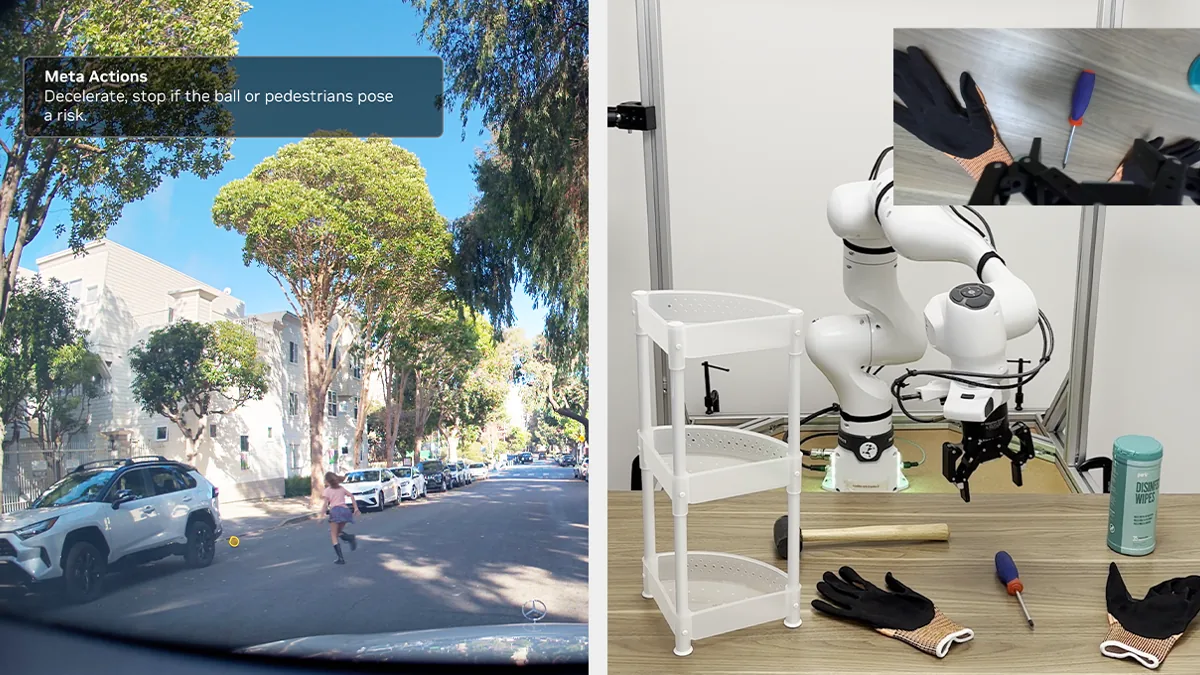
The architecture splits each input sequence into two paths: an autoregressive subsequence that handles reasoning and understanding via next-token prediction, and a diffusion subsequence that handles generation through iterative denoising. AR and DM tokens share joint attention across transformer layers while using separate parameter sets, letting the model switch roles without swapping weights. A single call to Cosmos 3 can produce a vision-language analysis in one pass, then a generated robot trajectory in the next. Developers can prompt it with spatial instructions ("put the pot to the left of the purple item") and receive back joint angles and gripper positions alongside a rendered video of the task.
NVIDIA is also releasing six Synthetic Data Generation (SDG) datasets covering robotics pick-and-place, physics simulation, spatial reasoning, human motion, autonomous driving scenarios, and warehouse safety. The companion Cosmos Framework on GitHub includes inference scripts, post-training pipelines, and agent skills for customizing the model to a specific robot embodiment or task environment.
The practical case for physical AI developers comes down to data cost. Collecting real-world edge cases for an autonomous forklift or surgical robot is expensive, slow, and sometimes impossible to repeat safely. Cosmos 3's video generation can simulate rare scenarios: a pedestrian stepping from between parked cars, a warehouse obstruction at an unfamiliar angle. NVIDIA's GEAR team is already using it to build video action models for games, simulation, and real-world robotics; Agile Robots is using it to generate trajectory data for industrial humanoids.
Cosmos 3 Nano is available now via Hugging Face and through NVIDIA NIM microservices for production deployment. The timing, alongside Jensen Huang's Computex keynote, signals NVIDIA's intent to position physical AI as the next major platform cycle, with Cosmos 3 as its open-model anchor against closed alternatives from robotics labs.