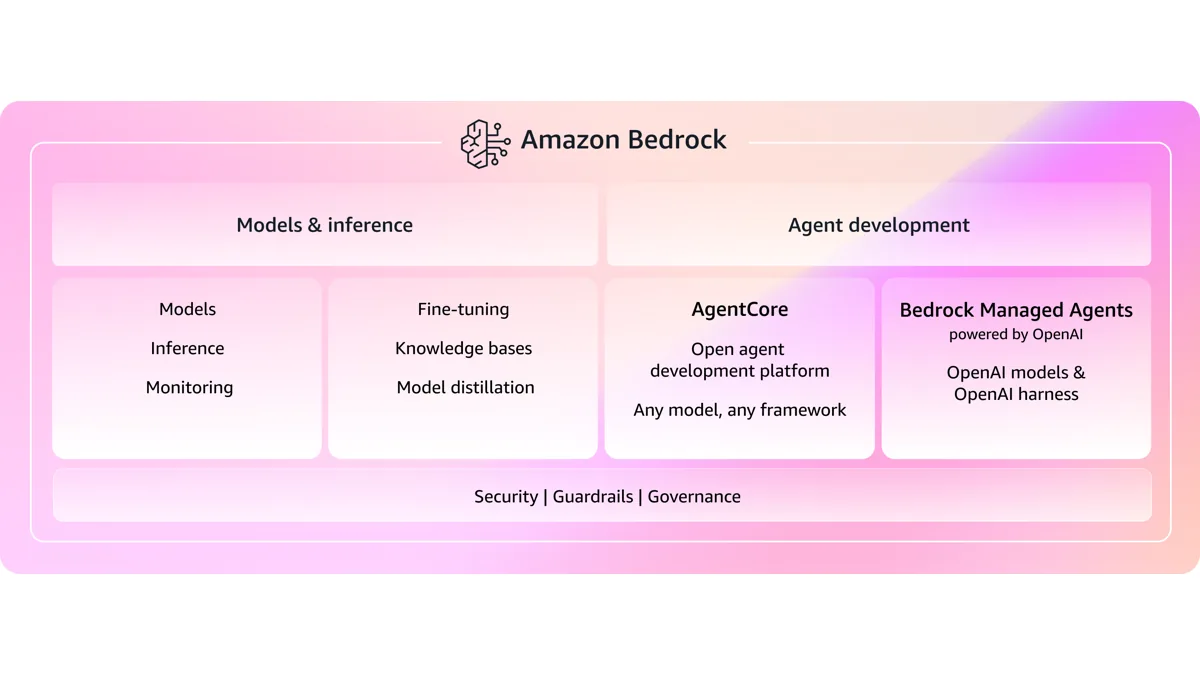
Amazon Bedrock is a fully managed foundation model service that Amazon Web Services now uses to distribute OpenAI’s frontier models to enterprise customers. AWS confirmed that GPT-5.5, GPT-5.4, and the Codex coding agent reached general availability on June 1 after a month-long preview tied to the two companies’ expanded partnership.
The announcement matters primarily for organizations that already run substantial workloads on AWS. Both GPT-5.5 and GPT-5.4 are billed at OpenAI’s standard first-party per-token rates with no added Bedrock margin, and usage counts against existing AWS enterprise discount agreements. Amazon Bedrock’s inference engine runs each request in an isolated queue with automated capacity management, and if a node fails mid-call, the request resumes rather than restarts. Governance controls inherit directly from the account’s existing IAM permissions, VPC and PrivateLink isolation, KMS encryption keys, and CloudTrail audit logs, which simplifies compliance sign-off for regulated industries. Prompts and responses are not used to train models and are not shared with OpenAI.
Codex is available through the Codex App, the command-line Codex CLI, and IDE integrations with Visual Studio Code, JetBrains, and Xcode, with all Amazon Bedrock inference routed through Bedrock’s infrastructure. The commercial model is pay-per-token with no per-seat or per-developer fees. GPT-5.5 is live in one US region so far; GPT-5.4 is in two; both are limited to US regions at this time.
The broader implication is structural. Cloud platform availability has historically been how enterprise AI models gain large-account penetration, and OpenAI now reaches AWS customers without requiring those customers to create a separate OpenAI account or negotiate their own billing terms. Amazon Bedrock Managed Agents powered by OpenAI is listed as coming soon, which would let teams deploy production-ready agents built on the OpenAI agent framework while keeping all inference on Bedrock. Amazon also flagged Daybreak, a forthcoming OpenAI cyber-security toolchain that includes Codex Security for vulnerability detection and remediation guidance, as a future Bedrock addition.
For developers evaluating where to call OpenAI models, the practical question is whether the Bedrock governance layer, the AWS commitment-discounting, and the resilient inference engine outweigh the added architectural indirection. Teams already heavy on SageMaker or AWS Lambda have a clear consolidation argument; teams with direct OpenAI API integrations gain less from the routing change.