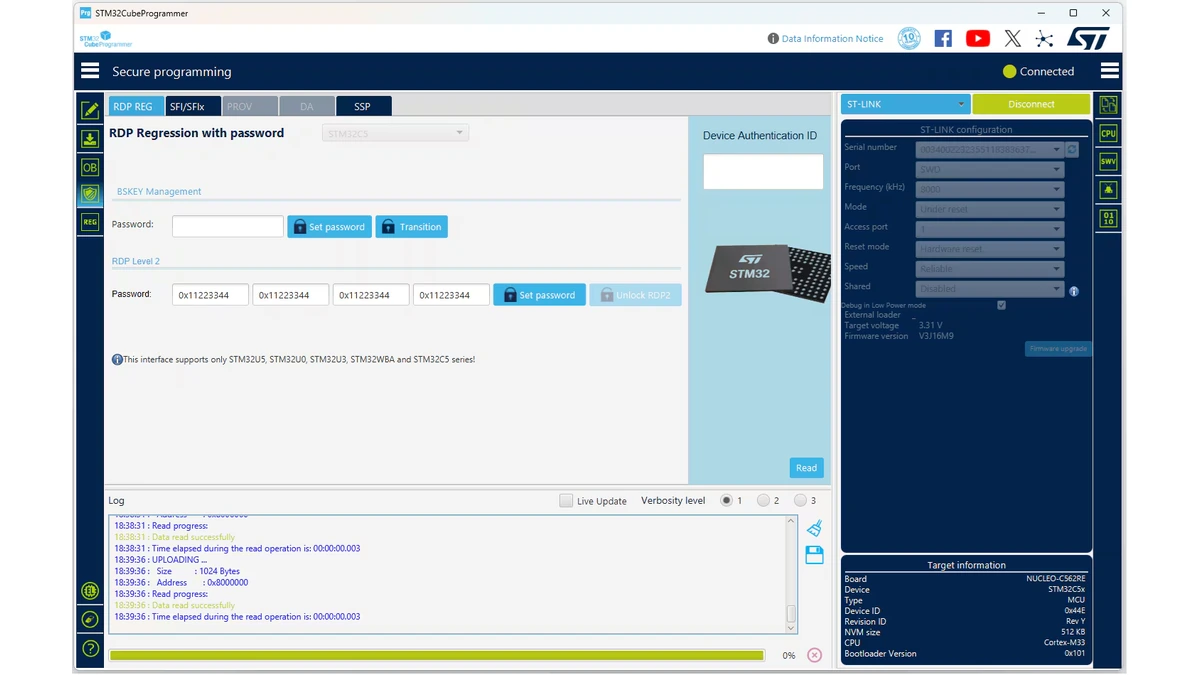
STMicroelectronics shipped STM32CubeProgrammer 2.23, the latest version of its STM32 flashing and debugging utility, according to the company's own release notes for the update. The release folds in 290 tickets, comprising 52 change requests, 238 fixes, and 200 work packages, with two changes aimed squarely at embedded developers who flash and provision STM32 chips outside the desktop GUI.
The first is a new Linux Arm 64-bit CLI package, detailed in STMicroelectronics's detailed release notes, that runs natively on Raspberry Pi boards without a graphical interface, a deliberate trade-off given the storage limits of those platforms. Developers can program internal and external flash and configure option bytes from the command line, but the package skips STM32CubeProgrammer's usual debugging tools. ST said it also supports readout protection on legacy models and RDP regression with a password, though debug authentication, product life-cycle management, and secure firmware installs are not yet available in the Linux build. The company said it is watching how developers use the package before expanding its feature set.
The second is boot-time security provisioning added to specific new STM32 microcontroller families. The STM32H553/543 series gains OBKey generation and provisioning, certificate generation, and debug authentication, alongside secure firmware installs through debug interfaces; the same trio of features lands on the newer STM32V863/873 series, while the STM32U335/345 and STM32U356/366 families pick up RDP regression with a password and, for the U356/366, secure firmware installs and key wrapping through debug interfaces. STMicroelectronics also extended existing key-wrapping support to the STM32U3B5/3C5 and STM32H5Ex/5Fx microcontrollers.
STM32 flashing and provisioning normally means a desktop GUI tied to an ST-LINK or J-Link probe, which works poorly on a headless test bench or a fielded device reached over a network link. The Raspberry Pi CLI package gives embedded teams a lightweight way to script flashing and option-byte configuration from a small Debian or Ubuntu machine instead. STMicroelectronics also made its AI-assisted help tool, STM32 Sidekick, reachable from a dedicated button in the interface and simplified how the software displays file paths, changes the company frames as removing friction rather than adding features.