Explosion, the company behind spaCy and Prodigy, released Ellf, a platform that connects coding assistants such as Claude Code, Codex and GitHub Copilot to the data-heavy parts of building custom NLP systems. Ellf targets a gap the company sees in current assistants: they write code well, but a language-model project also needs labeled examples, long-running jobs and a view on when a small trained model beats a prompt to a large one.
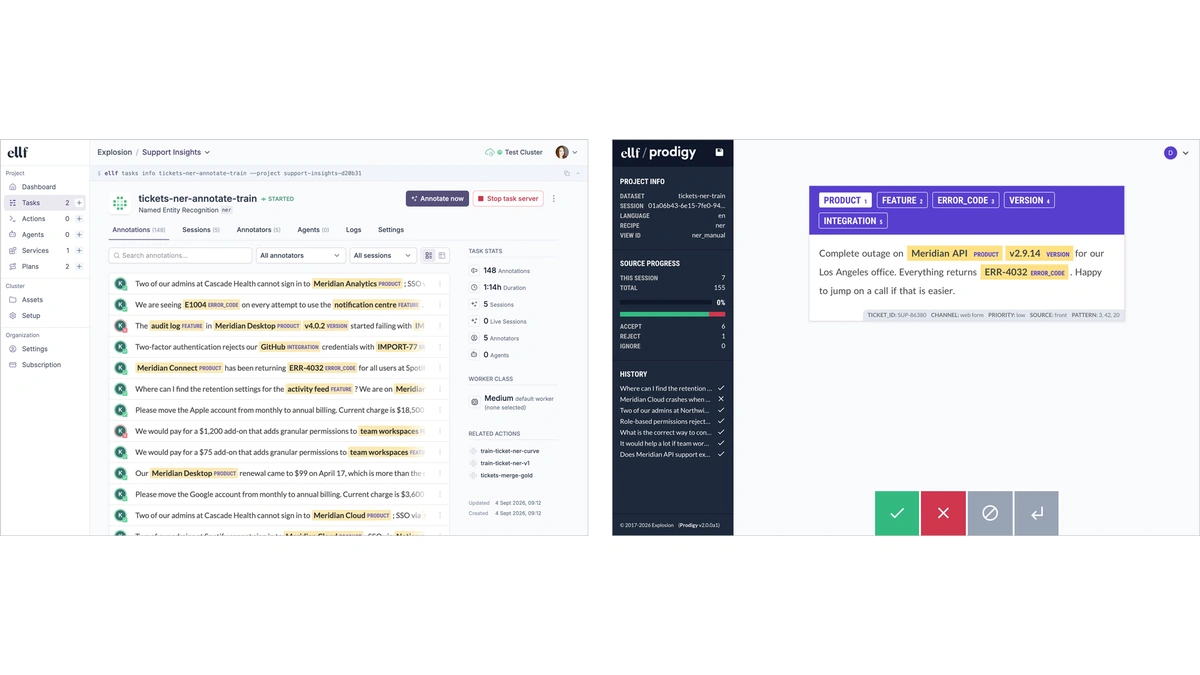
The company names three weak spots. Assistants do not suggest having people label real data, and teams without an easy tool skip that step. They handle long jobs awkwardly, and building that infrastructure from scratch makes a project much bigger. And they steer teams toward in-context learning with a large model instead of a trained component. For annotation, Ellf ships with Prodigy and lets the assistant write custom recipes with tailored interfaces. It can also assign annotation agents, backed by an LLM API or a local model, to produce a first pass that people then review and correct.
Work inside Ellf is organized as tasks for annotation, actions for jobs such as training and evaluation, agents, and services such as APIs or MCP servers. Each starts as a Python function, called a recipe, which the app turns into a web form and a command-line interface; the assistant operates the platform through that CLI. Computation runs on a Kubernetes cluster in the customer's own cloud account or on a local machine. Explosion says its servers never send requests to that cluster: the app fetches records from Explosion and the underlying data from the customer's infrastructure in two separate calls.
The third piece is a knowledge base built from the company's more than 10 years of industry NLP work, plus modules for project planning, annotation, custom Prodigy recipes, rule-based pattern generation, training, monitoring and question answering. Ellf keeps a running project plan of decisions and results, and a support module can send a session to Explosion staff for review.
The worked example in the launch post is a support-ticket pipeline. Ellf proposes splitting the job into a named entity recognizer for fields like product, feature and error code, and a text classifier that routes each ticket. A Gemini-powered agent drafts labels, generic entity types go to a second agent, and two people annotate a held-out evaluation set without a model in the loop, since model-assisted labels would flatter whatever the model already does well. A few hundred examples then train a small transformer-based pipeline on the customer's cluster.
Access starts with a free trial, a CLI install and cluster setup; the post lists no paid pricing. The design treats human attention as the scarce resource: the assistant can schedule a few hundred human judgments when they are worth requesting, which is the step most teams skip. What comes out is deliberately modest, a small, fast model the team owns and runs, rather than another per-call API.