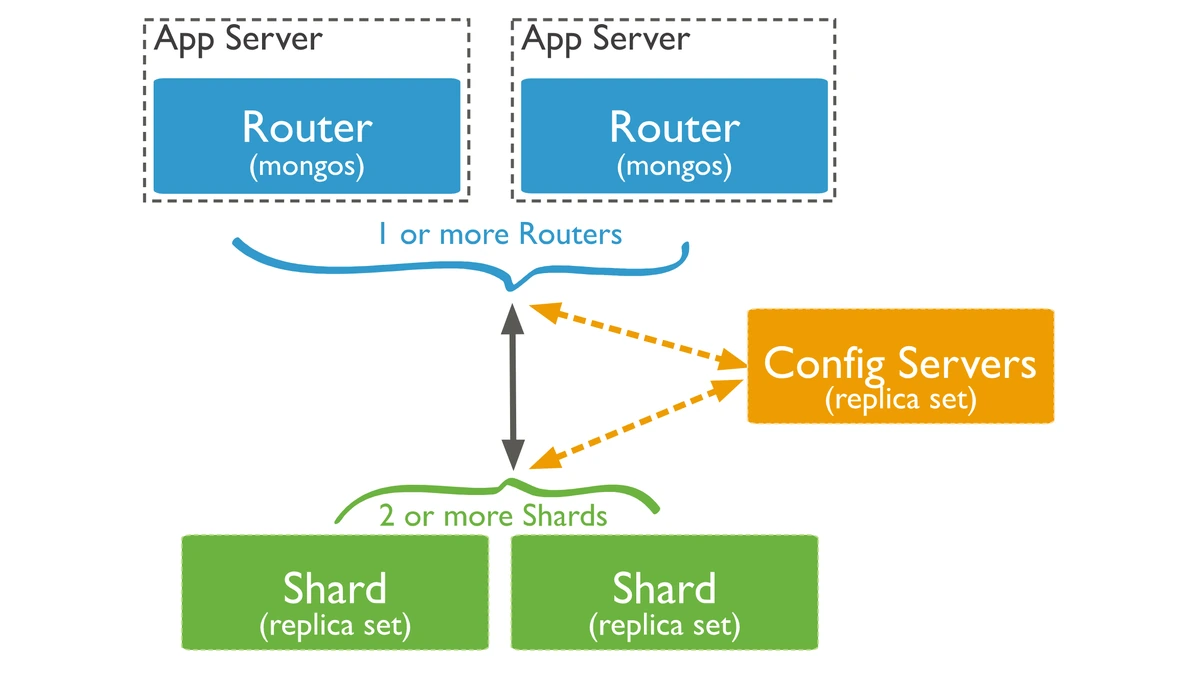
Database sharding is a horizontal scaling technique that splits a single logical database into multiple independent partitions, called shards, so each shard holds the same schema but only a subset of the rows. Oracle's own architecture documentation defines sharding as horizontal partitioning of data across independent databases, with each database in the pool called a shard and all shards together forming a single logical sharded database, or SDB. That distinction matters immediately: sharding does not mean carving up one table inside one database engine, the job a partitioned table handles in engines like PostgreSQL, MySQL, or SQL Server. It means running separate database instances, each with its own storage and compute, that together answer for one dataset, the approach behind Vitess (MySQL), Citus (PostgreSQL), and natively-sharded systems such as MongoDB, CockroachDB, and DynamoDB.
What Database Sharding Is
Database sharding is horizontal partitioning applied at the data tier, according to Oracle's own definition of the pattern. Oracle's Oracle Sharding overview describes the model as enabling distribution and replication of data across a pool of Oracle databases that share no hardware or software, a design Oracle and the PostgreSQL project both call a shared-nothing architecture. Google Cloud's Bigtable and Amazon's DynamoDB are built on the same shared-nothing architecture principle, distributing partitions across independent nodes rather than a single shared disk array. Because shards share no CPU, memory, or storage, a failure on one shard does not take down the rest of the sharded database, and adding a shard adds real, independent capacity rather than contending for a shared resource pool.
The upside is real, but it is not unconditional. Oracle's sharding documentation states that Oracle Database supports scaling up to 1,000 shards, a figure tied specifically to Oracle Database 12c Release 2 (12.2.0.1), not a universal ceiling that applies to every engine or version. The same documentation is explicit that sharding is intended for custom OLTP applications with a well-defined data model and data distribution strategy that primarily accesses data using a shard key, which rules out treating horizontal partitioning as a default answer for every growing table. A read-heavy reporting workload built on Snowflake or Amazon Redshift, or an analytical warehouse table in BigQuery, usually has cheaper paths to more capacity, covered later in this article. Sharding earns its complexity when write throughput on a single Postgres, MySQL, or SQL Server node is the actual constraint.
Sharding vs Replication vs Vertical Scaling
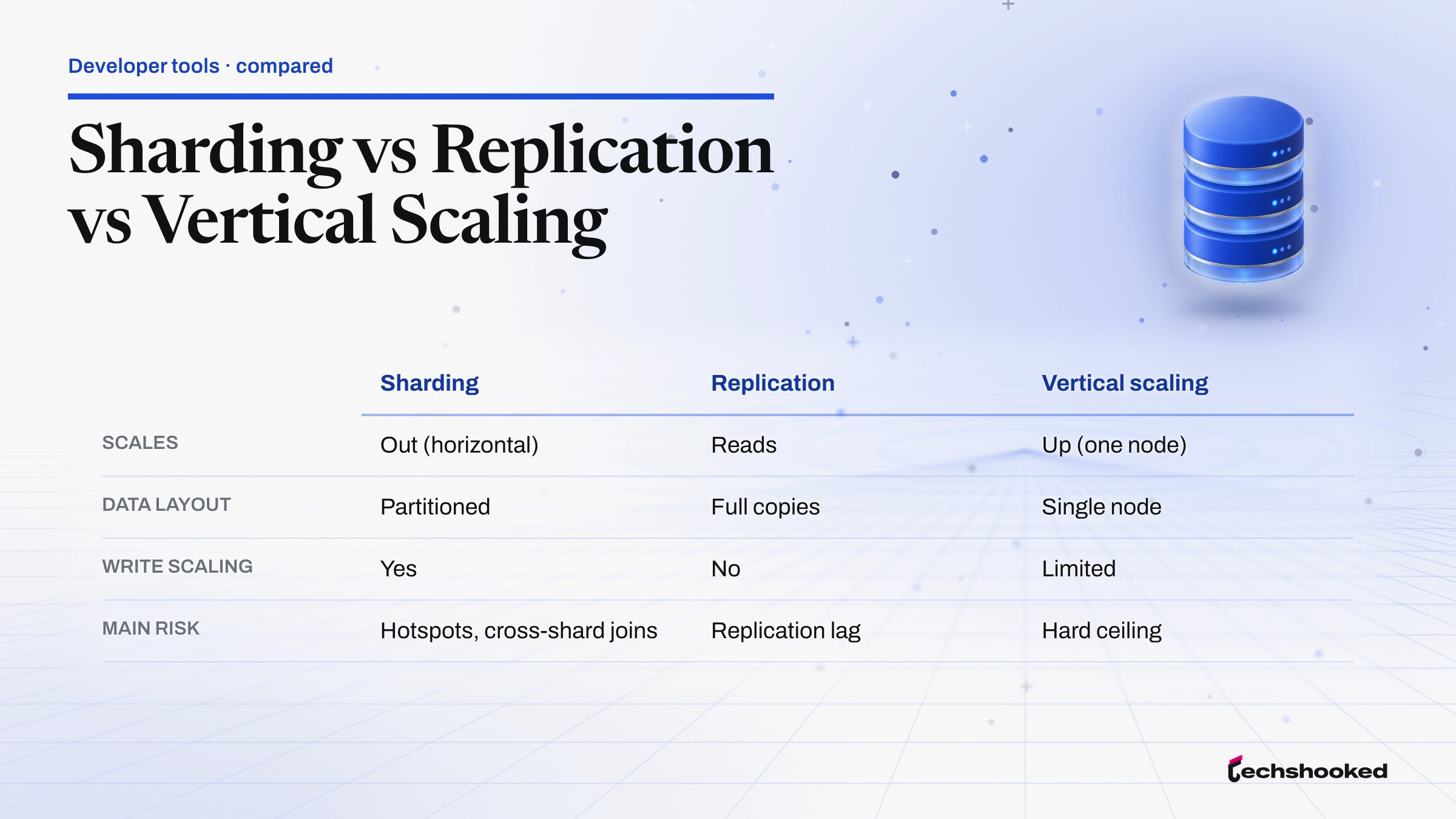
Database sharding is one of three ways to grow a database's capacity, and horizontal scaling through sharding solves a different problem than replication or vertical scaling. Vertical scaling adds CPU, memory, or faster storage, moving to a larger AWS EC2, Azure, or Google Compute Engine instance; it is the simplest option and requires no application changes, but it hits a hardware ceiling and a single point of failure remains. Replication copies data to additional nodes that serve reads, which multiplies read capacity cheaply but does nothing for write throughput, since writes still land on a primary. Sharding, by contrast, is horizontal scaling in the strict sense: it is the option that actually multiplies write capacity, at the cost of routing logic, cross-shard query complexity, and operational overhead that neither of the other two approaches carries.
The three approaches are not mutually exclusive, and production systems often combine them. MySQL's own reference manual describes how Group Replication can be used to implement highly available shards, where each shard maps to a replication group rather than a single unprotected node. That pairing illustrates an important nuance: sharding's fault isolation between shards is not the same thing as high availability within a shard. A shard that has no replica is still a single point of failure for the rows it holds, so teams that shard for write scale typically still replicate within each shard for resilience.
MySQL Cluster takes a different route to the same horizontal-scale goal. MySQL's own blog archive states that MySQL Cluster can scale out horizontally and provide 99.999-plus percent availability, and attributes much of its performance advantage over the in-memory MEMORY storage engine to row-based locking rather than MEMORY's table-level locking. The comparison is a useful reminder that "horizontal scaling" covers more than one architecture: a purpose-built clustered engine and an application-level sharding layer both scale out, but they distribute the work differently and carry different operational profiles.
| Dimension | Vertical Scaling | Replication | Sharding |
|---|---|---|---|
| What it solves | Single-node resource ceiling | Read capacity, availability | Write capacity, dataset size |
| Write capacity gain | Bounded by hardware | None (writes stay on primary) | Scales with shard count |
| Read capacity gain | Bounded by hardware | Scales with replica count | Scales with shard count |
| Complexity added | Minimal | Moderate (lag, failover) | High (routing, resharding, cross-shard queries) |
| Failure isolation | None; single point of failure | Replica loss is recoverable | A shard failure affects only its own rows |
| Practical ceiling | Largest available instance | Read-side only | Set by routing and rebalancing tooling |
Choosing a Shard Key: Range, Hash, Directory, and Geo Strategies
The shard key is the single field, or combination of fields, that determines which shard a row lives on, and Oracle's documentation specifies that applications must have a well-defined data model and data distribution strategy, consistent hash, range, list, or composite, that primarily accesses data using a shard key. Getting the shard key wrong is the single most expensive mistake in a sharding project, because changing it later means moving nearly every row in the dataset. The four strategies below are the ones that recur across sharded systems, and each trades even distribution against resharding ease.
- Range-based sharding: rows are split by contiguous key ranges, most often a date range or a sequential ID range. Adjacent rows land on the same shard, which makes range scans fast, but the most recently written range concentrates traffic on whichever shard holds the newest data, a pattern that directly sets up the hot shard problem covered next.
- Hash-based sharding: a hash function scatters keys across shards close to evenly, which spreads write load well and avoids the range-based hotspot. The cost shows up on read: a query that scans a range of keys, rather than fetching by a single key, has to fan out to every shard because adjacent keys no longer sit near each other.
- Directory-based sharding: a lookup service, often called a shard catalog, maps each key explicitly to a shard, rather than computing the mapping with a formula. This is the most flexible strategy, since shards can be rebalanced by updating catalog entries instead of rehashing the whole keyspace, but it adds a routing dependency that must itself be highly available.
- Geo-sharding: rows are partitioned by geography or region, keeping a user's data physically close to where that user connects from and helping satisfy data-residency requirements. The trade-off is population skew: a region with more users still produces a bigger shard, so geo-sharding alone rarely solves the hotspot problem by itself.
None of the four strategies is universally correct. A multi-tenant SaaS product with wildly uneven tenant sizes usually leans on directory-based sharding precisely because it can isolate an oversized tenant onto its own shard without rehashing everyone else. A time-series workload with predictable, evenly-sized daily volume often tolerates range-based sharding by date, accepting that the newest range is briefly hot in exchange for simple archival and deletion of old ranges. Choosing the shard key is a modeling exercise done once, deliberately, before the first row is written, not a setting adjusted after the fact.
The Hotspot Problem and Live Resharding
A hot shard forms when a shard key concentrates disproportionate traffic on one partition, a failure mode practitioners call the celebrity problem because a single high-activity key, a viral X or Instagram account, a large Salesforce or Shopify tenant, a popular product listing, can overload one shard while its neighbors sit idle. Range-based sharding by insertion order is especially prone to this: every new row lands on the same "latest" shard until that range fills, so the newest shard absorbs nearly all write traffic while older shards go quiet. Hash-based sharding, the pattern Vitess and Citus both lean on, avoids that specific pattern but introduces its own version whenever one logical entity, rather than one time range, dominates activity.
- Cause: skewed key distribution. Mitigation: a composite key that blends the skewed field with a well-distributed one, such as combining a tenant ID with a hash suffix, spreads that tenant's rows across more than one shard.
- Cause: a single oversized entity or tenant. Mitigation: directory-based routing that isolates the oversized entity onto a dedicated shard, or further splits that one shard independently of the rest.
- Cause: a popular time range in range-based sharding. Mitigation: consistent hashing, which limits how many keys must move when a shard is added or split, rather than a naive rehash that redistributes the entire keyspace.
Resharding, the process of changing the number of shards or the shard key mapping, is where sharding's operational cost shows up most sharply, and tooling maturity varies a great deal by ecosystem. The PostgreSQL project's own announcement of its Stateless Postgres Query Router, SPQR 1.0.0, released December 2023, states plainly that automatic shard rebalancing was not production ready at that release, even though SPQR itself was. That is a useful data point for anyone assuming resharding is a solved, routine operation: even a purpose-built router from a major open source database project shipped its first stable release without automated rebalancing, meaning teams on comparable tooling should plan resharding as a supervised, scheduled operation rather than something the system handles unattended.
Cross-Shard Queries and the Join Problem
Cross-shard queries are the sharp edge of database sharding, because a query that spans more than one shard cannot rely on the single-node ACID guarantees a non-sharded database provides. The tension here is a direct expression of the CAP theorem: a sharded system trades some consistency or availability for the partition tolerance that horizontal scaling demands. A join that used to be a single index lookup inside one engine becomes, in a sharded system, either a fan-out to multiple databases or a query that the routing layer has to specifically understand and support. Coordination services such as Apache ZooKeeper, Consul, or a Raft-based consensus layer often sit underneath that routing tier to keep shard metadata consistent. Four patterns cover most of how production systems handle this in practice.
- Scatter-gather queries: the application, or the routing layer, sends the same query to every shard and merges the results in application code. This works for any query shape but scales poorly as shard count grows, since latency is bounded by the slowest shard that responds.
- Query routers that resolve a shard automatically: PostgreSQL's SPQR determines a shard from the first statement of a transaction when possible, or from an explicitly specified shard or sharding key supplied by the client, and supports multiple routers running at once for fault tolerance rather than a single routing choke point.
- Denormalizing reference data onto every shard: small, slow-changing tables, such as a country or currency lookup table, get copied to every shard so a join against them never has to cross a shard boundary.
- Accepting eventual consistency for cross-shard aggregates: a total that spans shards, such as a global count or sum, is computed periodically rather than live, trading real-time accuracy for a query that does not have to touch every shard on every request.
The atomicity gap deserves a direct warning rather than a general reassurance. SPQR's own release announcement states that it supports some cross-shard queries, but that those queries have inconsistent snapshots and are not two-phase-commit-locked, so they do not provide true cross-shard atomicity. That is a specific, sourced limitation from the tool's own announcement, not a hypothetical edge case, and it generalizes: unless a sharding layer explicitly documents two-phase commit or an equivalent distributed-transaction protocol, assume a write that touches two shards is not atomic across them, and design the application to tolerate that rather than to depend on a guarantee that was never made.
When Sharding Is the Right Call
Database sharding earns its operational overhead only when a single database instance has genuinely run out of write capacity, not simply when a table has grown large. The clearest signal is a workload where single-node write throughput, not read load or dataset size on disk, is the actual bottleneck, paired with a natural, evenly distributable key already present in the data, such as a user ID, tenant ID, or account ID. A team also needs the operational maturity to own routing and rebalancing long-term, since, as the previous sections showed, even mature open source tooling from projects like Apache Cassandra, Scylla, or Yugabyte has shipped without fully automated rebalancing.
- Shard when: write throughput on a single node is the measured constraint, a well-distributed shard key already exists, and the team can commit to owning routing and resharding operations.
- Prefer replication when: the bottleneck is read load rather than writes, since adding read replicas is far cheaper than standing up a sharding layer.
- Prefer a partitioned table inside one engine when: the workload is analytical rather than transactional. Google Cloud's BigQuery partitioned tables documentation covers how partition pruning inside a single warehouse engine can solve the scan-cost problem for large analytical tables without the cross-node complexity sharding adds.
- Consider a managed sharded service when: the team wants sharding's scale without building the routing and rebalancing layer itself. Google Cloud's Cloud Spanner product page describes a managed database that handles horizontal distribution internally, which shifts the resharding and hotspot-management burden from the team to the vendor at the cost of that vendor's pricing and lock-in.
None of these alternatives makes sharding obsolete. They exist because sharding's cost, routing complexity, cross-shard query limits, and resharding overhead, is real and worth avoiding when a cheaper option actually fits the workload. Teams that have already worked through PostgreSQL, MongoDB, and Redis compared for database selection and picked an engine still face this second decision separately: how that chosen engine scales once one instance is no longer enough. And systems built around microservices communication patterns across gRPC, REST, and message queues often shard the data tier for the same reason they decomposed the service tier, isolating one part of the system so it can scale independently of the rest, without assuming the two decisions are the same problem.
References
- Oracle Sharding Architecture Overview, Oracle Database 12.2 Concepts
- Oracle Sharding Overview, Oracle Database 12.2 Administrator's Guide
- Stateless Postgres Query Router (SPQR) 1.0.0 Released, PostgreSQL.org
- Scaleout Design, PostgreSQL Wiki
- Cloud Spanner, Google Cloud
- Introduction to Partitioned Tables, Google Cloud BigQuery
Frequently Asked Questions
Is database sharding the same thing as table partitioning?
No. Table partitioning splits a table's rows into segments inside a single database engine, while database sharding, per Oracle's own architecture documentation, distributes data across independent databases that share no hardware or software. A partitioned table can still be queried as one table by one engine; a sharded database spreads that same logical table across multiple separate database instances, each running its own storage and compute.
What happens to existing queries when a database is resharded?
Resharding moves existing rows onto new shards, and PostgreSQL's own SPQR release notes flagged automatic rebalancing as not production ready at that tool's first stable release. Applications typically need a migration window, a consistent-hashing scheme that limits how many rows move, or a maintenance mode while data redistributes, because most sharding layers do not move data transparently while serving live traffic.
Can a sharded database still run transactions that span multiple shards?
Only with real limitations. PostgreSQL's SPQR query router explicitly supports some cross-shard queries, but its own announcement states those queries have inconsistent snapshots and are not two-phase-commit-locked, so they do not provide true cross-shard atomicity. Most sharded systems either avoid cross-shard transactions by design, denormalize data to keep related rows on one shard, or accept weaker consistency guarantees for the queries that must cross shard boundaries.
How many shards can a single sharded database realistically support?
The ceiling is vendor- and version-specific rather than universal. Oracle's documentation for Oracle Database 12c Release 2 (12.2.0.1) states support for scaling up to 1,000 shards, but that figure is tied to that specific release and sharding topology, not a general property of sharding itself. Teams should treat any shard-count ceiling as something to verify against the current documentation for the database engine and version they are actually running.